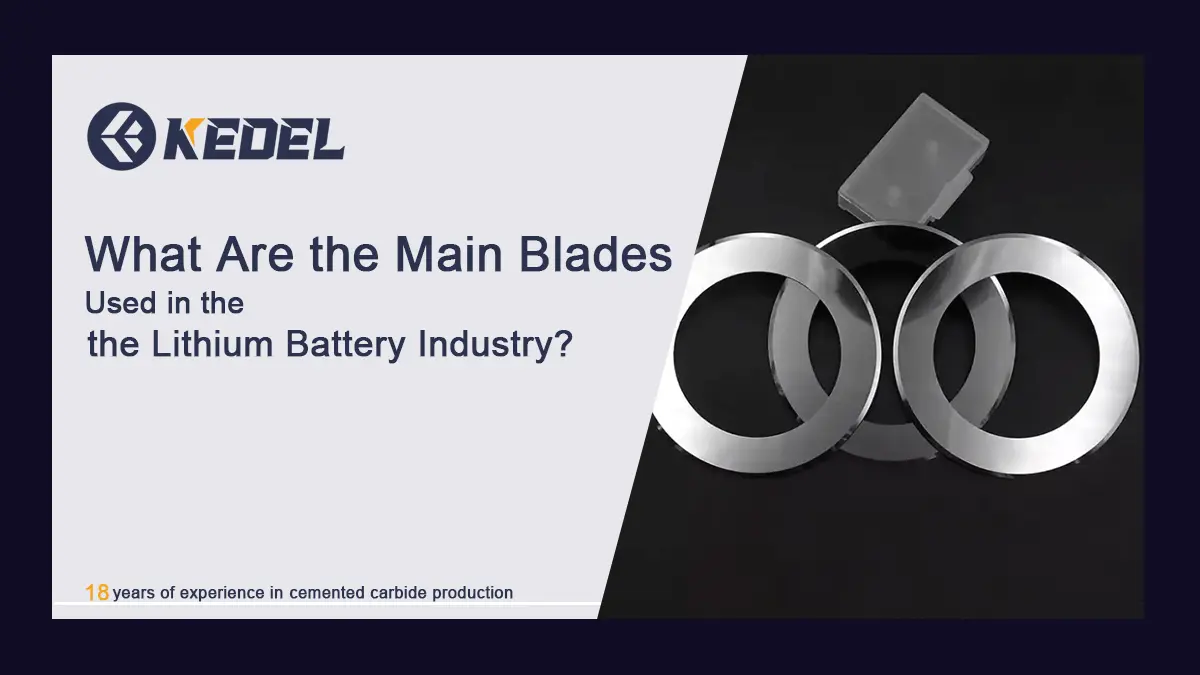
The production of lithium - ion batteries is a process with extremely high requirements for precision and cleanliness. From electrode sheet cutting to battery pack forming, many links rely on cutting to achieve the precise separation of materials. These cutting processes directly affect the battery's performance (such as capacity and safety) and production efficiency. For instance, an electrode sheet cutting deviation exceeding 0.1mm may lead to a short circuit in the battery cell, and burrs generated during separator cutting may trigger a micro - short circuit risk. Blades used in the lithium - ion battery industry are not universal tools but are specially designed according to the characteristics of the materials to be cut (like metal foils, separators, and composite materials) and the processing procedures. They are mainly made of cemented carbide, supplemented by special treatment processes. This article will elaborate on the most commonly used types of blades in lithium - ion battery production, including their application scenarios, material characteristics, and core requirements, helping you quickly understand the blade demands in this field.
1. Electrode Sheet Cutting: Precision Tools for the Core Process of Lithium - Ion Batteries
Electrode sheets are the core components of lithium - ion batteries. Composed of metal foils (aluminum foil for positive electrodes and copper foil for negative electrodes) coated with active materials (such as ternary materials and lithium iron phosphate), their thickness usually ranges from 10 to 100μm. Electrode sheet cutting involves slitting wide electrode sheets into narrow strips of a specified width. It requires "no burrs, no curling, and no dust". Otherwise, it will cause short circuits during the subsequent assembly of battery cells. Two main types of blades are used in this process:
1.1 Electrode Sheet Slitting Circular Knives
These are the most commonly used blades for electrode sheet cutting. They are usually used in pairs (the upper one is a circular knife and the lower one is a backing knife) to achieve slitting through shearing.
- Material: They are mainly made of ultra - fine grain cemented carbide (such as YG8X and YG10X with a WC grain size of 1 - 2μm). The reason is that electrode sheets contain metal foils and hard active materials, so the blades need to have both high hardness (HRA 90 - 92) and wear resistance to prevent rapid wear of the cutting edge which would generate burrs.
- Features: The cutting edge undergoes precision grinding, with the sharpness controlled between 0.005 - 0.01mm and the surface roughness Ra ≤ 0.1μm (this reduces friction with the electrode sheet and prevents the shedding of active materials). The cutter body has extremely high precision, with a radial runout of ≤ 0.002mm (ensuring the cutting dimensional deviation is ≤ 0.05mm).
- Application Scenarios: They are suitable for the slitting of positive and negative electrode sheets of power batteries and consumer batteries, especially for continuous slitting production lines of wide electrode sheets (with a width of 1 - 2 meters).
1.2 Electrode Sheet Cutting Flat Knives
These knives are used for the fixed - length cutting of electrode sheets (for example, cutting rolled electrode sheets into individual square ones) and belong to intermittent cutting.
- Material: They are also mainly made of cemented carbide. In some high - precision scenarios, powder high - speed steel (such as ASP - 60) is adopted to balance hardness and toughness (avoiding edge chipping due to impact during cutting).
- Features: The cutting edge is straight, and its angle is designed to be 30° - 45° (an acute angle ensures sharp cutting, while an obtuse angle reduces the risk of edge chipping). The flatness of the cutter body is ≤ 0.003mm (preventing the edge of the cut electrode sheet from warping).
- Application Scenarios: They are used for cutting electrode sheets of small - sized battery cells (such as mobile phone batteries and watch batteries) or for small - batch production in laboratories.
2. Separator Cutting: Burr - Free Tools for Insulating Layers
The separator serves as the "safety barrier" of a lithium - ion battery. Usually made of polyethylene (PE), polypropylene (PP), or composite films with a thickness of 5 - 20μm, it isolates the positive and negative electrodes while allowing lithium ions to pass through. The core requirements for separator cutting are "no burrs and no tensile deformation". Burrs may pierce the separator and cause short circuits, and stretching will affect the air permeability of the separator. Two main types of blades are used here:
2.1 Separator Slitting Circular Knives
They have a similar structure to electrode sheet slitting circular knives. However, since the separator is a polymer material, the blade design focuses more on anti - adhesion and low friction.
- Material: The base material is cemented carbide (YG6 - YG8). The cutting edge surface is subjected to anti - adhesion treatment (such as titanium nitride (TiN) coating and diamond - like carbon (DLC) coating) to reduce the adhesion between the separator and the cutting edge (especially PE/PP films are prone to sticking to the knife when generating heat due to friction).
- Features: The fillet of the cutting edge is relatively large (0.01 - 0.02mm) to avoid the sharp edge tearing the separator. The cutting pressure is low (usually 0.1 - 0.3MPa) to prevent tensile deformation of the separator.
- Application Scenarios: They are suitable for the slitting of separators in power batteries and energy storage batteries, especially for the slitting of composite separators (such as the PP/PE/PP three - layer structure).
2.2 Separator Hot Cutting Knives (Special Scenarios)
In some automated production lines, the separator needs to be cut synchronously with the electrode sheet and heat - sealed, so hot cutting knives are used.
- Material: The base of the blade is made of cemented carbide, and a heating element (such as a nickel - chromium alloy) is inlaid on the cutting edge. The temperature can be controlled between 80 - 150℃ (matching the heat - sealing temperature of the separator).
- Features: The heating is uniform (with a temperature difference of ≤ 5℃), avoiding carbonization of the separator due to local overheating. The cutting edge has both cutting and heat - sealing functions, which improves efficiency.
- Application Scenarios: They are used in the automated packaging lines of flexible lithium - ion batteries to realize the synchronous cutting and heat - sealing of separators and electrode sheets.
3. Battery Cell and Battery Pack Cutting: Impact - Resistant Tools for the Molding Stage
After the assembly of battery cells, cutting is required in some scenarios (such as the disassembly of defective products after battery cell capacity grading and the module cutting of battery packs). A battery pack is composed of multiple battery cells combined through structural parts, and sometimes it is necessary to cut the shell or connecting sheets. The materials to be cut in such cases are more complex (such as the aluminum - plastic film of the battery cell shell and the metal bracket of the battery pack), so the blades need to have higher impact resistance.
3.1 Battery Cell Disassembly Knives
They are used for disassembling defective battery cells (such as cutting off tabs and peeling off the shell) and come into contact with materials including metal foils, separators, and aluminum - plastic films.
- Material: They are made of medium - grain cemented carbide (with a WC grain size of 3 - 5μm and a Co content of 10% - 12%). The relatively high Co content enhances toughness, avoiding edge chipping caused by uneven force during disassembly.
- Features: The cutting edge has high strength and can withstand a certain degree of impact load. The cutter body is designed to be a sharp edge or a hook edge (facilitating the peeling of aluminum - plastic films and tabs).
- Application Scenarios: They are used in the quality inspection link of lithium - ion battery production for the disassembly and recycling of defective battery cells.
3.2 Battery Pack Cutting Saw Blades (Circular Knives)
They are used for cutting the shell (aluminum alloy and stainless steel) or internal structural parts of battery packs and belong to thick - material cutting.
- Material: Coarse - grain cemented carbide (with a WC grain size of 5 - 8μm) is welded to a steel base, balancing wear resistance and impact resistance (the steel base provides toughness support).
- Features: The thickness of the cutter body is 3 - 5mm, and the number of teeth is adjusted according to the material (sparse teeth are used for cutting aluminum alloy, and dense teeth for stainless steel). The surface is subjected to anti - rust treatment (to avoid rusting when in contact with cutting fluid during cutting).
- Application Scenarios: They are used for the maintenance and recycling of power battery packs or the module cutting of customized battery packs.
4. Core Requirements for Blades in the Lithium - Ion Battery Industry (Comparison Table)
Although different blades are applied in different scenarios, they all need to meet the special standards of the lithium - ion battery industry. The following is a comparison of key indicators:
| Blade Type | Materials to Cut | Core Precision Requirements | Material Features | Maximum Allowable Defects (Affecting Battery Performance) |
|---|---|---|---|---|
| Electrode Sheet Slitting Circular Knife | Aluminum/Copper Foil + Active Materials | Dimensional Deviation ≤ 0.05mm | Ultra - fine grain cemented carbide, high hardness | Burrs > 0.02mm (may cause short circuits) |
| Separator Slitting Circular Knife | PE/PP Separators, Composite Films | No Tensile Deformation at the Edge | Cemented carbide + anti - adhesion coating | Burrs > 0.01mm (may pierce the separator) |
| Battery Cell Disassembly Knife | Aluminum - Plastic Films, Tabs, Metal Foils | No Edge Chipping | Medium - grain cemented carbide, high toughness | Metal debris generated by edge chipping (contaminating the battery cell) |
| Battery Pack Cutting Saw Blade | Aluminum Alloy, Stainless Steel Shells | Flat and Burr - Free Cutting Surface | Coarse - grain cemented carbide + steel base | Shell Deformation > 0.5mm (affecting the tightness of the battery pack) |
5. Common Misconceptions: These "Taken - for - Granted" Ideas May Affect Battery Quality
In the selection of blades for lithium - ion batteries, many people make mistakes based on empiricism, resulting in reduced production efficiency or sub - standard battery performance:
Misconception 1: "Electrode Sheet Knives and Separator Knives Are Interchangeable"
Fact: Electrode sheets contain metals and hard active materials, requiring blades with high hardness and wear resistance. Separators are soft polymer materials, requiring blades with anti - adhesion properties and larger edge fillets. Using electrode sheet knives to slit separators will lead to the separator sticking to the edge and cause tensile deformation. Using separator knives to slit electrode sheets will result in burrs within 1 - 2 hours due to insufficient hardness.
Misconception 2: "The Sharper the Blade, the Better; the Sharper the Edge, the Better"
Fact: An overly sharp edge (such as an acute angle < 30°) tends to "gnaw" the metal foil when cutting electrode sheets, causing curling. When cutting separators, it will tear the material and produce micro - cracks. A qualified lithium - ion battery blade has a "sharp edge with a micro - fillet" (with a fillet radius of 0.005 - 0.01mm), which can cut the material without damaging the substrate.
Misconception 3: "Ordinary Cemented Carbide Blades Can Replace Specialized Blades"
Fact: The precision (such as radial runout > 0.01mm) and surface roughness (Ra > 0.4μm) of ordinary cemented carbide blades cannot meet the requirements of the lithium - ion battery industry. A battery factory once used ordinary circular knives to slit electrode sheets, which led to excessive burrs on the edge of the electrode sheets. The short - circuit rate of the battery cells increased from 0.1% to 2%, and finally, all products had to be reworked.
6. Conclusion: The Core of Lithium - Ion Battery Blades Lies in "Scenario Adaptation"
The selection of blades in the lithium - ion battery industry mainly depends on matching the blade's material (grain size and Co content), precision (runout and roughness), and edge design according to the materials to be cut (metal, polymer, and composite materials) and process requirements (slitting, cutting, and disassembly). For professionals in the tungsten carbide industry, when recommending blades, it is necessary to first understand the customer's specific processes (such as whether it is for slitting positive electrode sheets or separators) and material characteristics (such as electrode sheet thickness and separator type), and then provide customized solutions (such as coating treatment and precision grade) instead of recommending universal models.
If your lithium - ion battery production line is plagued by problems such as excessive cutting burrs and rapid blade wear, or if you need customized specialized blades for new - type batteries (such as solid - state batteries), feel free to communicate with us. We can provide blade sample testing and cutting parameter optimization guidance to help improve production yield.