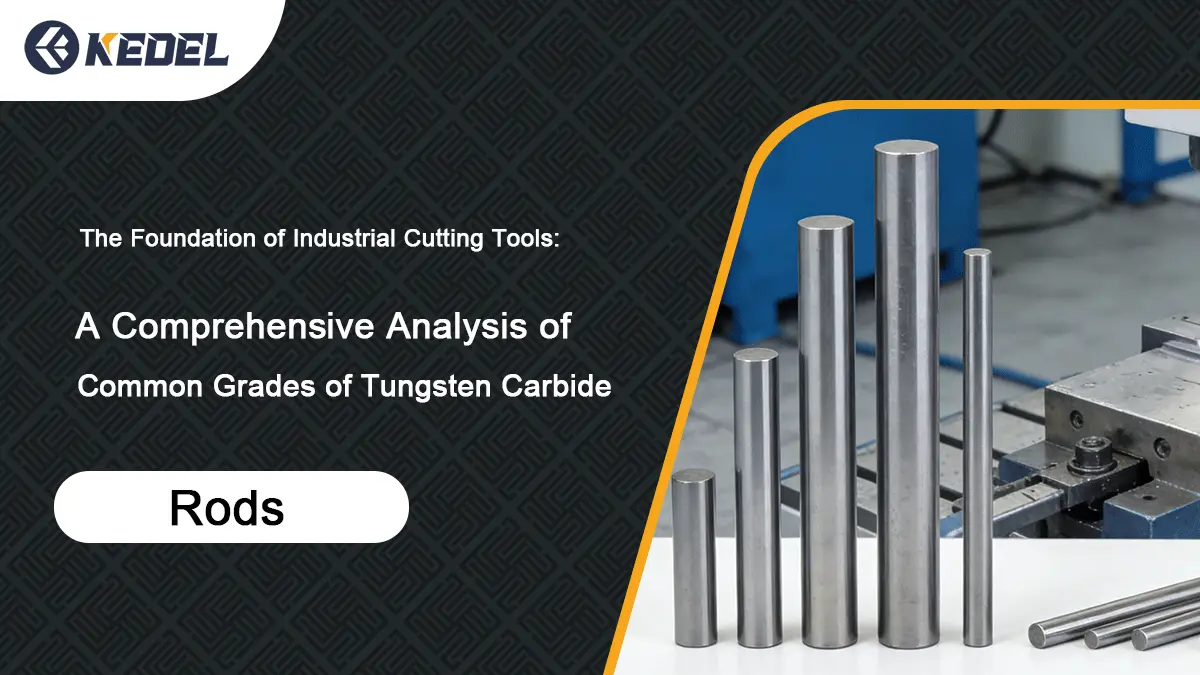
Tungsten Carbide Rods are the core blank material for manufacturing high-precision cutting tools (such as end mills, drills, and reamers). With their extremely high hardness and wear resistance, they are widely used in high-end fields such as aerospace, automotive manufacturing, and precision mold processing.
As procurement professionals know, selecting the right "grade" of tungsten carbide rod is crucial—different grades correspond to different cobalt contents, grain sizes, and physical properties, directly determining the processing efficiency and service life of the final cutting tools. Combining practical experience, this article thoroughly explains the mainstream grades and characteristics of tungsten carbide rods in the global market, helping you accurately select materials for different processing needs and balance cost and performance.
I. First, Understand: The 2 Core Naming Systems for Grades
In the tungsten carbide rod industry, there are only two mainstream grade naming systems. Understanding these two systems makes reading grades as simple as reading a "codebook":
| Naming System | Scope of Application | Core Coding Rules | Typical Features |
|---|---|---|---|
| YG Series | Commonly used in the Chinese market (tungsten-cobalt alloys) | The number represents the percentage of cobalt content; for example, YG6 means 6% cobalt content | Intuitive and easy to remember naming, covering general to specialized scenarios |
| YL/K Series | International standards/manufacturer customization | Focuses on marking grain size, such as sub-micron or nano grain | More focused on performance optimization, the mainstream choice for high-end CNC cutting tools |
II. Core Performance Comparison Table of Common Tungsten Carbide Rod Grades (For Quick Selection)
The most commonly used grades in the industry, core parameters, and application scenarios are organized into a table. You can directly refer to it when selecting materials without checking them one by one:
| Grade Category | Common Grade References | Cobalt Content (Co %) | Hardness (HRA) | Transverse Rupture Strength (TRS, $N/mm^2$) | Grain Size | Typical Application Scenarios |
|---|---|---|---|---|---|---|
| General-Purpose | YG6 / K10 | 6% | 90.5 | 2200 - 2400 | Medium/Fine Grain | Processing of cast iron, non-ferrous metals, and general steel |
| High-Hardness | YG6X / K10F | 6% | 91.5 | 2400 - 2600 | Fine/Ultra-Fine Grain | Processing of chilled cast iron, heat-resistant alloys, and precision machining |
| High-Strength | YG8 / K20 | 8% | 89.5 | 2600 - 2800 | Medium Grain | Medium-low speed cutting, heavy-duty cutting, and wear-resistant parts |
| Ultra-Precision Machining | YL10.2 / GU25 | 10% | 91.8 - 92.5 | 3500 - 4000 | Ultra-Fine Grain | Processing of stainless steel, aerospace aluminum alloys, and high-hardness mold steel |
| Impact-Resistant | YG12 / K40 | 12% | 88.0 | 3000+ | Medium-Coarse Grain | Mining tools, woodworking tools, and working conditions with high impact loads |
III. Detailed Explanation of Mainstream Grades: Precise Matching of Characteristics and Application Scenarios
1. Classic Versatile Grade: YG6 (K10/K20 Level)
This is a cost-effective "all-purpose grade" in the industry, used by almost all cutting tool manufacturers.
- Performance Characteristics: Moderate hardness, balanced wear resistance, and good machinability
- Application Scenarios: The first choice for tools processing ordinary cast iron, aluminum alloys, and non-metallic materials; it not only ensures sufficient service life but also effectively controls material costs, suitable for mass production of general-purpose tools
2. Fine-Grain Upgrade Grade: YG6X / K10F
The "X" in the grade indicates fine grain. By refining the size of tungsten carbide particles, both the hardness and edge strength are improved compared to YG6.
- Performance Characteristics: High hardness combined with good edge strength, not easy to chip
- Application Scenarios: Suitable for manufacturing precision cutting tools (such as precision boring tools and precision end mills) for processing chilled cast iron, non-ferrous metals, and their alloys
3. High-End Flagship Grade: YL10.2 / GU25 Series
Currently, this grade has the highest demand in the high-end cutting tool markets of Germany, the United States, and China, making it the "ace material" for precision machining.
- Performance Characteristics: Adopts ultra-fine grain technology of 0.5μm or smaller, with a cobalt content of about 10%; it can not only achieve high hardness above 92HRA but also has high transverse rupture strength above 3500N/mm², excelling in both hardness and toughness
- Application Scenarios: The top material for manufacturing solid carbide end mills and drills, specifically designed to handle difficult-to-machine materials such as stainless steel, titanium alloys, and high-temperature alloys
IV. Selecting Grades by Workpiece Material: Get It Right in One Step
Core Logic for Grade Selection: Select based on the "workpiece material" rather than just hardness. Three common processing scenarios and their corresponding selection plans are sorted out:
1. Processing Aluminum Alloys/Non-Ferrous Metals
- Core Requirement: Prevent adhesion between the tool and the material, and ensure the sharpness of the cutting edge
- Recommended Grades: YG6, YG6X (6% cobalt content, fine grain)
- Selection Reason: Low cobalt content + fine grain can reduce adhesion while ensuring sharpness and wear resistance
2. Processing Stainless Steel/Mold Steel/Aerospace Difficult-to-Machine Materials
- Core Requirement: Resist wear under high temperature and pressure, and prevent chipping
- Recommended Grades: YL10.2, GU25 (10% cobalt content, ultra-fine grain)
- Selection Reason: Ultra-fine grains improve hardness and wear resistance, while medium cobalt content ensures toughness, enabling it to withstand cutting impacts from difficult-to-machine materials
3. Processing Wood/Plastics/Ordinary Non-Metals
- Core Requirement: Stable service life and controllable cost
- Recommended Grades: YG8, YG10 (general-purpose, medium cobalt content)
- Selection Reason: These materials do not require extremely high hardness; general-purpose grades can meet the needs with the highest cost-performance ratio
V. 3 Practical Suggestions for Procuring Tungsten Carbide Rods
In addition to selecting the right grade, paying attention to these 3 points during procurement can reduce subsequent processing troubles and lower costs:
Pay Attention to Surface Condition:
- Unground Rods: Low price, suitable for manufacturers with their own high-precision grinders
- Ground Rods (h6 Tolerance): Can be directly used for subsequent processing; manufacturers without high-precision grinders are advised to buy them directly to save processing time and costs
Confirm Whether Internal Cooling Holes Are Needed:
- Currently, high-efficiency cutting tends to use carbide rods with internal cooling holes (single straight hole, double straight holes, spiral holes), which can provide internal cooling during deep hole processing, improving tool life and processing efficiency; if manufacturing deep hole tools, be sure to confirm in advance
Prioritize Suppliers with Stable Quality:
- If there are tiny sand holes or hard spots inside the tungsten carbide rod, it is easy to scrap during subsequent grinding into tools; it is recommended to choose suppliers with large production scales and strict quality control to ensure the consistency of grade performance
Summary
Selecting a tungsten carbide rod grade is essentially a balance between hardness, toughness, and cost: choose YG6 for general scenarios to pursue cost-performance; choose YG6X for precision machining to improve accuracy; choose YL10.2 for high-end difficult-to-machine scenarios to ensure performance. Understanding the core parameters and application scenarios of different grades allows you to accurately select materials when facing complex orders, avoiding blind trial and error.