In the cemented carbide industry, many people know it is "hard and wear-resistant" but are unclear about its specific material composition. In fact, cemented carbide is not a single material but a composite made by combining "hard phases," "binder phases," and small amounts of "additive phases" in specific proportions. The combination of different materials determines core properties like hardness, toughness, and heat resistance of cemented carbide, directly affecting its suitability for various scenarios (e.g., cutting, mining, precision molds). For example, cemented carbide used for cutting steel differs completely in material composition from that used for mining wear parts. This article breaks down the material system of cemented carbide from aspects of core material categories, their roles, common combinations, and selection logic, helping you understand "why materials are paired this way" and "how to choose materials for your scenario."
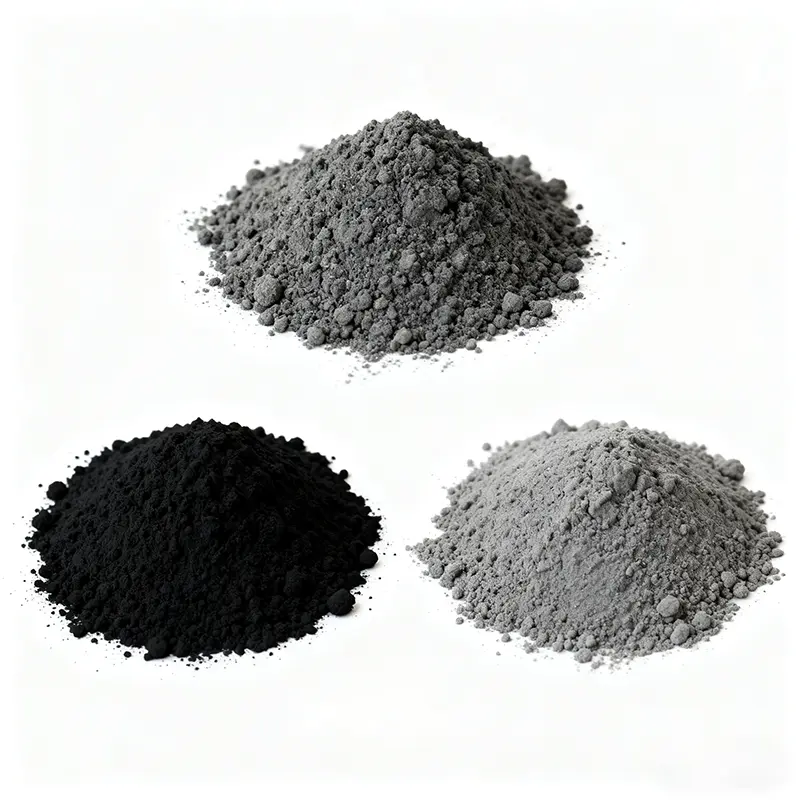
1. The Material Composition of Cemented Carbide: Three Core Components
The performance of cemented carbide is determined by the interaction of "hard phase + binder phase + additive phase," each with distinct roles: the hard phase provides hardness and wear resistance, the binder phase offers toughness, and additive phases optimize specific properties (e.g., heat resistance, corrosion resistance). The proportion and type of these components are key to distinguishing different cemented carbide grades.
1.1 Component 1: Hard Phase – The "Backbone" of Cemented Carbide
The hard phase is the core of cemented carbide, typically accounting for 90%–95% of the composition. It determines the material’s base hardness, wear resistance, and heat resistance. There are 4 commonly used hard phase materials in industry, each with distinct characteristics and applications:
| Hard Phase Material | Chemical Symbol | Core Function | Typical Applications | Notes |
|---|---|---|---|---|
| Tungsten Carbide | WC | Provides high hardness (8.5–9 Mohs), high wear resistance, and cost-effectiveness | General scenarios (cutting tools, mining liners, seal rings) | Moderate heat resistance alone (≤800°C); needs additives to enhance |
| Titanium Carbide | TiC | Improves resistance to "built-up edge" (prevents metal sticking to tools during cutting) and reduces friction | Cutting tools for steel (turning inserts, milling cutters) | Slightly lower hardness than WC (8–8.5 Mohs); poor toughness alone, must be mixed with WC |
| Tantalum Carbide | TaC | Significantly enhances heat resistance (withstands >1200°C) and refines grain structure | High-speed cutting of hard metals (stainless steel, alloy steel) | High cost; rarely used alone, usually added at 5%–10% with WC |
| Niobium Carbide | NbC | Similar to TaC, improves heat resistance and thermal shock resistance at lower cost | Mid-to-high-end cutting tools and high-temperature wear parts (as TaC alternatives) | Slightly lower performance than TaC; suitable for cost-sensitive high-temperature scenarios |
Key Conclusion: WC is the most widely used hard phase (over 90% of applications) due to its balanced hardness, wear resistance, and cost. TiC, TaC, and NbC are mostly "auxiliary hard phases," mixed with WC to address specific performance gaps.
1.2 Component 2: Binder Phase – The "Adhesive" of Cemented Carbide
The binder phase binds hard phase particles tightly, preventing brittle fracture of the hard phase. It typically accounts for 5%–10% of the composition. While it does not directly provide hardness, it determines the toughness and impact resistance of cemented carbide. There are 3 commonly used binder materials:
| Binder Material | Chemical Symbol/Composition | Core Function | Suitable Scenarios | Performance Limitations |
|---|---|---|---|---|
| Cobalt | Co | Good toughness (impact resistance), strong bonding with WC, and excellent formability | General scenarios (cutting tools, mining wear parts, precision molds) | Moderate corrosion resistance (prone to rust in humid/chemical environments) |
| Nickel | Ni | High corrosion resistance (resists rust in seawater, acids, and alkalis); non-magnetic | Corrosive environments (marine engineering, chemical valves, medical tools) | Slightly lower toughness than Co; prone to oxidation during sintering (requires vacuum processing) |
| Nickel-Chromium Alloy | Ni-Cr | Better corrosion resistance than pure Ni; enhances high-temperature oxidation resistance (≤1000°C) | Strongly corrosive + mid-temperature scenarios (chemical reactor components) | High cost; lower toughness than Co; unsuitable for high-impact scenarios |
Key Conclusion: Co is the most mainstream binder (over 80% of applications) for most non-corrosive scenarios. Ni and Ni-Cr are only used when corrosion resistance is required, accepting the trade-off of higher cost and lower toughness.
1.3 Component 3: Additive Phase – The "Performance Optimizer" of Cemented Carbide
Additive phases typically account for less than 5% of the composition. Their role is to "solve major issues with small doses," targeting specific performance improvements without altering the core properties of cemented carbide. There are 3 common additive phases in industry:
| Additive Material | Chemical Symbol | Core Optimization Function | Application Examples | Addition Ratio Range |
|---|---|---|---|---|
| Vanadium Carbide | VC | Refines hard phase grains, improves hardness uniformity and impact resistance | Thin-walled precision parts (e.g., micro-molds, medical tools) | 0.5%–2% |
| Molybdenum | Mo | Reduces sintering temperature (energy-saving) and improves material density (reduces porosity) | Complex-shaped parts (e.g., irregular seal rings, multi-edge tools) | 1%–3% |
| Chromium | Cr | Enhances corrosion resistance (especially with Ni binders) and prevents oxidation | Humid/mildly corrosive scenarios (e.g., water pump impellers, food machinery parts) | 0.3%–1% |
Key Conclusion: Additives are "added on demand." For example, VC is added to thin-walled parts to refine grains, and Mo is added to complex parts to improve sinterability. Over-addition is unnecessary (excess increases cost or causes performance imbalances).
2. Common Material Combinations in Cemented Carbide: Classified by Scenario
Different scenarios demand different properties, leading to standardized material combinations for cemented carbide. Below are 4 most common combinations, covering over 90% of industrial applications:
| Combination Type | Hard Phase Composition | Binder Phase | Additive Phase | Core Performance Characteristics | Typical Applications |
|---|---|---|---|---|---|
| WC-Co (General-Purpose) | 90%–95% WC | 5%–10% Co | None (or 0.5% VC) | Balances hardness and toughness; cost-effective; easy to process | Ordinary cutting tools (drills, turning tools), mining liners, seal rings |
| WC-TiC-Co (Steel Cutting) | 80%–85% WC + 5%–10% TiC | 5%–8% Co | None | Resists built-up edge; suitable for carbon steel and alloy steel | Lathe inserts, milling cutters, thread processing tools |
| WC-TaC-Co (High-Speed Hard Metal) | 85%–90% WC + 5%–8% TaC | 6%–10% Co | 1% Mo | Heat-resistant and thermal shock-resistant; suitable for high-speed cutting | Stainless steel cutting tools, aerospace alloy processing tools |
| WC-Ni (Corrosion-Resistant) | 92%–95% WC | 5%–8% Ni | 0.5% Cr | Resists seawater, acids, and alkalis; non-magnetic | Marine pump seal rings, chemical valve cores, medical scalpels |
Selection Logic: Clarify core needs before choosing a combination—use WC-Co for general scenarios, WC-TiC-Co for steel processing, WC-TaC-Co for high-speed cutting of hard metals, and WC-Ni for corrosive environments. No complex evaluation is needed; simply match the scenario.
3. Three Key Factors for Selecting Cemented Carbide Materials
Many people fall into the "parameter comparison trap" (e.g., obsessing over 1% differences in WC content). Instead, focus on 3 core scenario factors to avoid overcomplication:
3.1 Core Requirement: "Wear Resistance," "Impact Resistance," or "Corrosion Resistance"?
- Prioritize wear resistance: Choose combinations with high WC content (≥94%) and low binder phase (5%–6% Co) (e.g., WC-Co).
- Prioritize impact resistance: Choose combinations with low WC content (90%–92%) and high binder phase (8%–10% Co) (e.g., WC-Co with VC).
- Prioritize corrosion resistance: Directly select WC-Ni or WC-Ni-Cr combinations; avoid Co-based materials.
3.2 Operating Temperature: Does It Exceed 800°C?
- Room temperature to 800°C: Ordinary WC-Co combinations suffice; no need for TaC/NbC.
- 800°C to 1200°C: Must add TaC (5%–8%) or NbC; choose WC-TaC-Co combinations.
- Above 1200°C: Cemented carbide is unsuitable; use ceramics or ultra-high-temperature alloys instead.
3.3 Processing Cost: Is Complex Shaping Required?
- Simple shapes (e.g., round liners, ordinary tools): Choose WC-Co combinations for low processing difficulty and controlled cost.
- Complex shapes (e.g., thin-walled micro-hole parts, irregular molds): Choose combinations with 1%–2% Mo to reduce sintering temperature and minimize forming defects.
4. Clarifying Common Myths: Three Misconceptions About Cemented Carbide Materials
Myth 1: "Higher WC Content Means Better Cemented Carbide Performance"
Fact: While high WC content improves hardness, it reduces toughness. For example, cemented carbide with 96% WC and 4% Co is extremely hard but as brittle as ceramic—breaking if dropped—making it useless for impact-prone mining scenarios. The correct approach is to "balance on demand" rather than pursuing high WC content.
Myth 2: "Cobalt Is Sufficient for Binders; Nickel Is Too Expensive and Unnecessary"
Fact: In corrosive environments (e.g., seawater, chemicals), Co-based cemented carbide rusts and fails in 3–6 months, while Ni-based cemented carbide lasts 2–3 years. Though 30% more costly, Ni-based options are more economical long-term. Whether to use Ni depends on corrosion needs, not just cost.
Myth 3: "More Additives Mean More Comprehensive Performance"
Fact: Additives are "single-function optimizers"; over-addition causes interference. For example, adding both VC (to enhance toughness) and TaC (to improve heat resistance) forms brittle compounds during sintering, making the carbide prone to cracking. Use at most 1–2 additives, with a total content ≤5%.
5. Conclusion: Selecting Cemented Carbide Materials – "Match to Needs, Not Blindly Pursue Parameters"
The material system of cemented carbide may seem complex, but it follows clear rules: use WC as the core hard phase, select Co/Ni as the binder based on needs, optimize with small amounts of additives, and match fixed combinations to scenarios (e.g., WC-Co for general use, WC-Ni for corrosion resistance).
For professionals, there’s no need to memorize all material symbols. Simply clarify 3 questions: Does your scenario require "wear resistance/impact resistance/corrosion resistance"? Does the operating temperature exceed 800°C? Is the part shape complex? Answering these helps quickly select the right material combination.
If your scenario is unique (e.g., requiring both wear resistance and 1000°C heat resistance) and you’re unsure about material pairing, feel free to reach out. We can provide customized material combinations based on your specific working conditions.