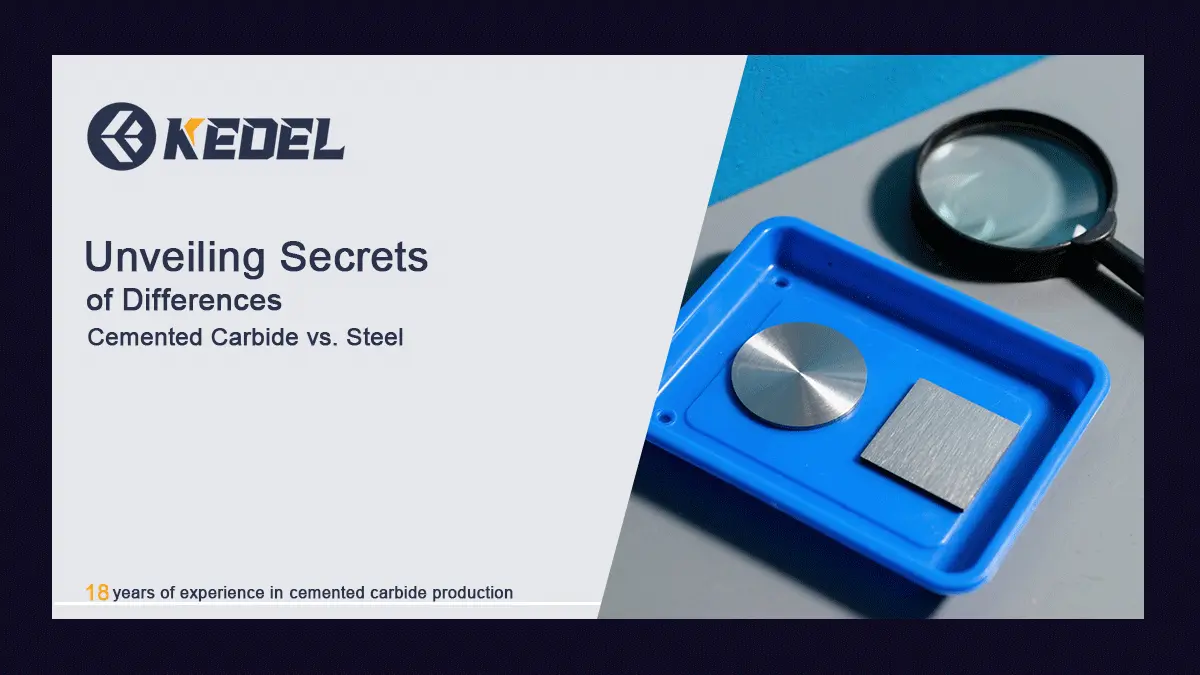
In the field of industrial manufacturing, cemented carbide (a composite material centered on tungsten carbide, WC) and steel are two of the most widely used basic materials, yet their performance positioning and applicable scenarios are distinctly different. Many people confuse the needs for "hardness" and "toughness"—for example, mistakenly believing that "steel is hard enough to replace cemented carbide for wear parts" or that "cemented carbide has good toughness and can be used as structural components." In reality, the core advantage of cemented carbide lies in its "high hardness and high wear resistance," designed specifically for scenarios involving particle erosion and high-frequency friction. Steel’s core advantage is its "high toughness and ease of processing," making it more suitable for structural parts that bear impact or require complex forming, as well as low-load wear scenarios. This article breaks down the key differences between the two from three dimensions—compositional definitions, core properties, and application scenarios—to help you avoid selection mistakes and accurately match industrial needs.
1. First, Understand the Basics: The Fundamental Difference Between Cemented Carbide and Steel—Composition Determines Properties
To grasp the differences between the two, it is first necessary to clarify their "material identities": cemented carbide is a "composite material," while steel is a "single alloy." Differences in composition directly lead to fundamental differences in performance.
1.1 Cemented Carbide: A "Wear-Resistant Composite" Centered on Tungsten Carbide
- Core Composition: Consists of a "hard phase" and a "binder phase"—the hard phase is tungsten carbide (WC, 85%-95% content), providing ultra-high hardness and wear resistance; the binder phase is metallic cobalt (Co, 5%-15% content), which tightly binds WC particles and endows the material with a certain degree of toughness (pure WC without a binder phase is extremely brittle and unusable).
- Manufacturing Process: Uses powder metallurgy technology—WC and Co powders are mixed in proportion → pressed into shape → vacuum sintered at 1400-1450°C → precision ground, ultimately forming dense blocks or special-shaped parts (such as tools, nozzles).
- Essential Property: A functional material "with wear resistance as the primary goal." All designs revolve around "improving hardness and wear resistance," with toughness serving only as an "auxiliary property" (balanced by adjusting Co content; higher Co content improves toughness but reduces wear resistance).
1.2 Steel: A "Tough Alloy" Based on Iron and Carbon
- Core Composition: Takes iron (Fe, over 95% content) as the matrix, with added carbon (C, 0.02%-2.11% content) and other alloying elements (such as chromium Cr, manganese Mn, tungsten W)—carbon content determines basic hardness (higher carbon content increases hardness but reduces toughness), while alloying elements optimize specific properties (e.g., Cr improves corrosion resistance, W enhances high-temperature hardness).
- Manufacturing Process: Uses smelting-rolling-heat treatment processes—iron ore is smelted into molten steel → cast into billets → rolled or forged into plates/bars → hardness and toughness are adjusted through heat treatments such as quenching and tempering (e.g., quenching hardens steel, tempering reduces brittleness).
- Essential Property: A general structural material "based on toughness and formability." Its hardness can be flexibly adjusted through heat treatment, but even after quenching, its wear resistance is far lower than that of cemented carbide (excessively high hardness causes a sharp drop in toughness, leading to brittleness).
2. Core Performance Comparison: 6 Dimensions, Clear Differences
In industrial selection, "hardness, wear resistance, and toughness" are the three most critical indicators. Combined with temperature resistance, processability, and cost, they fully distinguish the applicable boundaries of cemented carbide and steel. The table below compares them from a practical application perspective (taking the most common "WC-Co cemented carbide" and "medium-carbon alloy structural steel" as examples):
| Performance Dimension | Cemented Carbide (e.g., WC-8%Co) | Steel (e.g., 45# steel after quenching) | Key Difference Analysis |
|---|---|---|---|
| Hardness (Mohs/Rockwell) | Mohs 8.5-9 (Rockwell HRA 89-91) | Mohs 6.5-7 (Rockwell HRC 55-58) | Cemented carbide is 1.3-1.4 times harder than steel, second only to diamond and cubic boron nitride, and can withstand hard particles that steel cannot resist |
| Wear Resistance (Relative Value) | 100 (baseline, wear rate ≤0.01mm/100h) | 10-15 (wear rate ≥0.08mm/100h) | Cemented carbide is 6-10 times more wear-resistant than steel. For example, when machining gray cast iron, cemented carbide tools last 5-8 times longer than steel tools |
| Toughness (Impact Toughness) | 25-30 J/cm² (moderate toughness, prone to chipping under severe impact) | 40-50 J/cm² (high toughness, can withstand strong impact) | Steel’s toughness is 1.5-2 times that of cemented carbide. For example, when struck with a hammer, steel only deforms, while cemented carbide shatters |
| Temperature Resistance (Short-Term) | 700-800°C (Co softens beyond this range, reducing hardness) | 400-500°C (hardness drops significantly beyond this range, prone to oxidation) | Cemented carbide has better temperature resistance than steel, suitable for medium-temperature wear scenarios (e.g., auxiliary processing of hot metals) |
| Processability | Difficult to process (requires diamond tools for grinding, cannot be forged/welded) | Easy to process (can be turned, milled, forged, welded with ordinary machine tools) | Steel’s formability is far superior to cemented carbide; it can be made into complex structures (e.g., gears, shafts), while cemented carbide can only be processed into simple shapes |
| Cost (Relative Value) | 100 (baseline, approximately ¥200-300/kg) | 10-15 (approximately ¥5-8/kg) | Cemented carbide costs 6-20 times more than steel and is only cost-effective in "high wear demand" scenarios; steel is more economical for ordinary scenarios |
3. Typical Application Scenarios: Each Has Its Strengths, No Absolute Replacement
Performance differences directly determine their application fields—cemented carbide focuses on "high wear resistance, low impact" functional scenarios, while steel focuses on "high toughness, formability required" structural or low-load scenarios, with almost no overlapping "competitive scenarios."
3.1 Typical Applications of Cemented Carbide: Where Wear Resistance Is Needed, There It Is
The value of cemented carbide lies entirely in its "wear resistance," making it suitable for high-frequency friction or hard particle erosion scenarios that steel cannot withstand:
- Cutting Tools: Turning tools, milling tools, drills (for machining cast iron, stainless steel, non-ferrous metals)—steel tools need regrinding after machining 100 cast iron parts, while cemented carbide tools can machine 500-800 parts, increasing efficiency by over 5 times.
- Wear Parts: Mine ball mill liners, corrugated paper slitting knives, oil drilling nozzles—these parts are in long-term contact with hard particles (ore, paper fibers, cuttings). Steel parts wear out and are scrapped in 1-3 months, while cemented carbide parts can last 1-2 years.
- Precision Wear Components: Wire-drawing dies (for drawing copper wire, steel wire), mechanical seal rings—wire-drawing dies made of cemented carbide can ensure wire diameter deviation ≤0.001mm, while steel dies cannot achieve this precision and wear out of tolerance in 1 month.
3.2 Typical Applications of Steel: Where Toughness or Complex Forming Is Needed, There It Is
The value of steel lies in its "toughness + ease of processing," making it suitable for scenarios requiring impact resistance, complex structural forming, or low wear demand:
- Structural Parts: Mechanical gears, drive shafts, automobile frames—these parts need to transmit power or bear impact. Steel’s toughness prevents fracture, while cemented carbide used as gears would chip under stress.
- Low-Load Tools: Hand saw blades, ordinary screwdrivers, scissors—these tools are used infrequently with low cutting loads. Steel’s hardness is sufficient, and its cost is only 1/10 that of cemented carbide, eliminating the need for "over-specification."
- Welded/Formed Parts: Steel structure workshops, pipelines, containers—steel can be welded into large-size structures, while cemented carbide cannot be welded and is 1.8 times heavier than steel (density 15g/cm³ vs. 7.8g/cm³), making it unsuitable for large structural parts.
4. Clarifying Common Misconceptions: Avoid "Taken-for-Granted" Selection Errors
In practice, many people choose the wrong material due to "confused performance priorities." The following 3 common misconceptions need clarification:
4.1 Misconception 1: "Steel is hard enough after quenching and can replace cemented carbide for wear parts."
Fact: Steel’s "hardness" does not equal "wear resistance." Although quenched steel has increased hardness, its wear resistance is only 1/10 that of cemented carbide, and excessive hardness reduces toughness. For example, a factory used quenched steel for sandblasting nozzles, which wore out and leaked after 1 week; switching to cemented carbide nozzles allowed 3 months of use. Despite higher costs, it reduced 10 tool change downtimes, improving overall efficiency.
4.2 Misconception 2: "Cemented carbide has good performance and can replace steel for structural parts."
Fact: Cemented carbide’s "advantages" only lie in wear resistance; insufficient toughness is a fatal flaw. For example, a device using cemented carbide for drive shafts broke during trial operation due to slight vibration; switching to 45# steel drive shafts resulted in only slight deformation under overload impact, without immediate failure—more suitable for the "safety needs" of structural parts.
4.3 Misconception 3: "Cemented carbide is expensive, so steel should be chosen for all scenarios."
Fact: In high-wear scenarios, steel’s "low cost" is offset by "frequent replacements." For example, a mine using steel liners needed monthly replacements, with 2 days of downtime per change, resulting in annual maintenance costs exceeding ¥500,000; switching to cemented carbide liners (replaced every 6 months) reduced annual maintenance costs to ¥300,000. Although single liners are more expensive, total costs decreased by 40%.
5. Selection Logic: 3 Quick Steps to Match Without Hesitation
No complex calculations are needed. Follow these 3 steps to determine whether to choose cemented carbide or steel, ideal for quick decision-making by production or procurement teams:
Determine Core Needs—"Wear Resistance First" or "Toughness/Formability First"?
- If the core need is wear resistance (e.g., cutting hard materials, contact with particle erosion): Choose cemented carbide to prioritize service life.
- If the core need is toughness or complex forming (e.g., power transmission, welded structures, hand tools): Choose steel to prioritize safety and processability.
Evaluate Working Condition Intensity—"High Load" or "Low Load"?
- For high-load wear (e.g., continuous production cutting lines, mine ball mills): Choose cemented carbide to avoid frequent downtime.
- For low-load use (e.g., occasionally used hand tools, mild friction without particles): Choose steel to control costs.
Weigh Costs—"Short-Term Cost" or "Long-Term Cost"?
- For long-term, high-frequency use: Calculate "comprehensive costs" (material cost + replacement/downtime costs)—cemented carbide is more cost-effective.
- For short-term or one-time use: Calculate "short-term costs"—steel is more economical.
6. Conclusion: No "Better" Material, Only "More Suitable" One
Cemented carbide and steel are not "competitors" but "complements"—cemented carbide solves the pain point of steel’s "lack of wear resistance," while steel addresses cemented carbide’s "poor toughness and difficult processing." For professionals in the tungsten carbide industry, there’s no need to focus on "promoting high-priced cemented carbide" when recommending materials. Instead, first understand the customer’s "core needs (wear resistance/toughness), working condition intensity, and cost budget," then match the most suitable material—this is the true way to help customers reduce costs and improve efficiency.
If your enterprise faces issues like "short service life of wear parts" or "easy fracture of structural parts" in material selection, or is unsure whether to choose cemented carbide or steel for a specific scenario, feel free to communicate. We can provide customized material solutions based on your working parameters (e.g., friction intensity, impact frequency, forming requirements).