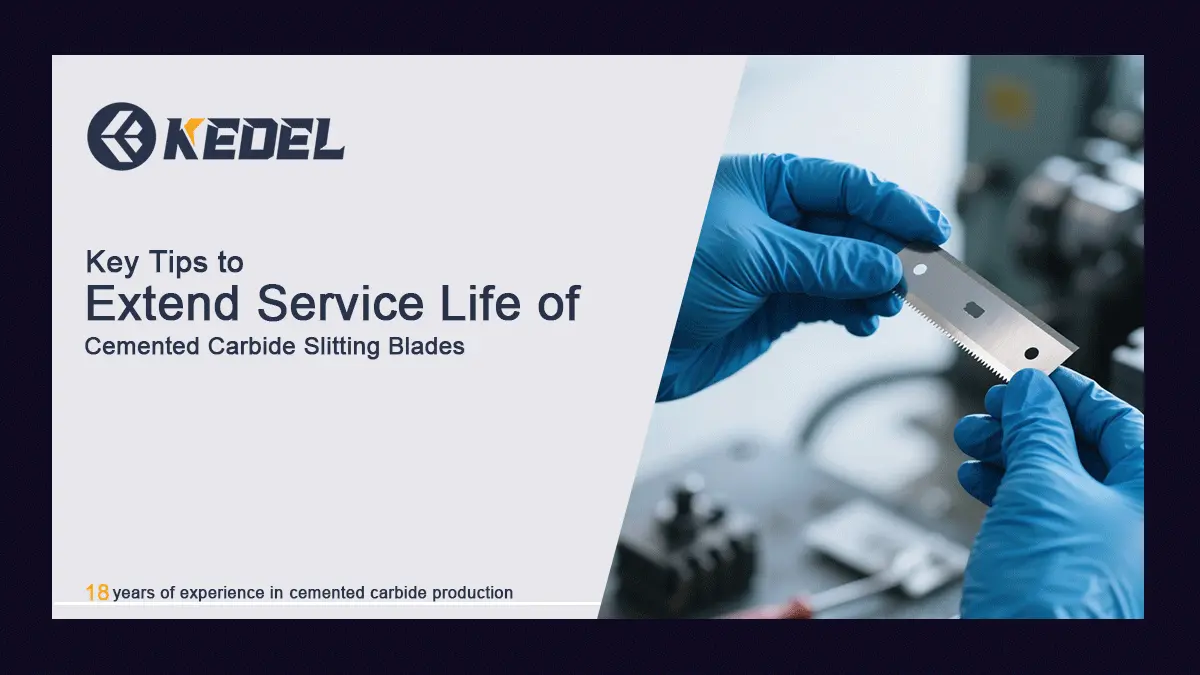
Cemented carbide slitting blades are core components for slitting metal strips (e.g., stainless steel strips, aluminum strips, copper strips) and non-metal strips (e.g., plastic strips, paper strips). Their service life directly determines the production efficiency and consumable costs of slitting lines—typically, high-quality cemented carbide slitting blades can be used continuously for 50-100 hours. However, in practice, due to issues like improper selection, installation deviations, and parameter失控, many blades need replacement after only 20-30 hours. This not only increases procurement costs but also causes downtime losses (approximately 1-2 hours of downtime per blade change). Extending their service life does not rely on "more expensive blades" but on addressing hidden wear factors through four core links: material matching in selection, precise installation, parameter control, and daily maintenance. This article details key tips for each link, helping you extend the service life of cemented carbide slitting blades by over 50% while ensuring stable slitting quality.
1. Selection & Matching: Choose the Right "Basic Model" to Reduce Wear from the Source
The maximum service life of cemented carbide slitting blades is first determined by "whether the selection matches the slitting material." If the blade’s material and structure do not align with the strip’s properties, even standardized subsequent operations will result in "innate deficiencies" and rapid wear.
1. Match Blade Material to Slitting Material Properties
Different strips vary significantly in hardness, toughness, and wear resistance. Targeted selection of "WC grain size + Co content + additives" for cemented carbide is essential:
| Slitting Material Type | Material Characteristics | Recommended Blade Material Parameters | Core Advantages |
|---|---|---|---|
| High-hardness metal strips (stainless steel, galvanized steel) | Hardness HB 150-250, prone to blade wear | Fine-grain WC (1-3μm) + 6%-8% Co + 2% TiC | Fine-grain WC enhances wear resistance; TiC improves high-temperature stability (prevents softening from frictional heat during slitting) |
| Medium-hardness metal strips (aluminum, copper) | Hardness HB 50-120, good toughness but prone to sticking | Medium-grain WC (3-5μm) + 8%-10% Co | Medium grains balance wear resistance and toughness; high Co content reduces "frictional wear" caused by material sticking |
| Non-metal strips (plastic, paper) | Low hardness but contains fiber impurities, prone to edge jamming | Coarse-grain WC (5-8μm) + 10%-12% Co + 1% TaC | Coarse-grain WC resists impurity scratching; high Co content improves edge chipping resistance (fibers easily jam edges, requiring toughness support) |
2. Choose Blade Structure by Slitting Width
Different slitting widths have varying requirements for "edge length and positioning accuracy." The wrong structure causes local overload wear:
- Narrow strip slitting (width ≤ 10mm): Select "narrow-edge" slitting blades (edge width 2-3mm) with precision positioning rings (tolerance ≤ 0.005mm) to avoid local stress concentration from "excessively wide edges."
- Wide strip slitting (width > 50mm): Select "wide-edge" slitting blades (edge width 5-8mm) and add "support rings" at both ends of the blade to prevent "uneven wear" (middle edge wears faster than ends) caused by blade sagging during slitting.
2. Precise Installation: Control "Micron-Level Deviations" to Avoid "Uneven Wear"
Cemented carbide slitting blades require extremely high installation accuracy—even a 0.01mm concentricity deviation causes uneven force on the blade during slitting, resulting in "uneven wear" (one edge wears excessively while the other remains nearly intact), directly reducing service life by 50%.
1. Before Installation: Thoroughly Clean Locating Surfaces to Prevent "Impurity垫高"
- Clean the spindle locating surface and blade locating hole (or step) with alcohol (concentration ≥ 95%), wiping repeatedly 2-3 times to ensure no iron chips, oil, or fiber residues remain (even 0.005mm of impurities tilts the blade by over 0.1°, causing a 20% force deviation on the edge during slitting).
- Check the flatness of the spindle locating surface: Use a dial gauge to measure. If flatness error > 0.002mm (e.g., spindle wear or scratches), repair the spindle (e.g., grinding and polishing) before installing the blade. Otherwise, the blade will experience "runout wear" during rotation.
2. During Installation: Strictly Control Concentricity and Torque to Avoid "Uneven Force"
- Concentricity Control: Gently slide the blade onto the spindle. Fix a dial gauge to the machine frame, touch the gauge head lightly to the blade’s outer circle (5mm from the edge), and rotate the spindle manually. Record the dial gauge reading—runout must be ≤ 0.005mm. If exceeding the limit, fine-tune the blade position (or replace the positioning ring) until requirements are met.
- Bolt Torque Control: Tighten the blade fixing bolts in a "diagonal symmetric" order using a torque wrench (avoid ordinary wrenches operated by feel). Strictly follow the torque value specified in the equipment manual (usually 8-15 N·m, adjusted by blade diameter: 10 N·m for φ200mm blades, 12 N·m for φ300mm blades). Tighten each bolt to the target torque in 2-3 steps (one-time tightening easily tilts the blade).
3. After Installation: Manual Test Rotation to Check for "Hidden Jamming"
- In the power-off state, rotate the spindle manually 3-5 times to feel for uneven resistance (e.g., jamming or abnormal noise). If present, the blade and spindle locating surface may not fit tightly (impurities may remain) or bolt torque may be uneven. Recheck and adjust to avoid "impact wear" on the edge caused by jamming during slitting.
3. Parameter Control: Avoid "Overload Slitting" to Reduce "Abnormal Wear"
失控 of slitting parameters (slitting speed, feed rate, slitting pressure) is the main cause of "abnormal wear" of cemented carbide slitting blades—excessive speed softens the edge due to frictional heat, excessive pressure dulls the edge from over-squeezing the strip, and improper feed rate causes "tensile wear" of the strip.
1. Slitting Speed: "Reduce Speed to Match" Material Hardness to Avoid "Thermal Wear"
Slitting speed must be strictly controlled for different materials to prevent edge softening from frictional heat exceeding 700℃ (softening temperature of cemented carbide’s cobalt binder):
| Slitting Material Type | Recommended Slitting Speed (m/min) | Common Incorrect Speed & Consequences |
|---|---|---|
| Stainless steel strip (0.5mm thick) | 80-120 | 150m/min: Edge temperature reaches 850℃, accelerating wear by 3x |
| Aluminum strip (1.0mm thick) | 150-200 | 250m/min: Increased friction between strip and edge causes sticking, leading to "chip wear" on the edge |
| Plastic strip (0.3mm thick) | 200-250 | 300m/min: Plastic melts and sticks to the edge, forming "coating wear" and rapid dulling |
2. Slitting Pressure: "Just Enough to Cut" to Avoid "Compressive Wear"
Excessive slitting pressure (exceeding 1.5x the force required to cut the strip) causes the edge to over-squeeze the strip, not only creating burrs on the strip edge but also subjecting the edge to additional load, accelerating wear by 2x.
- Adjustment Method: Start with "low pressure" (e.g., 0.5MPa for stainless steel strips). Observe if the slit strip edge is flat and burr-free. If burrs exist, gradually increase pressure (0.1MPa each time) until burrs disappear (typically 0.8-1.2MPa for stainless steel strips, 0.3-0.6MPa for aluminum strips).
3. Feed Rate: Match Speed to Avoid "Tensile Wear"
The feed rate (distance the strip advances per spindle rotation) must be adjusted synchronously with slitting speed to ensure the strip enters the cutting area smoothly, preventing edge tensile wear from excessive feed rate:
- Reference Formula: Feed rate (mm/r) = Slitting speed (m/min) ÷ (Spindle speed (r/min) × 1000)
- Example: Spindle speed = 1000r/min, slitting speed = 100m/min. Feed rate = 100 ÷ (1000 × 1000) × 1000 = 0.1mm/r (excessive feed rate causes strip wrinkling and edge tension; insufficient feed rate reduces efficiency and causes repeated edge friction on the same area).
4. Daily Maintenance: Focus on "Wear Monitoring + Re-Sharpening" to Extend Lifecycle
Cemented carbide slitting blades are not "disposable consumables"—through daily wear monitoring and standardized re-sharpening, they can be reused 2-3 times, significantly reducing costs.
1. Daily Wear Monitoring: Regular Checks to Avoid "Defective Cutting"
- Establish a wear inspection mechanism: Stop the machine every 8 hours (or after slitting 50,000 meters of strip) to inspect blade wear, focusing on "flank wear" (a key wear indicator for cemented carbide slitting blades).
- Wear Threshold Standard: Continue using the blade if flank wear ≤ 0.1mm; stop and re-sharpen if exceeding 0.1mm (continued use causes "exponential" wear acceleration—wearing from 0.1mm to 0.3mm takes only 2-3 hours, and the edge may chip).
- Inspection Method: Observe the flank with a magnifying glass (10-20x) or measure edge thickness changes with a dial gauge (replace if thickness of a new 5mm blade drops to < 4.9mm).
2. Re-Sharpening: Standardized Operation to Restore Edge Precision
If blade wear ≤ 0.3mm (no edge chipping), re-sharpening can restore over 80% of service life:
- Re-Sharpening Tools: Use a diamond grinding wheel (grain size 200-400 mesh, hardness HRC 60-65). Avoid ordinary aluminum oxide wheels (fast wear and prone to edge thermal chipping).
- Re-Sharpening Parameters: Feed rate ≤ 0.02mm/pass, grinding wheel speed 1500-2000r/min. Continuously cool the edge with coolant (emulsion concentration 5%-8%) to prevent temperature exceeding 600℃.
- Post-Sharpening Inspection: Edge surface roughness must be Ra ≤ 0.2μm (measured with a roughness tester); edge sharpness controlled at 0.01-0.02mm (measured with a dedicated edge tester). Avoid "over-sharp edges" (prone to chipping).
3. Storage for Idle Blades: Proper Protection to Avoid "Rust + Collision"
Blades not in use require standardized storage to prevent damage during idle periods:
- Clean Before Storage: Wipe the edge and locating surface with alcohol, dry, and apply a thin layer of anti-rust oil (only on the locating surface—never on the edge to avoid strip contamination during subsequent slitting).
- Store in Dedicated Containers: Place in a knife box with foam slots, with edges facing the slot interior (to avoid collision). Store in a dry (humidity ≤ 60%), room-temperature (15-25℃) environment. Do not store with acids or alkalis (to prevent corrosion of the cobalt binder).
5. Clarifying Common Misconceptions: Avoid Misconceptions That "Accelerate Wear"
In many cases, rapid blade wear is not a "quality issue" but stems from operational misconceptions. The following 3 high-frequency misconceptions require correction:
Misconception 1: "The Harder the Blade, the Better—Fine-Grain WC Blades Are More Wear-Resistant"
Fact: Fine-grain WC blades are hard but have poor toughness. When slitting strips with impurities (e.g., galvanized steel strips with zinc dross, plastic strips with filler particles), edges are easily scratched and chipped, resulting in shorter life than medium-grain WC blades. For example, a factory used fine-grain WC (2μm) blades to slit galvanized steel strips—edges chipped every 30 hours. After switching to medium-grain WC (4μm) blades, edges lasted 80 hours without chipping, increasing overall service life by 1.7x.
Misconception 2: "No Cooling or Lubrication Is Needed During Slitting to Save Costs and Avoid Strip Contamination"
Fact: Lack of cooling and lubrication intensifies frictional heat between the edge and strip, accelerating wear. A factory chose "dry cutting" for stainless steel strips to save coolant—blade life shortened from 60 hours to 25 hours. After resuming emulsion cooling, not only did blade life recover, but slitting energy consumption also decreased by 15% due to reduced friction, lowering overall costs by 20%.
Misconception 3: "Worn Blades Should Be Discarded Immediately—Re-Sharpening Is Not Cost-Effective"
Fact: Standardized re-sharpening costs only 1/3 of a new blade and can be repeated 2-3 times. For a φ200mm cemented carbide slitting blade, the new blade costs $120, while re-sharpening costs $30, and the re-sharpened blade achieves 70% of the new blade’s service life (approximately 50 hours). A slitting factory reduced monthly blade procurement costs from $2,400 to $900 through re-sharpening, saving $14,400 annually.
Conclusion: The Core of Extending Service Life Is "Comprehensive Management"
Extending the service life of cemented carbide slitting blades essentially relies on "full-lifecycle comprehensive management"—matching material properties during selection, controlling micron-level accuracy during installation, avoiding overload parameters during use, and conducting wear monitoring and repair during maintenance. Every link requires precise control, rather than relying on a single "high-end blade."
For professionals in the tungsten carbide industry, when recommending slitting blades, do not just provide "models" (e.g., YG8, YT15). Instead, first understand the customer’s "slitting material (hardness, thickness), slitting width, and equipment parameters," then provide customized solutions including "material formula + structural recommendations + operating parameters" to help customers avoid wear risks from the source.
If your slitting line still struggles with "short blade life and frequent replacements," or if you need customized cemented carbide slitting blades for specific strips (e.g., ultra-thin stainless steel strips, high-toughness aluminum strips), feel free to communicate. We can provide blade sample testing and slitting parameter adjustment guidance to help you quickly implement service life extension solutions.