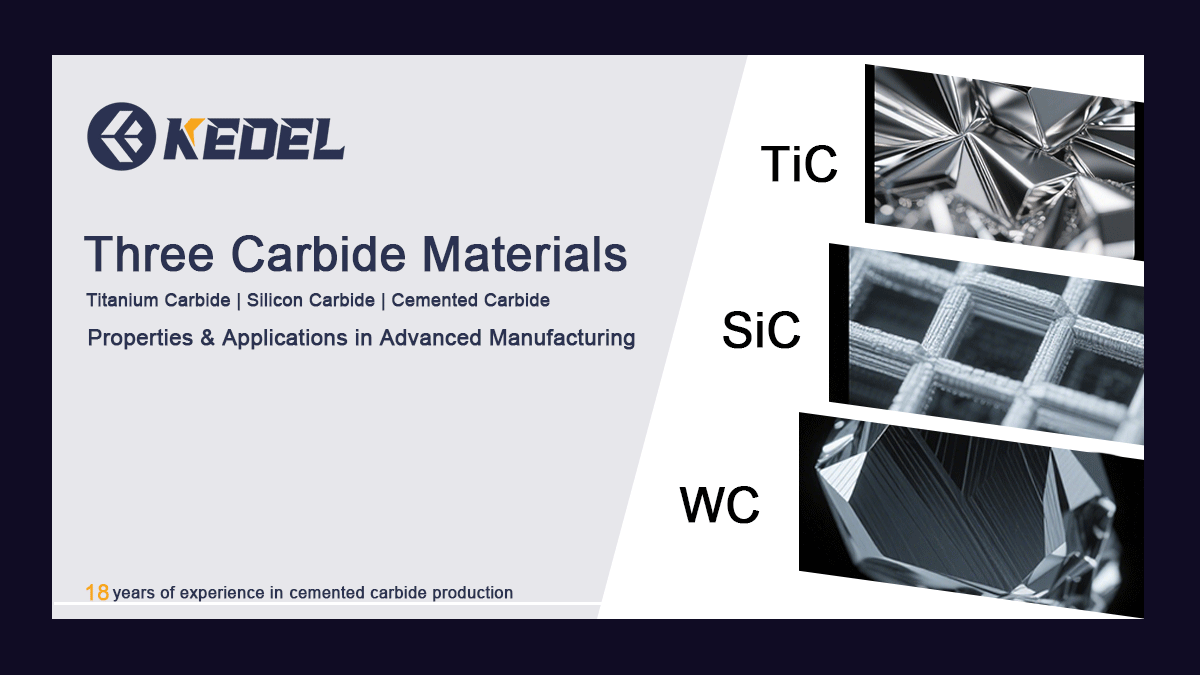
In the fields of industrial wear resistance, high-temperature resistance, and high-precision machining, titanium carbide (TiC), silicon carbide (SiC), and cemented carbide (represented by WC-Co) are three core hard materials. While they all share the common traits of "high hardness and wear resistance," their compositional structures, performance limitations, and applicable scenarios differ significantly: Cemented carbide balances wear resistance and toughness, making it the first choice for medium-to-high impact wear scenarios. Titanium carbide emphasizes high-temperature stability and chemical erosion resistance, often used as an additive or coating. Silicon carbide, with its ultra-high hardness and corrosion resistance, excels in low-impact, strong-corrosion, or high-temperature environments. This article breaks down the core properties, typical applications, and selection logic of these three materials to help clarify "which material fits which scenario," avoiding selection errors due to confused characteristics.
1. First, Clarify: Basic Positioning and Core Differences of the Three Materials
Before diving into properties, let’s quickly distinguish their core positioning with a simple table to build an overall understanding:
| Material Type | Core Composition/Structure | Performance Keywords | Industrial Position |
|---|---|---|---|
| Cemented Carbide (mainly WC-Co) | Tungsten carbide (WC) as the hard phase, cobalt (Co) as the binder phase | Wear-resistant, balanced toughness, machinable | Medium-to-high impact wear parts (tools, molds, nozzles) |
| Titanium Carbide (TiC) | Pure titanium carbide (TiC) or composite with other carbides | High-temperature stable, anti-built-up edge, low friction | Additive (enhances cemented carbide), coating material |
| Silicon Carbide (SiC) | Compound of silicon and carbon (ceramic material) | Ultra-hard, corrosion-resistant, high-temperature resistant, brittle | Low-impact wear parts, components for high-temperature/corrosive environments |
2. Properties and Applications of the Three Materials: Scenario-Based Analysis
2.1 Cemented Carbide (mainly WC-Co): The Industrial Workhorse with "Balanced Wear Resistance and Toughness"
Cemented carbide is currently the most widely used hard material in industry. Its core advantage is "being both wear-resistant and moderately tough," avoiding the "hard but brittle" drawback of pure ceramic materials. It is particularly suitable for wear scenarios that require withstanding moderate to high impact.
Core Properties
- Composition and Structure: Mainly composed of tungsten carbide (WC, 85%-95%) and cobalt (Co, 5%-15%). Cobalt acts as a binder, "holding together" the hard WC particles to balance hardness and toughness.
- Hardness and Toughness: Mohs hardness 8.5-9 (second only to diamond and boron carbide), impact toughness 20-35J/cm² (far higher than SiC’s 5-8J/cm²), capable of withstanding medium-to-high impact (e.g., tool cutting, high-pressure nozzle spraying).
- Temperature and Corrosion Resistance: Short-term temperature resistance up to 800°C (cobalt softens beyond this), resistant to weak acids and alkalis (cobalt is easily corroded in strong acids). Good machinability (can be ground into complex shapes such as special molds and precision tools).
Typical Applications
- Cutting Tools: Account for over 60% of cemented carbide applications, such as milling cutters, turning tools, and drills. Suitable for machining steel, cast iron, and non-ferrous metals (e.g., WC-Co cemented carbide tools for stainless steel cutting have a 5-10x longer life than high-speed steel).
- Wear-Resistant Molds and Components: Corrugated paper slitting knives, wire-drawing dies (for drawing metal wires), and mine ball mill liners. For example, tungsten carbide wire-drawing dies have a wear rate of only 0.01mm per 1000 meters when drawing copper wire.
- High-Pressure Nozzles: Oil drilling nozzles and high-pressure cleaning nozzles, capable of withstanding 30-100MPa pressure while resisting wear from particles in drilling fluid or cleaning fluid.
2.2 Titanium Carbide (TiC): A Functional Material with "High-Temperature Stability and Erosion Resistance"
Pure titanium carbide (TiC) is relatively brittle (impact toughness only 5-10J/cm²) and rarely used alone as structural components. Instead, it is mostly used as an "additive" or "coating material" to enhance the performance of other materials, with core value in high-temperature stability and chemical erosion resistance.
Core Properties
- Composition and Structure: Pure TiC is a non-metallic compound with a stable crystal structure. It is often compounded with WC and Co (e.g., WC-TiC-Co cemented carbide) or made into coatings (e.g., PVD/CVD TiC coatings).
- Hardness and Toughness: Mohs hardness 9-9.5 (slightly higher than WC), but pure TiC has poor toughness and is prone to chipping when used alone.
- Temperature and Corrosion Resistance: Temperature resistance up to 1600°C (far higher than WC-Co cemented carbide’s 800°C), strong resistance to built-up edges (less likely to stick to the workpiece during cutting), and resistance to strong acids and alkalis (better than WC-Co).
Typical Applications
- Cemented Carbide Additive: Adding 5%-15% TiC to WC-Co to form "WC-TiC-Co cemented carbide" for cutting tools used on difficult-to-machine materials like stainless steel and high-temperature alloys. It improves anti-built-up edge performance by 40%, preventing tool sticking.
- Tool Coatings: Applying a 5-10μm TiC coating to high-speed steel or cemented carbide tools via PVD (Physical Vapor Deposition) increases surface hardness (up to HV2000+) and temperature resistance, extending tool life by 2-3x (e.g., coated stainless steel milling cutters).
- Functional Ceramic Components: Small amounts of pure TiC are made into high-temperature ceramics, such as nozzle liners for rocket engines and high-temperature sensor housings, capable of long-term operation in environments above 1200°C.
2.3 Silicon Carbide (SiC): A Ceramic Hard Material with "Ultra-High Hardness and Corrosion Resistance"
Silicon carbide is a typical high-performance ceramic material with excellent hardness, corrosion resistance, and high-temperature resistance. However, it has poor toughness (impact toughness 5-8J/cm²), making it suitable for low-impact, strong-corrosion, or high-temperature wear scenarios. It cannot replace cemented carbide in medium-to-high impact applications.
Core Properties
- Composition and Structure: A compound of silicon (Si) and carbon (C), divided into sintered silicon carbide (SSiC) and reaction-bonded silicon carbide (RBSiC), with a density of 3.2g/cm³ (40% lighter than WC-Co).
- Hardness and Toughness: Mohs hardness 9.2-9.5 (the highest among the three materials), but brittle and prone to fracture under impact, unsuitable for high-impact scenarios (e.g., mine crushing).
- Temperature and Corrosion Resistance: Temperature resistance up to 1700°C (in air), resistant to strong acids and alkalis (including hydrochloric acid, sulfuric acid, and sodium hydroxide), and has good thermal conductivity (3x that of alumina ceramics).
Typical Applications
- Wear-Resistant and Corrosion-Resistant Components: Mechanical seal rings for chemical pumps and wear-resistant liners for desulfurization equipment. For example, SiC mechanical seal rings in sulfuric acid-containing slurry have a 3-5x longer life than WC-Co.
- Semiconductor and Electronic Fields: Used as a third-generation semiconductor material in power devices (e.g., SiC chips) due to its high-temperature and high-voltage resistance, suitable for new energy vehicle inverters and photovoltaic inverters.
- Special Fields: Bulletproof inserts (utilizing ultra-high hardness to resist impact) and high-temperature kiln furniture (e.g., sintering plates for ceramic kilns), capable of repeated use in 1600°C kilns.
3. Comparison Table of Core Properties and Applications
For more intuitive selection, the table below summarizes key indicators and typical applications of the three materials, facilitating quick scenario matching:
| Comparison Dimension | Cemented Carbide (WC-Co) | Titanium Carbide (TiC, including composites/coatings) | Silicon Carbide (SiC) |
|---|---|---|---|
| Core Composition | WC + Co (5%-15%) | Pure TiC; or WC-TiC-Co; or TiC coatings | SiC (sintered/reaction-bonded) |
| Mohs Hardness | 8.5-9 | 9-9.5 | 9.2-9.5 |
| Impact Toughness (J/cm²) | 20-35 (medium-high toughness) | 5-10 (low for pure TiC; 15-20 for composites) | 5-8 (low toughness, brittle) |
| Maximum Temperature Resistance (°C) | 800 (short-term) | 1600 (pure TiC); 900-1000 for composites | 1700 (in air) |
| Corrosion Resistance | Resistant to weak acids/alkalis; not to strong ones | Better than WC-Co; excellent for coated versions | Resistant to strong acids/alkalis (best) |
| Cost (Relative Value) | 100 (baseline) | 150-200 (coatings/composites); >300 for pure TiC | 200-300 (sintered SiC) |
| Typical Applications | Cutting tools, slitting knives, mine wear parts, high-pressure nozzles | Cemented carbide additives, tool coatings, high-temperature ceramic components | Chemical seal rings, semiconductor chips, high-temperature kiln furniture, bulletproof inserts |
| Unsuitable Scenarios | Strong corrosion (e.g., concentrated hydrochloric acid), ultra-high temperatures (>800°C) | High impact (pure TiC), uncoated pure TiC structural parts | High impact (e.g., mine crushing, heavy cutting) |
4. Clarifying Common Misconceptions: Avoiding Material Selection Confusion
Misconception 1: "Titanium carbide/silicon carbide have higher hardness than cemented carbide and can replace it in all wear scenarios."
Fact: Hardness ≠ durability; toughness is critical. For example, in mine crushing equipment wear parts, replacing cemented carbide with silicon carbide would result in chipping within 1-2 days due to poor impact toughness (5-8J/cm² vs. 20-35J/cm²). Cemented carbide, however, can withstand ore impact with a service life of 1-2 months. Titanium carbide and silicon carbide are only suitable for low-impact scenarios and cannot replace cemented carbide in medium-to-high impact applications.
Misconception 2: "Titanium carbide is an independent material and can be used alone to make cutting tools."
Fact: Pure titanium carbide has poor toughness and is prone to chipping when used alone as a tool. Industrially, pure TiC is rarely used as a structural component; it is mostly "compounded" or "coated"—for example, WC-TiC-Co cemented carbide tools (with TiC as an additive) or TiC coatings on ordinary tools to enhance performance, rather than being used alone.
Misconception 3: "Cemented carbide has poor corrosion resistance and cannot be used in chemical scenarios."
Fact: While cemented carbide (WC-Co) is not resistant to strong acids, it can withstand weak acids/alkalis and most industrial fluids (e.g., oil, water-based coolants). Its corrosion resistance can also be improved by adjusting composition—for example, replacing cobalt (Co) with nickel (Ni) to make WC-Ni cemented carbide, which has corrosion resistance close to silicon carbide. It can be used in mild chemical scenarios (e.g., wear parts for neutral slurries) at 50% lower cost than silicon carbide.
5. Selection Logic: 3 Steps to Choose the Right Material
No complex calculations are needed. Follow these 3 steps to match materials to scenarios, ideal for quick decision-making by production or procurement teams:
Step 1: Evaluate "Impact Intensity" – The Core Screening Criterion
- Medium-to-high impact (e.g., cutting, crushing, high-pressure spraying): Choose cemented carbide (WC-Co) for sufficient toughness to avoid chipping.
- Low impact/no impact (e.g., chemical sealing, high-temperature static components): Choose silicon carbide (for strong corrosion/high temperature) or titanium carbide coatings (to enhance tool performance).
Step 2: Evaluate "Environmental Requirements" – Prioritize Temperature/Corrosion Resistance
- High temperature (>1000°C): Choose silicon carbide (resistant to 1700°C) or titanium carbide composites (resistant to 1000°C+).
- Strong corrosion (strong acids/alkalis): Choose silicon carbide (best) or WC-Ni cemented carbide (second-best, lower cost).
- Ordinary environment (room temperature, neutral fluids): Choose cemented carbide (highest cost-effectiveness).
Step 3: Evaluate "Functional Needs" – Do You Need Special Properties?
- Enhance tool anti-sticking/high-temperature resistance: Choose titanium carbide coatings or WC-TiC-Co cemented carbide.
- Need lightweight/semiconductor functionality: Choose silicon carbide (low density, semiconductor properties).
- General wear resistance needs: Directly choose cemented carbide (WC-Co).
6. Conclusion: Each Material Has Its "Exclusive Scenario" – No Absolute Replacement
Titanium carbide, silicon carbide, and cemented carbide are not "better or worse" but "each with strengths"—cemented carbide is the "workhorse" for medium-to-high impact wear scenarios, titanium carbide is the "assistant" for enhancing material performance (as an additive/coating), and silicon carbide is the "specialist" for low-impact, strong-corrosion, or high-temperature scenarios.
For professionals in the tungsten carbide industry, when recommending materials, focus on understanding the customer’s "impact intensity, environmental conditions, and functional needs" rather than simply comparing hardness or cost. For example, in chemical high-pressure spraying scenarios with moderate impact and mild corrosion, recommend WC-Ni cemented carbide over silicon carbide to balance performance and cost; only recommend silicon carbide if impact is low and corrosion is extreme.
If your enterprise faces issues like "wear-resistant but chipping" or "corrosion-resistant but high-cost" in material selection, or needs customized materials with special properties (e.g., corrosion-resistant cemented carbide, TiC-coated tools), feel free to communicate. We can provide material solutions and sample testing support based on your working parameters (impact, temperature, medium).