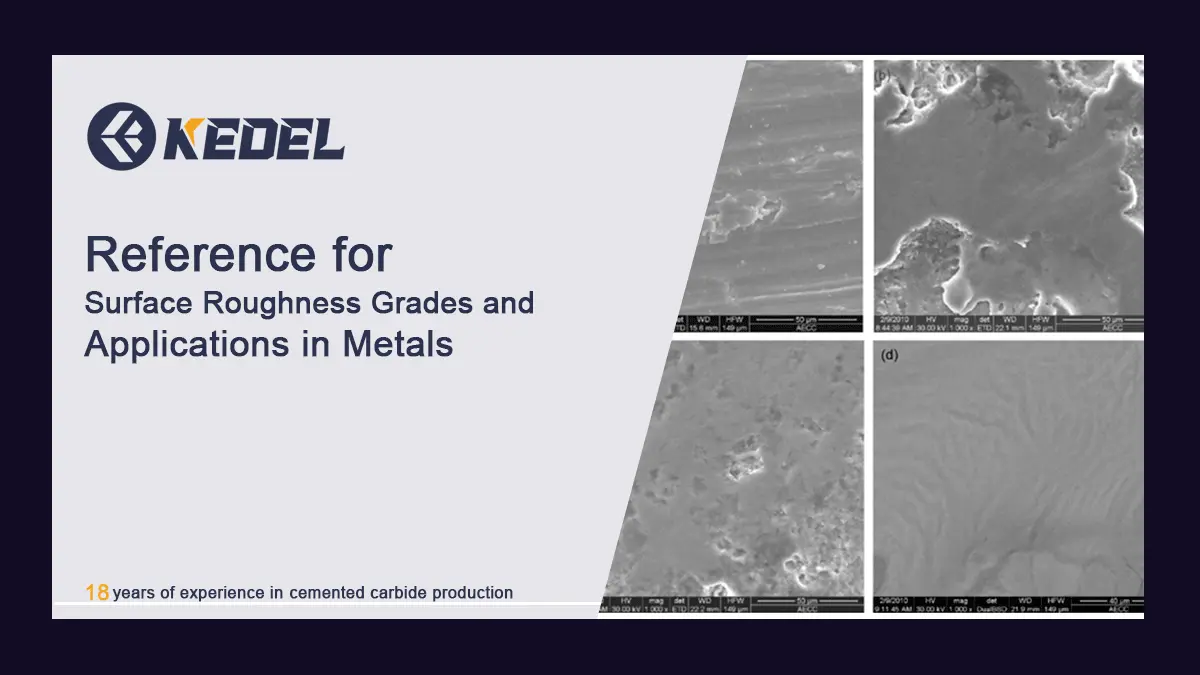
Surface roughness is one of the key performance indicators of cemented carbide products, directly affecting their cutting efficiency, wear resistance, assembly compatibility, and service life. Simply put, surface roughness refers to the degree of micro-irregularities on the cemented carbide surface. The smaller the value, the smoother the surface, and the higher the corresponding machining precision and service performance. Different application scenarios (such as precision cutting, mining, and electronic components) have significantly different requirements for cemented carbide surface roughness—selecting the right roughness grade ensures optimal product performance, while incorrect selection may lead to tool adhesion, excessive wear, or assembly failures. This article uses plain language and clear tables to introduce common cemented carbide surface roughness grades, measurement parameters, machining methods, and typical applications, helping industry practitioners quickly match requirements and improve selection efficiency.
1. First, Understand: Core Parameters of Surface Roughness (Simple Introduction)
Two key parameters are mainly used to describe surface roughness in the industry. No complex calculations are needed—just remember their core meanings:
| Parameter Code | Name (Plain Explanation) | Core Function | Common Unit |
|---|---|---|---|
| Ra | Arithmetic Mean Deviation (Most Commonly Used) | Measures the average distance from micro-peaks and valleys on the surface to the reference line, reflecting overall smoothness | Micrometer (μm) |
| Rz | Maximum Height Deviation | Measures the vertical distance between the highest and lowest points on the surface, reflecting local extreme irregularities | Micrometer (μm) |
Key Conclusion: In practical applications, Ra is the main reference standard. The smaller the Ra value, the smoother the surface, and the higher the machining difficulty and cost. For example: A surface with Ra 0.02μm is 80 times smoother than a surface with Ra 1.6μm, requiring more precise equipment and longer processing time.
Note: In daily communication, the roughness grade is often expressed directly as "Ra + value" (e.g., "Ra 0.8μm") without additional explanation of the parameter type.
2. Common Cemented Carbide Surface Roughness Grades: Machining Methods + Characteristics
The surface roughness of cemented carbide is mainly achieved through subsequent processing techniques. Different grades correspond to different machining precisions and surface conditions. Below are the 4 most commonly used grades in the industry, divided from ultra-precision machining to rough machining:
| Roughness Grade (Ra) | Surface Condition | Typical Machining Methods | Core Characteristics |
|---|---|---|---|
| 0.012 - 0.025μm | Ultra-smooth (Mirror Finish) | Precision Polishing, Ultra-precision Grinding | No obvious scratches on the surface, extremely low friction coefficient, suitable for high-precision fitting or gapless assembly |
| 0.05 - 0.1μm | High Smoothness (Precision Machining) | Precision Grinding, Honing | Fine surface with no visible lines to the naked eye, strong wear resistance, suitable for precision cutting or sealing scenarios |
| 0.2 - 0.8μm | Medium Smoothness (Semi-precision Machining) | Semi-precision Grinding, Precision Turning | Slight machining marks on the surface, barely visible to the naked eye, balancing performance and cost, most widely used |
| 1.6 - 6.3μm | Rough (Rough Machining) | Rough Grinding, Turning | Obvious machining lines on the surface, visible to the naked eye, high machining efficiency and low cost, suitable for heavy-load and wear-resistant scenarios |
Supplementary Explanation:
- Ultra-precision machining (Ra ≤ 0.025μm): The processing cost is 3-5 times that of ordinary precision machining, only used in high-end precision scenarios (e.g., semiconductor equipment components);
- Rough machining (Ra ≥ 1.6μm): Although the surface is rough, the hardness and toughness of cemented carbide are not affected. On the contrary, it can increase friction with other components (e.g., the cutting surface of mining tools).
3. Core Application References: Select the Right Grade for Different Scenarios
Below are matching suggestions for the most mainstream application fields of cemented carbide and roughness grades, explaining the selection logic combined with actual usage requirements for direct reference:
| Application Field | Specific Product Examples | Recommended Roughness Grade (Ra) | Selection Reason (Core Requirement) |
|---|---|---|---|
| Precision Cutting Tools | Micro-drills (PCB Processing), Precision Reamers, Coated End Mills | 0.05 - 0.1μm | Reduce cutting resistance, minimize tool adhesion, and ensure the surface finish of processed workpieces (e.g., electronic components) |
| Mining/Construction Machinery | Coal Miner Picks, Roadheader Bits, Hydraulic Breaker Chisels | 1.6 - 6.3μm | Increase friction with rocks/ore, improve cutting impact force, and lower rough machining costs |
| Electronic/Semiconductor Equipment | Lithium Battery Pole Piece Slitting Knives, Chip Packaging Mold Components | 0.012 - 0.025μm | Ultra-smooth surface avoids scratching pole pieces/chips and ensures assembly clearance ≤ 0.005mm |
| Aerospace Components | Engine Turbine Blades, Precision Bearing Races | 0.025 - 0.05μm | High-temperature resistance, low friction, reduce energy loss during high-speed rotation, and extend service life |
| General Mechanical Parts | Gears, Bushings, Ordinary End Mill Bodies | 0.2 - 0.8μm | Balance assembly precision and processing cost, meeting basic requirements for daily rotation/cutting |
| Sealing/Fitting Components | Hydraulic Valve Spools, Seal Ring Contact Surfaces | 0.025 - 0.05μm | Ultra-smooth surface improves sealing effect and avoids hydraulic oil leakage or gas penetration |
Practical Case:
- End mills for processing aluminum alloy mobile phone frames: Recommended Ra 0.1μm, which can reduce aluminum chip adhesion (aluminum alloy has strong viscosity) and ensure no scratches on the frame surface;
- Cemented carbide picks for coal mining: Recommended Ra 3.2μm, the rough surface can enhance bite force with coal seams, avoid pick slipping, and reduce processing costs.
4. Selection Notes: 3 Key Reminders
- Do not blindly pursue "the smoother the better": Ultra-smooth surfaces (Ra ≤ 0.025μm) have extremely high processing costs. For application scenarios without precision requirements (e.g., ordinary mining tools), choosing rough machining grades is more cost-effective;
- Adjust grades for coated products: For cemented carbide with TiAlN, TiN, or other coatings, the recommended substrate roughness before coating is Ra 0.2 - 0.4μm—an overly smooth surface will affect coating adhesion, leading to coating peeling;
- Confirm with processing technology: If cemented carbide products require subsequent assembly (e.g., welding, bolt fixing), the roughness can be appropriately increased (Ra 0.8 - 1.6μm) to enhance the stability of the connection part.
Conclusion: The Core of Selection is "Demand Matching"
The selection of cemented carbide surface roughness is essentially a balance between "performance requirements" and "processing costs": precision scenarios (electronics, aerospace) require high smoothness grades (Ra ≤ 0.1μm), while heavy-load and general-purpose scenarios are suitable for medium or rough grades (Ra ≥ 0.2μm). As an industry practitioner, when recommending products, you can first clarify the customer's core needs: "Do you need precision machining without scratches? Or heavy-load wear resistance with low cost?" Then match the corresponding roughness grade.
If you need to recommend more precise roughness grades for specific products (e.g., custom tools, special scenario components) or understand the cost differences between different processing technologies (e.g., polishing, precision grinding), please feel free to contact us for customized suggestions to help optimize product performance and control production costs.