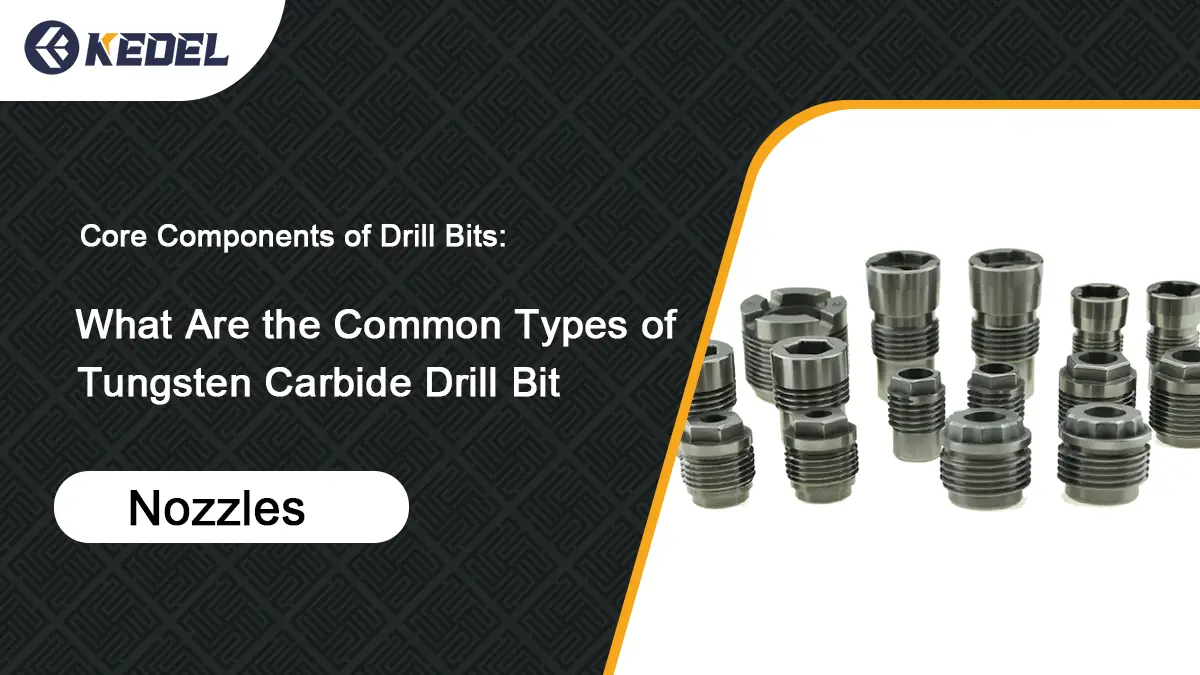
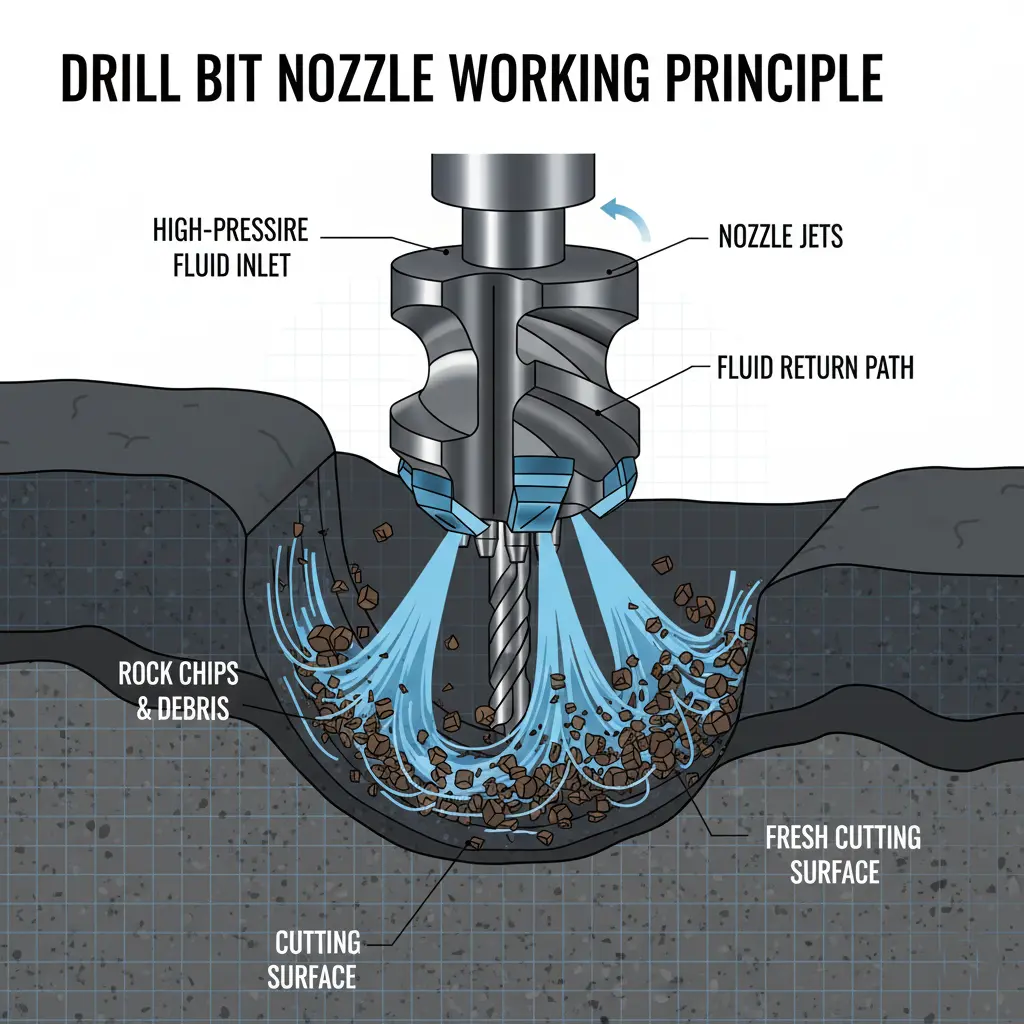
In the fields of oil, natural gas, and mining, the cutting efficiency of a drill bit depends not only on the hardness of its teeth but also on the design of its hydraulic jetting system. As a key accessory of the drill bit, tungsten carbide nozzles are responsible for jetting mud under high pressure to clean the bottom of the hole, cool the drill bit, and carry cuttings. Different types of drill bits (such as PDC bits, tricone bits, drag bits, etc.) have different nozzle structures and installation methods. This article focuses on introducing the common types of tungsten carbide nozzles in the drilling and mining industries, analyzing their structural characteristics and application conditions, and providing professional reference suggestions for your accessory selection and procurement.
I. First, Clarify: The Core Requirement of Drilling Nozzles – Erosion Resistance
During drilling, the mud (drilling fluid) is often filled with high-concentration solid particles, and the jetting pressure is extremely high. This high-pressure erosion environment will cause severe physical wear to the nozzle orifice. Therefore, the core of selecting a nozzle is to check its erosion resistance:
- Wear Resistance: The extremely high hardness of tungsten carbide can ensure that the inner hole size of the nozzle remains unchanged under high-pressure scouring for hundreds of hours, thereby maintaining stable jetting pressure;
- Impact Resistance: In complex mining and downhole conditions, the nozzle must withstand vibration and fluid pulses. The high bending strength of tungsten carbide can effectively prevent the nozzle from breaking.
II. Classified by Drill Bit Type: Comprehensive Analysis of Common Nozzle Types
Different drill bits have different working environments and hydraulic requirements, and the corresponding nozzle types are also different. The classification description is sorted out for easy understanding:
1. PDC Bit Nozzles
| Most PDC (Polycrystalline Diamond Compact) bits use thread-connected nozzles, which are convenient to replace at any time according to hydraulic requirements, offering high flexibility. | Nozzle Type | Structural Characteristics | Core Advantages | Application Scenarios |
|---|---|---|---|---|
| Standard Threaded Nozzles | Compact structure with external threads or internal hexagonal grooves | Strong versatility, easy installation and removal | Conventional PDC bits, drilling in ordinary formations | |
| Extended Nozzles | The nozzle head extends outward, making the nozzle closer to the bottom of the hole | More efficient in cleaning cuttings and reducing "balling" phenomenon | Sticky formations prone to balling, deep hole drilling | |
| Cross-Flow/Side Nozzles | Special nozzle angle to optimize flow field distribution | Reduce fluid dead zones on the drill bit surface and improve cooling uniformity | High-speed PDC bits, drilling in complex formations |
2. Tricone Bit Nozzles
| The pressure fluctuates greatly during the operation of tricone bits, which have higher requirements for the sealing and fixing of nozzles. The focus is on vibration resistance and fatigue resistance. | Nozzle Type | Structural Characteristics | Core Advantages | Application Scenarios |
|---|---|---|---|---|
| Standard Nozzles | Conventional structure, suitable for standard mounting holes of tricone bits | Strong versatility and controllable cost | Ordinary rotary drilling, medium-hard formations | |
| Shielded/Guided Groove Nozzles | With shield or guided groove on the outside, having both jetting and protective functions | Protect the drill bit body from wear by returning mud | High sand content formations, high-pressure drilling | |
| Micro/Mini Nozzles | Small size, suitable for multi-nozzle design | Can achieve multi-directional jetting and wide cleaning range | Small tricone bits, special multi-nozzle drill bit designs |
3. Drag Bit & Mining Nozzle
| This type of drill bit is mostly used in relatively soft formations or open-pit mining. The nozzle design focuses more on easy installation and basic wear resistance. | Nozzle Type | Structural Characteristics | Core Advantages | Application Scenarios |
|---|---|---|---|---|
| Press-Fit Nozzles | Threadless, fixed by interference fit or circlip | Quick installation and removal, suitable for drag bit structure | Drag bits, drilling in soft formations | |
| Central Hole Nozzles | Large orifice, located at the center of the drill bit | High cutting removal efficiency, not easy to clog | Large mining drill bits, open-pit mining |
III. Specification and Performance Comparison Table of Common Drill Bit Nozzles (For Quick Selection)
The core parameters of nozzles corresponding to different drill bits are sorted into a table, which can be directly referred to during procurement without checking one by one:
| Drill Bit Type | Common Nozzle Shapes | Installation Method | Common Material Grades | Key Performance Requirements |
|---|---|---|---|---|
| PDC Bit | Standard Threaded/Extended | Threaded connection (with O-ring seal) | YG6 / YG8 / YN6 | High hardness, precise thread accuracy, good sealing performance |
| Tricone Bit | Flanged/Shielded | Threaded or circlip fixed | YG11 / YG15 | Vibration and impact resistance, fatigue resistance, reliable sealing |
| Drag Bit | Cylindrical/Simple | Press-fit or mechanical locking | YG11 | Basic wear resistance, easy installation |
| Mining Bit | Special-Shaped Sleeve/Straight Hole | Inlaid type | YG13 / YG15 | Extremely high toughness, resistance to large particle scouring |
IV. 3 Key Factors Affecting Nozzle Life (Pit Avoidance Guide)
In many cases, the early failure of nozzles is not due to poor material quality but ignoring these details. Three core influencing factors summarized from years of experience must be noted:
1. Seal Failure (Most Common Problem)
- Cause: Poor quality or improper installation of the O-ring between the nozzle and the drill bit seat
- Consequence: High-pressure mud flows out from the gap, causing a "piercing" phenomenon that quickly erodes the tungsten carbide nozzle and the drill bit steel body
- Solution Suggestion: Select high-quality oil-resistant and high-temperature-resistant O-rings, and check whether the sealing surface is clean and free of scratches before installation
2. Binder Phase Selection (Adapting to Mud Environment)
- Acidic mud/with corrosive additives: Choose YN series (nickel-based) tungsten carbide to prevent alloy loosening caused by cobalt loss
- Conventional physical scouring environment: Choose YG series (cobalt-based) tungsten carbide for higher hardness and better cost performance
3. Inner Hole Geometry (Affecting Erosion Life)
- High-Quality Nozzles: With smooth contraction curves inside, ensuring smooth fluid flow without eddy currents
- Low-Quality Nozzles: Rough internal surfaces, prone to eddy currents, accelerating local erosion and wear
- Selection Suggestion: Request the supplier to provide an inner hole finish test report during procurement
V. 4 Must-Confirm Items for Procuring/Replacing Nozzles
To avoid buying or installing the wrong nozzles, be sure to confirm these 4 points when procuring or replacing nozzles:
- Thread Specification: Clarify whether it is a conventional specification such as No. 12 or No. 13, or a special metric thread. It is best to provide a sample or drawing of the old part
- Orifice Size: Usually graded in units of 1/32 inch (e.g., 10/32", 12/32"). The orifice size directly affects the pump pressure and needs to match the drilling parameters
- Sealing Accessories: Confirm whether matching O-rings are needed, as well as the material and size of the O-rings
- Installation Tools: Prepare matching internal hexagonal wrenches or special disassembly tools to avoid alloy cracking caused by uneven installation force
Summary
Although the drill bit nozzle is small, it is a "throat" component that determines drilling efficiency and drill bit life. Selecting the right type is crucial: choose high-precision threaded nozzles for PDC bits, impact-resistant nozzles for tricone bits, and high-toughness nozzles for mining bits. Matching with tungsten carbide grades suitable for the mud environment can effectively reduce the frequency of downhole drill bit replacement and save costs.