
Cemented carbides composed of tungsten carbide (WC) as the hard phase and cobalt (Co) as the binder phase are rare industrial materials that “retain hardness even at high temperatures.” Their maximum continuous operating temperature can reach 800°C, and they can withstand short-term temperatures exceeding 1,000°C—far outperforming ordinary steel (e.g., 45# steel softens above 500°C) and high-speed steel (W18Cr4V loses significant hardness around 600°C). This heat resistance is not due to a single factor but the synergistic effect of tungsten carbide’s inherent high-temperature stability, cobalt’s compatible binding properties, and the microstructural characteristics formed by the two. For industrial production, this trait solves critical pain points in high-temperature scenarios: from frictional heat generation (600–800°C) during metal cutting to the operating temperatures (400–500°C) of aluminum alloy die-casting molds, and wear of mining equipment in underground high-temperature environments. This article breaks down the core reasons for the heat resistance of WC-Co cemented carbides from three dimensions—component properties, microstructure, and practical applications—making the principles easy to understand.
1. Core Reason 1: Tungsten Carbide (WC) Is a “Naturally Heat-Resistant Skeleton”
The heat resistance of cemented carbides first stems from the inherent properties of their core component: tungsten carbide. As the “hard phase,” WC acts like the “steel reinforcement in a building,” providing stable support for the material at high temperatures. This is reflected in three key aspects:
1.1 Ultra-High Melting Point Lays the Foundation for Heat Resistance
Tungsten carbide has an extremely high melting point of 2,870°C—far higher than the typical high temperatures encountered in industrial settings (most high-temperature working conditions are <1,000°C). For comparison:
- Ordinary carbon steel has a melting point of approximately 1,538°C and softens above 500°C due to increased atomic mobility.
- High-speed steel (W18Cr4V) has a melting point of around 1,400°C; its hardness drops from HRC 62 to below HRC 50 at 600°C, making it unusable for cutting.
- Even at 1,000°C, tungsten carbide only softens slightly—its melting point is never reached, so it does not melt or undergo structural collapse.
1.2 Stable Crystal Structure Resists Deformation at High Temperatures
Tungsten carbide has a hexagonal close-packed (HCP) crystal structure, where atoms are tightly arranged with strong bonding forces. This structure prevents atomic diffusion or structural disorder at high temperatures:
- At room temperature, this structure gives WC its high hardness (HRA 90–93).
- At high temperatures (e.g., 800°C), atoms vibrate slightly but maintain an orderly arrangement—unlike ordinary metals, which deform as atoms “loosen” and gaps widen.
- In contrast, high-speed steel has a body-centered cubic (BCC) structure, where atomic gaps easily expand at high temperatures, causing rapid strength loss.
1.3 Excellent Chemical Inertness Prevents Oxidation or Reaction at High Temperatures
In high-temperature industrial environments, materials must resist not only “temperature” but also “environmental corrosion” (e.g., oxidation in air, reaction with cutting fluids). Tungsten carbide exhibits stable chemical properties at high temperatures:
- Below 800°C, only a thin oxide film (WO₃) forms on its surface when exposed to air. This film is dense and prevents further oxidation of the internal material.
- It does not react (e.g., dissolve or erode) with common industrial media such as metal cutting fluids or molten aluminum alloys.
- Unlike ceramic materials (e.g., alumina), which also have high melting points, ceramics tend to react with molten metals at high temperatures, causing surface spalling—an issue WC avoids.
2. Core Reason 2: Cobalt (Co) Binder Plays a “High-Temperature Compatibility Role”
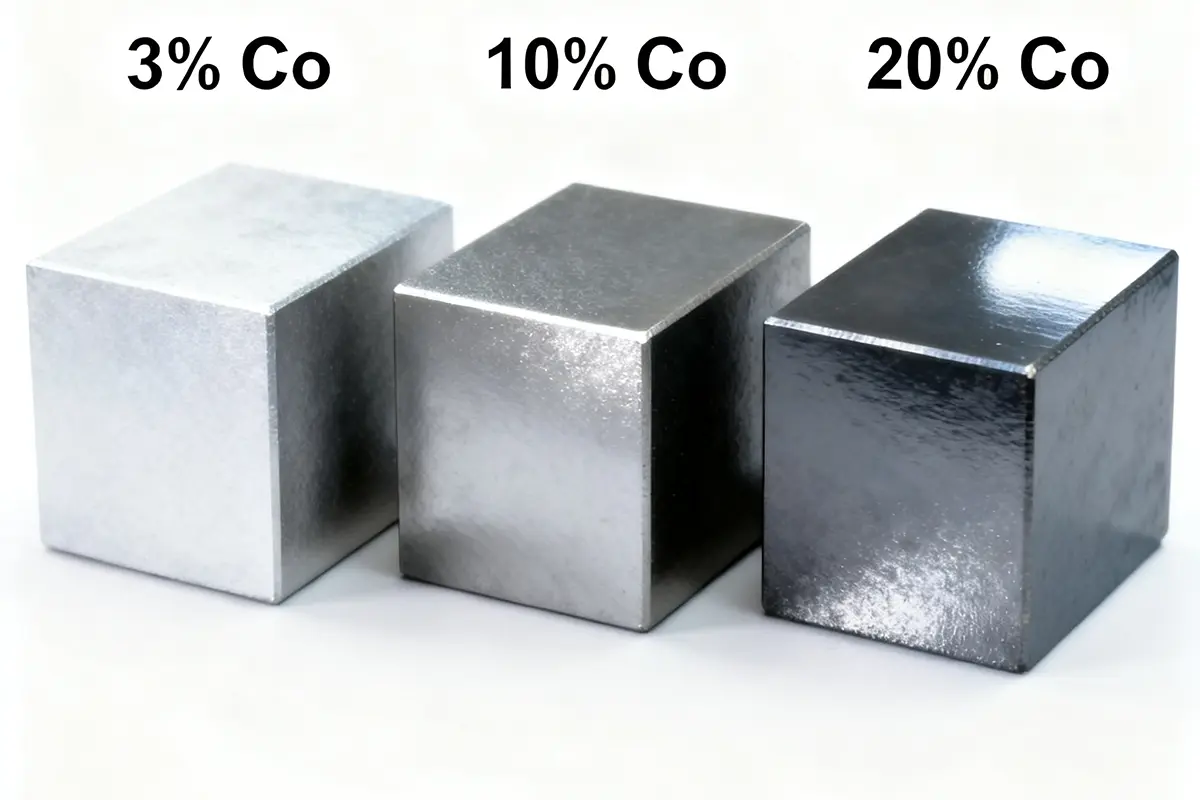
A common question arises: Cobalt has a melting point of only 1,495°C—far lower than WC—so why doesn’t it undermine heat resistance? In reality, cobalt (typically 6–15% by weight) acts as a “binder phase” and does not exist in isolation. Instead, it is uniformly dispersed between WC grains, forming a microstructure where “WC grains are encapsulated by the Co phase.” Its high-temperature role focuses on two key functions:
2.1 Maintains Bonding Force with WC Grains at High Temperatures
At room temperature, cobalt is a ductile metal that “binds” hard but brittle WC grains together to prevent cracking. At high temperatures (e.g., 600–800°C), cobalt softens slightly (becoming “semi-solid”) but does not fully melt or flow away:
- This slight softening actually “buffers” thermal stress between WC grains (different materials expand at different rates at high temperatures, creating stress), preventing the material from cracking due to stress buildup.
- Meanwhile, the bonding force (metallurgical bonding) between cobalt and WC grains remains strong at high temperatures—unlike binders made from other low-melting metals (e.g., copper, melting point 1,085°C), which would melt and lose their binding ability by 800°C.
2.2 Inhibits WC Grain Growth to Maintain High-Temperature Stability
At high temperatures, material grains tend to “grow” (small grains merge into larger ones), leading to hardness loss. Cobalt acts as an “inhibitor” to prevent excessive WC grain growth at high temperatures:
- Cobalt atoms adsorb on the surface of WC grains (at grain boundaries), forming a “barrier layer” that slows the diffusion of WC atoms and inhibits grain merging.
- Without cobalt, WC grains would grow from 3μm to over 8μm after 10 hours at 800°C, reducing hardness by 20%. With cobalt, grain growth is limited to less than 10%, and hardness remains nearly stable.
3. Core Reason 3: Synergistic Enhancement of the WC-Co Microstructure
Beyond the individual properties of its components, the “dense microstructure” formed by WC and cobalt further enhances heat resistance. High-quality WC-Co cemented carbides undergo high-temperature sintering (1,400–1,500°C) to form a structure where “WC grains are uniformly distributed, Co fills gaps, and there are no significant pores” (density typically ≥14.5g/cm³). The advantages of this structure are:
3.1 Dense Structure Reduces High-Temperature Oxidation Pathways
If a material contains pores, high-temperature air or corrosive media can seep into the interior through these pores, accelerating oxidation (e.g., ceramics with high porosity oxidize 3x faster than WC-Co). The dense structure of WC-Co:
- Contains almost no visible pores, so external oxygen can only contact the material’s surface and cannot penetrate inward.
- The WO₃ oxide film formed on the surface (below 800°C) adheres tightly to the dense structure, providing “double protection” against further oxidation.
3.2 Uniform Distribution Enhances Load Stability at High Temperatures
In high-temperature scenarios, materials often bear loads (e.g., cutting forces, mold pressure). The uniform distribution of WC grains in WC-Co ensures that loads are evenly transferred through the Co phase to each WC grain, avoiding localized stress concentration:
- For example, in aluminum alloy die-casting molds, the mold must withstand 20MPa of pressure at 400°C. The uniform structure of WC-Co disperses this pressure, preventing deformation due to localized softening at high temperatures.
- In contrast, high-speed steel exhibits uneven hardness at high temperatures, leading to indentation in softer areas and mold failure.
4. Heat Resistance Comparison: WC-Co vs. Other Industrial Materials
To highlight its advantages, below is a comparison of WC-Co with other common “wear-resistant, heat-resistant materials” used in industry:
| Material Type | Key Composition | Melting Point (°C) | Max Continuous Operating Temp (°C) | Hardness Retention at 500°C | Typical High-Temperature Applications |
|---|---|---|---|---|---|
| WC-Co Cemented Carbide | Tungsten Carbide + 6–15% Co | 2,870 (WC) | 600–800 | ≥90% (HRA) | Metal cutting tools, die-casting molds |
| High-Speed Steel | W18Cr4V | 1,400 | 400–500 | ≤60% (HRC) | Low-speed cutting tools, room-temperature molds |
| Alumina Ceramic | Al₂O₃ | 2,054 | 800–1,000 | ≥95% (HRA) | High-temperature insulators, non-impact wear parts |
| Ordinary Carbon Steel | 45# Steel | 1,538 | 300–400 | ≤30% (HRC) | Room-temperature structural parts, non-load-bearing components |
As shown, while WC-Co’s heat resistance is slightly lower than that of alumina ceramic, it balances “heat resistance + impact resistance” (ceramics are prone to cracking at high temperatures). Compared to high-speed steel and carbon steel, its advantages in heat resistance and hardness retention are significant—making it one of the best choices for “high-temperature wear + load-bearing” scenarios.
5. 2 Key Factors Affecting the Heat Resistance of WC-Co Cemented Carbides
The heat resistance of WC-Co varies with its formulation, primarily influenced by cobalt content and tungsten carbide grain size. Consider these factors when selecting a grade:
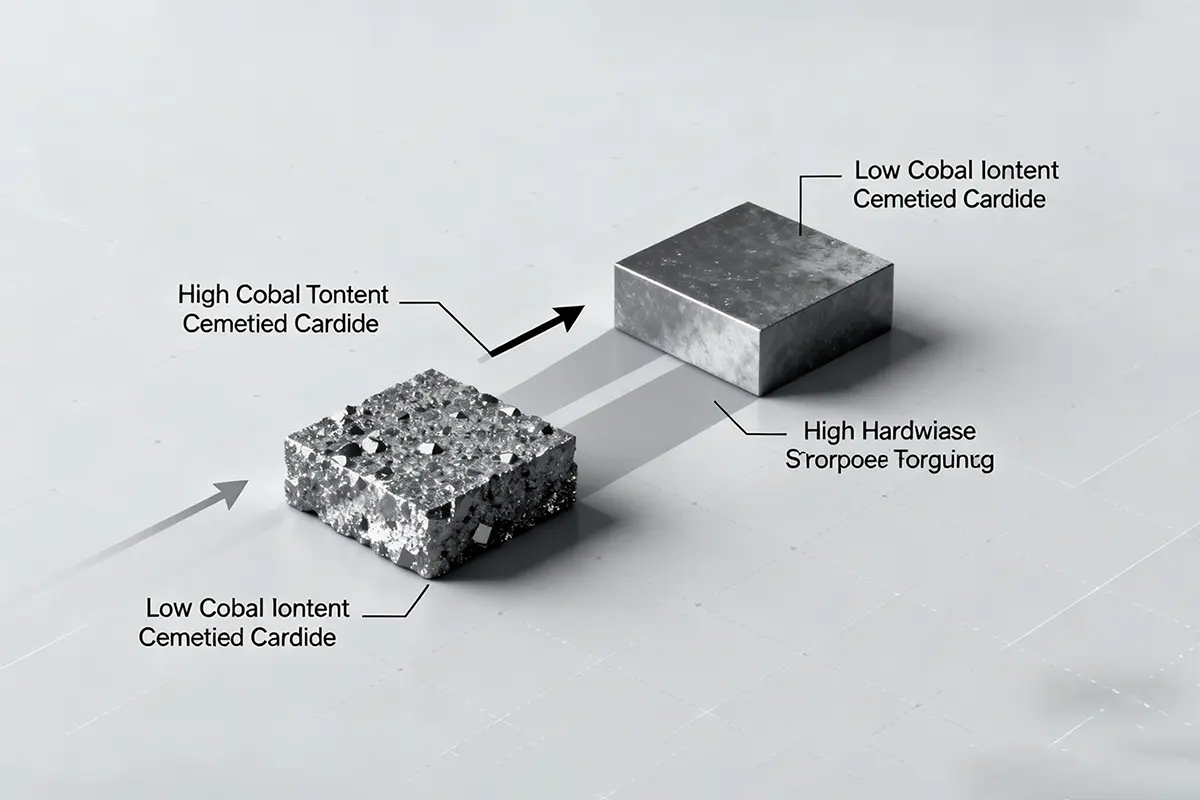
5.1 Cobalt Content: Lower Cobalt = Better Heat Resistance (When Toughness Is Sufficient)
With sufficient toughness to prevent cracking, lower cobalt content means a higher proportion of WC—and better heat resistance:
- Low cobalt (6–8%, e.g., YG6): High WC content, retaining ≥92% hardness at high temperatures. Suitable for low-impact, high-temperature scenarios (e.g., precision grinding tools).
- Medium cobalt (8–12%, e.g., YG8): Balances heat resistance and toughness. Suitable for medium-impact, medium-temperature scenarios (e.g., general-purpose cutting tools).
- High cobalt (12–15%, e.g., YG15): Excellent toughness and impact resistance but retains ≤85% hardness at high temperatures. Suitable for high-impact, low-temperature scenarios (e.g., mining drill bits).
5.2 Tungsten Carbide Grain Size: Fine Grains = Better Heat Resistance
Fine-grain WC (1–3μm) has more grain boundaries, where cobalt atoms act as stronger “inhibitors” to prevent grain growth at high temperatures:
- Fine-grain WC-Co (e.g., YG6X): After 10 hours at 800°C, grain growth is <5%, and hardness remains nearly unchanged.
- Coarse-grain WC-Co (e.g., YG15): Under the same conditions, grain growth exceeds 15%, and hardness drops by ~10%.
- For high-temperature precision scenarios (e.g., semiconductor high-temperature fixtures), prioritize fine-grain grades.
6. Common Misconception: “Cobalt Has a Low Melting Point, So WC-Co Isn’t Heat-Resistant”
Many assume WC-Co lacks heat resistance because cobalt has a low melting point (1,495°C)—this is a typical misunderstanding that ignores the material’s microstructure:
- In WC-Co, cobalt does not exist “in isolation” but as a “thin film” surrounding WC grains. Protected by WC, it does not soften or flow away like pure cobalt (which becomes semi-liquid at 800°C).
- Practical tests show: At 800°C, the Co phase in WC-Co only softens slightly (hardness ~HRC 20) but still binds WC grains. In contrast, pure cobalt is already semi-liquid at 800°C and has no strength.
Conclusion: WC-Co Heat Resistance Is a Synergy of “Components + Structure”
The heat resistance of WC-Co cemented carbides is not due to a single component but the synergy of “WC’s high-melting stable skeleton, cobalt’s high-temperature binding and buffering, and a dense, uniform microstructure.” This trait allows it to retain hardness at 600–800°C while withstanding moderate impact and loads—making it ideal for industrial scenarios like metal cutting, high-temperature molds, and high-temperature mining environments.
For professionals in the tungsten carbide industry, when recommending WC-Co products, align the grade with the customer’s “maximum operating temperature + impact load”: Choose low-cobalt fine-grain grades (e.g., YG6X) for high-temperature, low-impact scenarios; medium-cobalt medium-grain grades (e.g., YG8) for medium-temperature, medium-impact scenarios; and high-cobalt coarse-grain grades (e.g., YG15) for low-temperature, high-impact scenarios.