
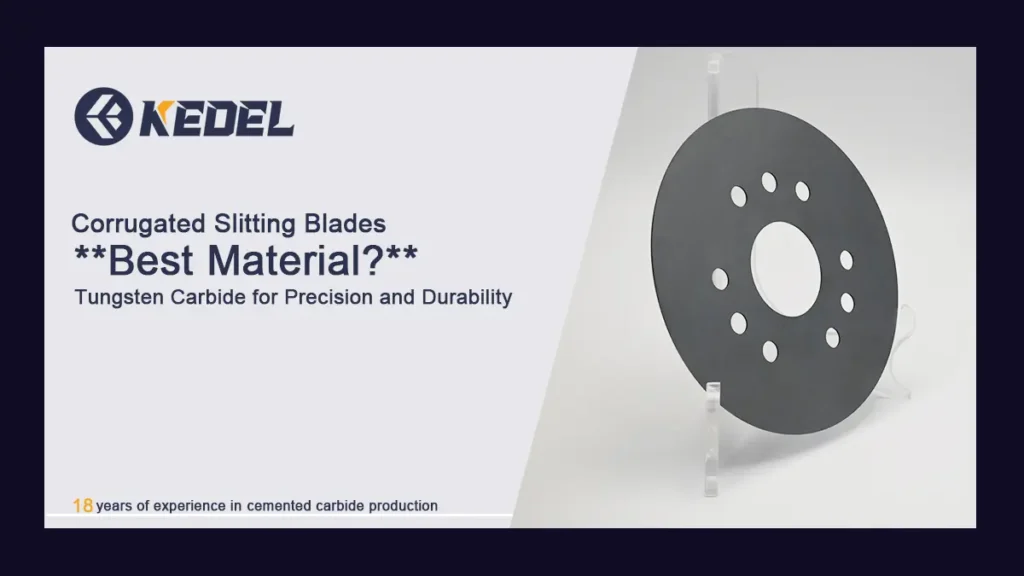
In the corrugated paper slitting process, blade material directly determines slitting efficiency, cut quality, and blade replacement frequency. However, there is no single "best material"—different slitting scenarios (e.g., single/multi-layer corrugated paper, small/batch production, low/high-speed slitting) have vastly different material requirements. Currently, the mainstream materials for corrugated paper slitting blades are three types: tungsten carbide alloy (WC-Co), high-speed steel (HSS), and steel-inserted tungsten carbide. Among them, tungsten carbide alloy is ideal for high-load, large-batch precision slitting; HSS suits low-cost, small-batch simple slitting; and steel-inserted tungsten carbide balances the advantages of both, adapting to medium-batch mixed scenarios. This article breaks down the performance, application scenarios, pros and cons, and selection logic of each material to help you find the "best material" that best fits your needs.
1. First, Clarify: Core Requirements for Corrugated Paper Slitting Blades—The Basis for Material Selection
The prerequisite for choosing the right material is understanding the core challenges blades face during slitting. These requirements directly determine the key performance indicators of the material:
- Wear Resistance: Corrugated paper contains fibers, and long-term slitting wears down the blade edge. Insufficient wear resistance causes burrs on cuts and frequent blade replacements (e.g., low-wear materials may need replacement every 1-2 days, while high-wear materials can last 1-2 weeks).
- Impact Resistance: When slitting multi-layer corrugated paper (e.g., 5-layer, 7-layer), blades withstand instantaneous impact. Poor impact resistance easily leads to edge chipping (especially at high slitting speeds, where impact force doubles).
- Cost Balance: High-wear materials are usually more expensive. Production volume must be considered—choose high-wear materials for large-batch production (to spread unit costs) and low-cost materials for small-batch production (to avoid waste).
- Adaptability to Slitting Speed: High-speed slitting (≥200m/min) requires good thermal stability from the material. Ordinary materials easily soften due to frictional heat, reducing service life.
2. Detailed Analysis of Three Core Materials: Performance, Application Scenarios, and Pros & Cons
Choosing a material for corrugated paper slitting blades essentially involves balancing "wear resistance, impact resistance, and cost." Below is a detailed breakdown of the three mainstream materials, including specific application cases:
2.1 Tungsten Carbide Alloy (WC-Co)—The "Optimal Choice" for High-Load Precision Slitting
Tungsten carbide alloy is a high-end option for corrugated paper slitting blades. Its core components are tungsten carbide (WC, 90%-95%) and cobalt (Co, 5%-10%), with cobalt acting as a binder to tightly bond WC particles.
-
Core Performance:
- High Hardness: Mohs hardness 8.5-9 (the highest among the three materials), with edge wear rate 5-8 times slower than HSS.
- Long Service Life: When slitting multi-layer corrugated paper (e.g., 5-layer) in large batches, service life reaches 800-1200 hours—4-6 times that of HSS.
- Good Thermal Stability: Minimal hardness change at high temperatures (≤600℃), adapting to high-speed slitting (200-300m/min) without softening from frictional heat.
-
Applicable Scenarios:
- Large-batch continuous slitting (daily slitting volume ≥50,000 meters).
- Multi-layer/thick corrugated paper slitting (3-layer or more, basis weight ≥200g/m²).
- High-speed slitting (≥200m/min) or precision slitting (requiring burr-free cuts and width deviation ≤0.1mm).
-
Pros & Cons:
- Pros: Highest wear resistance, longest service life, adapts to high-speed precision scenarios, reduces downtime for blade replacement, and improves overall productivity.
- Cons: High cost (3-5 times that of HSS), slightly poor impact resistance (lower Co content = higher brittleness; severe impact easily chips the edge, requiring avoidance of foreign objects during slitting).
-
Typical Case: A large carton factory slits 100,000 meters of 5-layer corrugated paper daily. Using WC-Co blades (8% Co content), it replaces blades only twice a month. Previously, with HSS, it replaced blades 12 times a month—productivity increased by approximately 15%.
2.2 High-Speed Steel (HSS)—The "Cost-Effective Choice" for Small-Batch Low-Cost Slitting
HSS is a type of alloy tool steel, mainly containing alloying elements such as tungsten, chromium, and vanadium (e.g., W18Cr4V). It has lower hardness than tungsten carbide but better toughness and lower cost.
-
Core Performance:
- Moderate Hardness: Rockwell hardness HRC 62-65 (equivalent to Mohs hardness 6.5-7), with wear resistance 2-3 times higher than ordinary carbon steel but lower than tungsten carbide.
- Good Toughness: Best impact resistance among the three materials; slight impact (e.g., small foreign objects during slitting) rarely chips the edge.
- Low Cost: Material cost is only 1/3-1/5 that of tungsten carbide, with low processing difficulty (ordinary machines can grind it, no need for diamond tools).
-
Applicable Scenarios:
- Small-batch slitting (daily slitting volume ≤10,000 meters).
- Single-layer/thin corrugated paper slitting (1-2 layers, basis weight ≤150g/m²).
- Low-speed slitting (≤100m/min) or simple slitting (e.g., sample cutting, temporary production).
-
Pros & Cons:
- Pros: Low cost, good toughness, easy processing—suitable for scenarios with limited budgets or low loads.
- Cons: Poor wear resistance, short service life (even small-batch slitting requires edge grinding every 1-2 days); easily wears at high speeds, making it unsuitable for multi-layer thick paper.
-
Typical Case: A small packaging factory mainly produces small-batch customized cartons, slitting 5,000 meters of 1-2 layer corrugated paper daily. Using HSS blades, its monthly blade cost is only 300 yuan. With tungsten carbide, monthly cost would exceed 1,500 yuan—an unnecessary waste.
2.3 Steel-Inserted Tungsten Carbide—The "Balanced Choice" for Medium-Batch Mixed Scenarios
Steel-inserted tungsten carbide blades adopt a composite structure of "steel base + tungsten carbide edge." The steel base (e.g., 45# steel, Cr12MoV) provides toughness and support, while the tungsten carbide edge (2-5mm thick) offers wear resistance—balancing the advantages of both materials.
-
Core Performance:
- Balanced Wear Resistance & Toughness: Edge wear resistance is close to pure tungsten carbide (service life 3-4 times that of HSS), and the steel base has 50% better impact resistance than pure tungsten carbide.
- Moderate Cost: Tungsten carbide usage is only 1/3-1/2 that of pure tungsten carbide blades, with overall cost 30%-50% lower than pure tungsten carbide and 2-3 times higher than HSS.
-
Applicable Scenarios:
- Medium-batch slitting (daily slitting volume 10,000-50,000 meters).
- Mixed-thickness slitting (sometimes single-layer, sometimes 3-layer corrugated paper).
- Scenarios requiring wear resistance but with limited budgets, or slitting environments prone to slight impact (e.g., occasional small foreign objects).
-
Pros & Cons:
- Pros: Balances wear resistance and toughness, moderate cost—suitable for intermediate scenarios with non-extreme needs.
- Cons: Complex processing technology (requires welding/press-fitting of the tungsten carbide edge); poor craftsmanship (e.g., weak welding) easily causes edge detachment.
-
Typical Case: A medium-sized printing factory handles both batch carton production and customized sample cutting. Using steel-inserted tungsten carbide blades, it achieves a service life of 500 hours when slitting 3-layer corrugated paper—cost is 40% lower than pure tungsten carbide, and no edge chipping occurs when handling occasional sample cutting (low impact).
3. Comparison of Key Indicators for Three Materials: Quick Selection Table
To facilitate intuitive judgment, the table below compares the three materials across core indicators, enabling scenario-based matching:
| Comparison Indicator | Tungsten Carbide Alloy (WC-Co) | High-Speed Steel (HSS) | Steel-Inserted Tungsten Carbide |
|---|---|---|---|
| Hardness (Mohs) | 8.5-9 (Highest) | 6.5-7 (Lowest) | 8.0-8.5 (Medium, edge only) |
| Service Life (3-Layer Corrugated Paper) | 800-1200 hours | 150-200 hours | 400-600 hours |
| Impact Resistance | Poor (prone to chipping) | Good (rarely chips) | Moderate (wear-resistant edge + impact-resistant base) |
| Material Cost | High (~200-300 yuan/kg) | Low (~50-80 yuan/kg) | Moderate (~120-180 yuan/kg) |
| Applicable Slitting Speed | High-speed (200-300m/min) | Low-speed (≤100m/min) | Medium-high speed (100-200m/min) |
| Applicable Production Volume | Large-batch (≥50,000 meters/day) | Small-batch (≤10,000 meters/day) | Medium-batch (10,000-50,000 meters/day) |
| Core Advantage | Most wear-resistant, longest service life, adapts to high-speed precision | Lowest cost, best toughness, easy processing | Balances wear resistance & toughness, moderate cost |
4. Three-Step Selection Method: Find Your "Best Material"
There is no need to dwell on an "absolute best" material. Follow these three steps to quickly match the material to your needs:
Step 1: Consider Slitting Material—Layer Count/Basis Weight Determines Wear Resistance Needs
- For single-layer/thin corrugated paper (≤2 layers, basis weight ≤150g/m²): Choose HSS (sufficient wear resistance, low cost).
- For multi-layer/thick corrugated paper (≥3 layers, basis weight ≥200g/m²): Choose tungsten carbide alloy or steel-inserted tungsten carbide (requires high wear resistance).
- For mixed slitting (sometimes single-layer, sometimes multi-layer): Prioritize steel-inserted tungsten carbide (balances both needs).
Step 2: Consider Production Volume/Speed—Batch Size Determines Cost-Effectiveness
- For large-batch/high-speed slitting (≥50,000 meters/day, speed ≥200m/min): Choose tungsten carbide alloy (long service life reduces downtime for blade replacement, lower long-term cost).
- For medium-batch slitting (10,000-50,000 meters/day, speed 100-200m/min): Choose steel-inserted tungsten carbide (lower cost than tungsten carbide, longer service life than HSS).
- For small-batch/low-speed slitting (≤10,000 meters/day, speed ≤100m/min): Choose HSS (no need for high wear resistance, saves cost).
Step 3: Consider Budget & Risk—Balance Cost and Edge Chipping Risk
- For sufficient budget and clean slitting environment (no foreign objects): Choose tungsten carbide alloy (pursue maximum efficiency).
- For limited budget and slitting environment prone to foreign objects (e.g., occasional paper scraps): Choose steel-inserted tungsten carbide or HSS (impact-resistant, avoids waste from edge chipping).
- For very limited budget and temporary use only: Choose HSS (lowest cost, no long-term investment required).
5. Clarifying Common Myths: Avoid Mistakes in Material Selection
Myth 1: "Harder materials are better—tungsten carbide is always the right choice."
Fact: Higher hardness means lower toughness. If foreign objects (e.g., paper scraps, tape) are present in the slitting environment, tungsten carbide blades easily chip—more wasteful than HSS. For example, a factory using tungsten carbide to slit tape-adhered corrugated paper experienced 3 edge chips a week; switching to steel-inserted tungsten carbide reduced chipping to occasional occurrences, with lower overall cost.
Myth 2: "HSS has low cost—suitable for all scenarios."
Fact: HSS has poor wear resistance. Large-batch slitting requires frequent blade replacement/sharpening, leading to high hidden costs (downtime, labor). For example, a factory slitting 50,000 meters of 3-layer corrugated paper daily replaced HSS blades 12 times a month, with downtime losses of approximately 2,000 yuan. Switching to tungsten carbide reduced replacements to 2 times a month, cutting downtime losses to 300 yuan—total cost decreased by 15% despite higher blade costs.
Myth 3: "Steel-inserted tungsten carbide is a ‘transitional material’—inferior to pure tungsten carbide."
Fact: Steel-inserted tungsten carbide is a "targeted solution," not a transitional option. In medium-batch mixed scenarios, its comprehensive cost-effectiveness is higher than pure tungsten carbide. For example, a factory handling both batch production and sample cutting found that the total cost (blades + downtime) of steel-inserted tungsten carbide was 40% lower than pure tungsten carbide—fully meeting production needs.
6. Conclusion: No "Absolute Best," Only "Most Suitable"
The best material for corrugated paper slitting blades is essentially "scenario-adapted": choose tungsten carbide alloy for large-batch, high-speed, multi-layer slitting; HSS for small-batch, low-speed, single-layer slitting; and steel-inserted tungsten carbide for medium-batch mixed scenarios. The core is to avoid "extreme choices"—not blindly pursuing high hardness or simply choosing the cheapest option, but balancing slitting material, production volume, and budget.
For professionals in the tungsten carbide industry, the key is to convey "selection logic" to customers: first clarify the customer’s slitting layer count, daily production volume, and budget, then recommend the corresponding material—instead of solely promoting high-profit tungsten carbide products. This not only helps customers reduce costs but also builds long-term trust.
If your enterprise faces issues such as short blade service life, frequent replacements, or high costs, or is unsure which material fits your scenario, feel free to reach out. We can provide customized blade material and specification recommendations based on your slitting parameters (layer count, speed, production volume).