
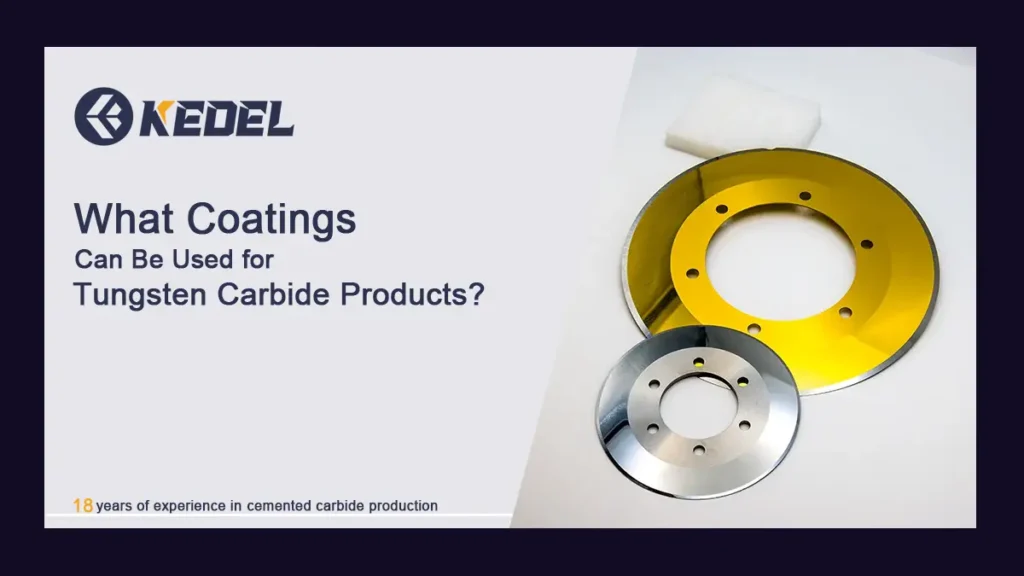
Tungsten carbide is already known for its hardness and wear resistance, but in many industrial scenarios—like high-temperature machining, corrosive environments, or low-friction applications—it still needs an extra boost. Coatings are the solution: they enhance specific properties of tungsten carbide without changing its core strength. The right coating can extend a tungsten carbide product’s lifespan by 2–5 times, improve its performance, and open up new uses (e.g., machining hard metals or working in seawater). But with so many coatings available, how do you choose? This article breaks down the most common coatings for tungsten carbide, their key benefits, ideal applications, and how to pick the right one for your needs. All content is based on real industrial practice, with simple explanations and actionable insights.
1. First: Why Coat Tungsten Carbide?
Before diving into specific coatings, let’s clarify why tungsten carbide needs coatings. Even though it’s hard, it has limitations:
- Oxidation at high temperatures: Above 500°C (932°F), uncoated tungsten carbide reacts with oxygen, forming a brittle oxide layer that peels off and reduces wear resistance.
- High friction: In sliding or rotating parts (e.g., seals, bearings), uncoated tungsten carbide creates friction that wastes energy and accelerates wear.
- Corrosion in harsh environments: Cobalt-bonded tungsten carbide (the most common type) can rust or erode in seawater, chemicals, or humid conditions.
- Built-up edge (BUE) in machining: When cutting soft metals (e.g., aluminum), metal chips stick to the tungsten carbide tool tip, ruining cut quality.
Coatings fix these issues by adding a thin, protective layer (usually 2–10 micrometers thick) that targets specific weaknesses—without compromising tungsten carbide’s inherent hardness.
2. 5 Most Common Coatings for Tungsten Carbide Products
Not all coatings work the same way. Below are the most widely used options in industry, organized by their core purpose (e.g., heat resistance, corrosion resistance). Each includes key details to help you match it to your application.
| Coating Type | Main Composition | Core Benefits | Ideal Applications | Key Notes |
|---|---|---|---|---|
| Titanium Nitride (TiN) | Titanium + Nitrogen | 1. Boosts wear resistance by 30–50% 2. Reduces friction (lower than uncoated WC) 3. Bright gold color (easy to identify) |
General-purpose cutting tools (drills, lathe inserts) for machining steel, cast iron, or wood; tungsten carbide watch cases (scratch resistance + aesthetics). | Not ideal for high temperatures (>500°C) or corrosive environments. |
| Titanium Aluminum Nitride (TiAlN) | Titanium + Aluminum + Nitrogen | 1. Excellent high-temperature resistance (up to 800°C/1472°F) 2. Resists oxidation better than TiN 3. Reduces BUE in machining |
High-speed cutting tools (milling inserts, end mills) for hard metals (e.g., stainless steel, alloy steel); tungsten carbide parts in high-heat equipment (e.g., furnace components). | The most popular coating for modern machining tools—versatile and durable. |
| Chromium Nitride (CrN) | Chromium + Nitrogen | 1. Superior corrosion resistance (works in seawater, chemicals) 2. Low friction (ideal for sliding parts) 3. Resists temperature up to 700°C/1292°F |
Tungsten carbide seals, bearings, or pump parts in marine/chemical environments; cutting tools for aluminum (reduces BUE). | More corrosion-resistant than TiN/TiAlN but slightly less wear-resistant. |
| Diamond-Like Carbon (DLC) | Carbon (amorphous structure) | 1. Ultra-low friction (similar to diamond) 2. High wear resistance (harder than TiN) 3. Non-toxic (safe for medical/ food contact) |
Tungsten carbide medical tools (e.g., dental drills), precision seals (e.g., in fuel injectors), or parts in food processing equipment (no contamination). | Not suitable for high temperatures (>400°C)—can decompose into carbon. |
| Aluminum Chromium Nitride (AlCrN) | Aluminum + Chromium + Nitrogen | 1. Extreme high-temperature resistance (up to 900°C/1652°F) 2. Better oxidation resistance than TiAlN 3. High hardness (Mohs 9.5) |
Tungsten carbide tools for ultra-high-speed machining (e.g., aerospace alloy cutting); parts in high-heat industrial furnaces. | More expensive than TiAlN but worth it for extreme heat scenarios. |
3. How to Choose the Right Coating: 4 Key Questions
With multiple coatings available, the key is to match the coating’s strengths to your product’s specific use case. Ask these four questions to narrow down your choice:
3.1 What’s the main challenge your tungsten carbide part faces?
- Wear from friction (e.g., cutting, grinding): Choose TiN or DLC (high wear resistance).
- High temperatures (e.g., high-speed machining): Choose TiAlN or AlCrN (heat/oxidation resistance).
- Corrosion (e.g., seawater, chemicals): Choose CrN (best corrosion protection).
- Low friction (e.g., seals, bearings): Choose DLC or CrN (lowest friction coefficients).
3.2 What’s the maximum temperature the part will encounter?
- <400°C: DLC, TiN
- 400–800°C: TiAlN, CrN
-
800°C: AlCrN (only option for extreme heat)
3.3 What material is the part interacting with?
- Machining steel/cast iron: TiN (cost-effective) or TiAlN (high-speed).
- Machining aluminum/soft metals: CrN or DLC (reduces BUE).
- Contact with seawater/chemicals: CrN (corrosion-resistant).
- Contact with food/medical devices: DLC (non-toxic, non-contaminating).
3.4 What’s your budget?
Coatings vary in cost—balance performance and price:
- Budget-friendly: TiN (cheapest, good for general use).
- Mid-range: TiAlN, CrN (versatile, cost-effective for most industrial needs).
- Premium: DLC, AlCrN (for specialized scenarios like medical or extreme heat).
4. Common Myths About Tungsten Carbide Coatings (Busted)
Even experienced professionals make mistakes when choosing coatings. Here are the most frequent myths, and why they’re wrong:
Myth 1: “The thicker the coating, the better.”
Fact: Thicker coatings (over 10 micrometers) don’t improve performance—they can crack or peel off under impact. Most industrial coatings are 2–5 micrometers thick: thin enough to flex with the tungsten carbide base, thick enough to protect it.
Myth 2: “One coating works for all tungsten carbide products.”
Fact: A coating that’s great for cutting tools (e.g., TiAlN) will fail in seawater (no corrosion resistance). Always match the coating to the part’s specific challenge (heat, corrosion, friction)—there’s no “one-size-fits-all.”
Myth 3: “Coatings replace the need for high-quality tungsten carbide.”
Fact: Coatings enhance good tungsten carbide—they can’t fix low-quality material. A porous or poorly sintered tungsten carbide part will still fail, even with a top coating. Always start with a high-grade tungsten carbide base.
Myth 4: “Uncoated tungsten carbide is always cheaper in the long run.”
Fact: Uncoated parts wear out faster and need frequent replacement. A coated tungsten carbide tool may cost 20–30% more upfront, but it lasts 2–5 times longer—saving money on labor and downtime for replacements.
5. How Coatings Are Applied to Tungsten Carbide
You don’t need to know the technical details of coating application, but understanding the basics helps you work with suppliers. The most common methods for tungsten carbide are:
- Physical Vapor Deposition (PVD): The most popular method. It uses high vacuum and low temperature (300–500°C) to deposit coating atoms onto the tungsten carbide surface. PVD coatings (e.g., TiN, TiAlN) are thin, uniform, and bond well to tungsten carbide.
- Chemical Vapor Deposition (CVD): Uses high temperature (800–1000°C) and chemical reactions to form a coating. CVD coatings are thicker and more wear-resistant than PVD, but the high heat can weaken some tungsten carbide grades. It’s often used for AlCrN or thick TiN coatings.
- Thermal Spraying: Rarely used for precision parts (e.g., tools) but common for large wear parts (e.g., mining liners). It melts coating material and sprays it onto the tungsten carbide surface—good for thick, rough coatings.
6. Final Thought: Coatings Are a “Performance Boost,” Not a Fix
Tungsten carbide’s strength lies in its inherent hardness, but coatings turn “good” parts into “great” ones. The right coating can let your tungsten carbide tools machine harder metals, your seals last in seawater, and your high-heat parts resist oxidation—all while cutting replacement costs.
The key is to stop thinking “what coating is best” and start thinking “what does my part need?” If you’re unsure (e.g., a new tool design or a part for a harsh environment), work with a supplier who can test coatings for your specific scenario.