

In the corrugated paper processing chain, slitting is a critical link connecting "raw paper rolls" to "finished cardboard/cartons." It involves cutting large corrugated paper rolls into specified widths or lengths based on downstream needs (e.g., carton dimensions, packaging specifications). However, different scenarios have vastly different requirements for slitting efficiency, precision, and cost, leading to distinct slitting methods. Currently, the mainstream slitting methods for corrugated paper in industry are three types: circular knife slitting (including upper-lower knife pinch slitting and single circular knife slitting), flat knife slitting, and laser slitting. Each method differs in principle, equipment structure, and application scenarios—for example, high-speed mass production prioritizes circular knife slitting, small-batch precision cutting suits laser slitting, and low-cost simple processing uses flat knife slitting. This article breaks down the core logic, operational characteristics, pros and cons, and selection advice for each method, helping you quickly match the most suitable solution to your needs.
1. Circular Knife Slitting: The Mainstream Choice for High-Speed Mass Production
Circular knife slitting is the most widely used method in the corrugated paper industry. It relies on rotating circular blades for "continuous cutting" and is ideal for high-speed slitting of large paper rolls into narrow strips (for carton production). It is divided into two subtypes—upper-lower knife pinch slitting and single circular knife slitting—with the former being the first choice for mass production.
1.1 Upper-Lower Knife Pinch Slitting (Most Common)
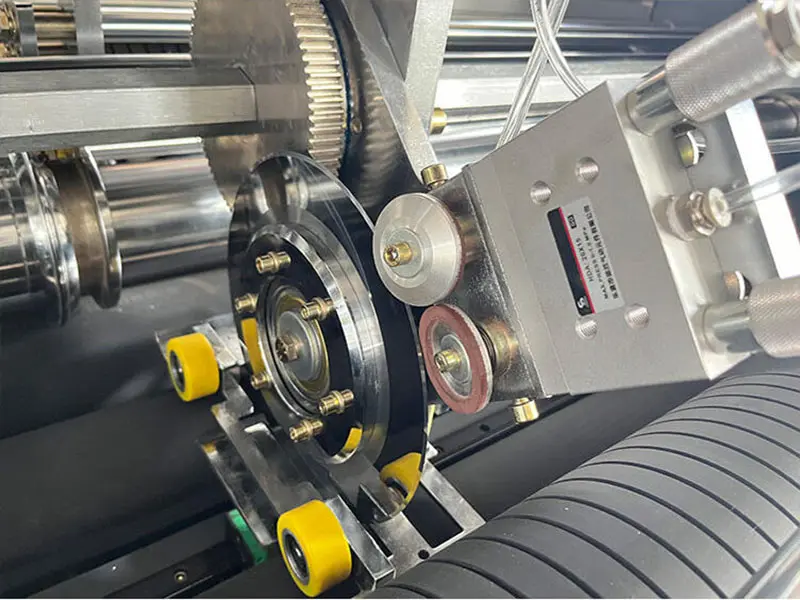
- Slitting Principle: Cooperates with an "upper knife (actively rotating circular cutting blade)" and a "lower knife (fixed or passively rotating circular grooved/flat blade)". When the upper knife presses down, it cuts into the corrugated paper, while the lower knife supports from below and assists in cutting, forming a "pinch cutting" effect (similar to scissors but with continuously rotating blades).
- Key Parameters:
- Slitting speed: 200–300 meters per minute (suitable for high-speed mass production);
- Cutting precision: width tolerance of ±0.1–0.3mm;
- Blade material: The upper knife preferably uses tungsten carbide (WC-Co type, high hardness and wear resistance, service life of 800–1200 hours); the lower knife can use tungsten carbide or high-strength alloy (e.g., Cr12MoV, focusing on toughness).
- Suitable Scenarios:
- Mass slitting of corrugated paper into strips (e.g., cutting raw paper rolls into narrow rolls for carton production);
- Slitting of multi-layer corrugated paper (3-layer, 5-layer), especially when protecting the corrugated core structure (lower knife support prevents flute collapse).
- Pros & Cons:
- Pros: Fast speed and high efficiency; flat, burr-free cuts; protects the corrugated structure without affecting subsequent compressive strength;
- Cons: High initial equipment investment (requires supporting servo motors to control blade synchronization); needs regular adjustment of upper-lower knife gap (to avoid wear or poor cutting).
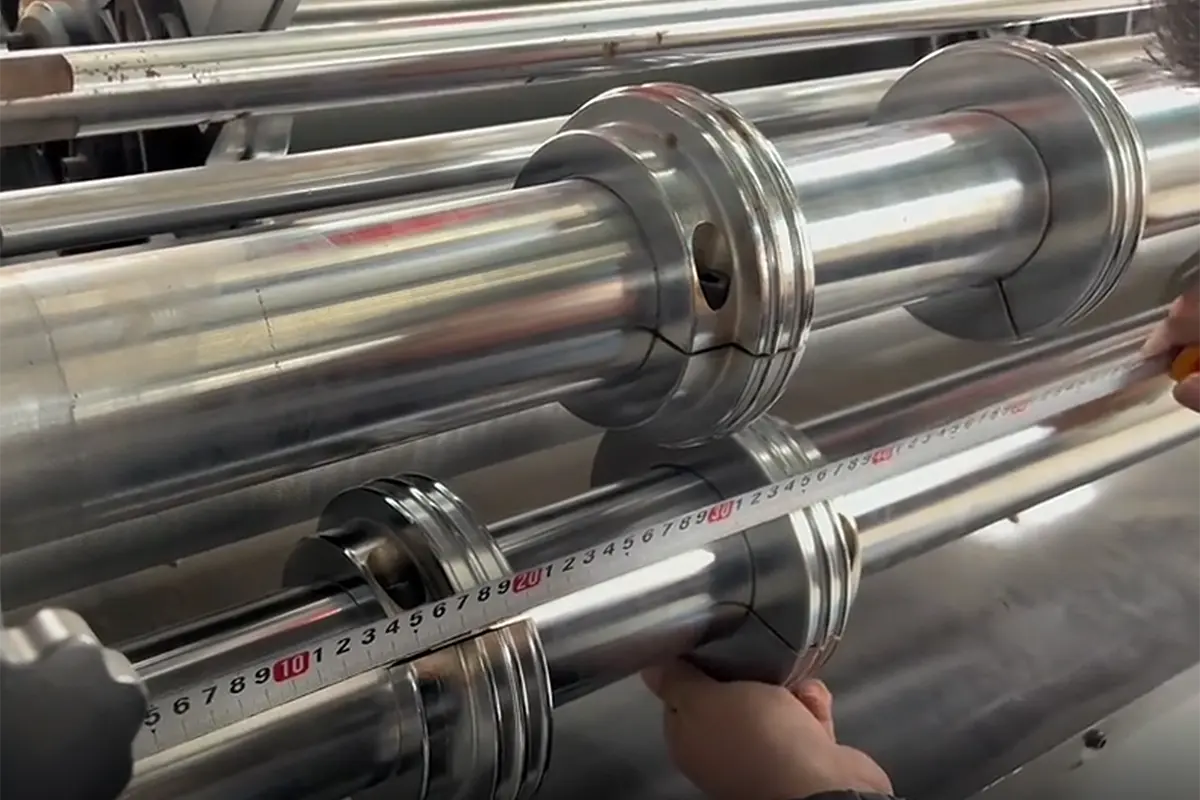
1.2 Single Circular Knife Slitting (Simplified Version)
- Slitting Principle: Uses only one actively rotating circular blade, with a fixed "anvil" (e.g., rubber plate, metal plate) below. The blade presses down to directly cut the corrugated paper (similar to a circular blade cutting paper).
- Key Parameters:
- Slitting speed: 80–150 meters per minute (lower than upper-lower knife pinch slitting);
- Cutting precision: width tolerance of ±0.3–0.5mm;
- Blade material: Mostly tungsten carbide blades (require frequent grinding, service life of 400–600 hours); the anvil needs regular replacement (to avoid affecting cuts after wear).
- Suitable Scenarios:
- Small-batch, low-precision slitting (e.g., temporary cutting of small samples);
- Slitting of single-layer or thin corrugated paper (2-layer) (thick paper is prone to burrs).
- Pros & Cons:
- Pros: Simple equipment structure and low cost; easy to operate without complex parameter adjustment;
- Cons: Slow speed, not suitable for mass production; thick paper slitting easily collapses corrugated cores; frequent anvil replacement due to fast wear.
2. Flat Knife Slitting: A Low-Cost Simple Cutting Solution
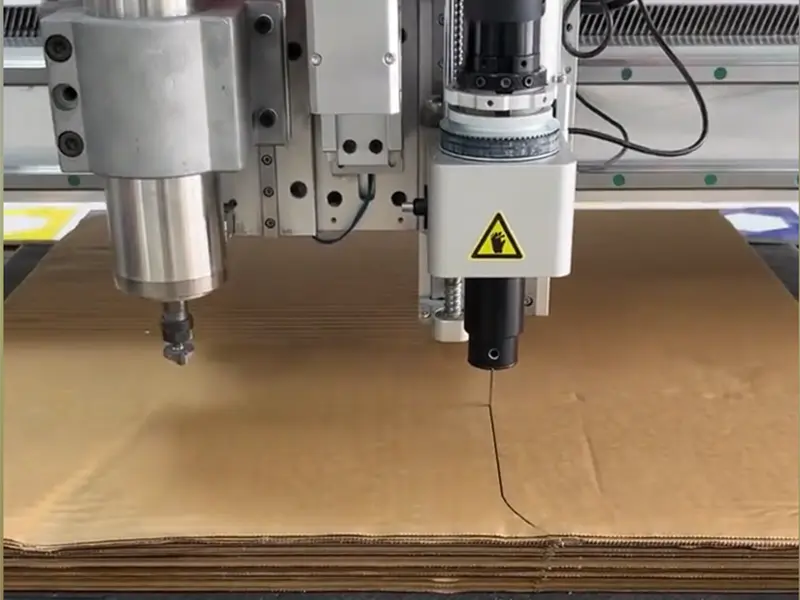
Flat knife slitting (also called "die cutting") relies on "fixed flat blades" for "intermittent cutting." It is more suitable for cutting corrugated paper into specified lengths or irregular shapes (rather than strips) and is common in small-batch or customized processing scenarios.
2.1 Slitting Principle
- The blade is a rectangular flat edge (like an enlarged utility knife blade) fixed on a knife holder. After the corrugated paper is conveyed to the cutting position via a conveyor belt, the knife holder presses down to cut or punch the paper into the specified shape (e.g., rectangular cardboard, expanded view of irregular cartons). After cutting, the blade lifts, and the paper continues to be conveyed, forming an "intermittent" operation.
- For irregular cutting (e.g., circles, trapezoids), the flat knife can be made into a corresponding die shape (i.e., "flat knife die cutting").
2.2 Key Parameters
- Slitting speed: 30–80 sheets per minute (calculated by single sheets, not suitable for continuous rolls);
- Cutting precision: length tolerance of ±0.2–0.5mm;
- Blade material: High-speed steel (HSS) for general scenarios; tungsten carbide-coated flat blades for high wear resistance (service life 3–5 times longer than HSS).
2.3 Suitable Scenarios
- Small-batch corrugated paper cutting (e.g., customized cartons, sample production);
- Cutting corrugated paper into single sheets (not strips) or irregular shapes (e.g., gift boxes, cushioning liners);
- Combined with die-cutting plates to complete cutting and creasing simultaneously (facilitating subsequent box folding).
2.4 Pros & Cons
- Pros: Low equipment cost (simple flat knife machines cost only a few thousand yuan); can cut irregular shapes with high flexibility; easy to operate without professional skills;
- Cons: Slow speed, not suitable for continuous roll slitting; thick corrugated paper (5-layer or more) is difficult to cut; flat knives need regular sharpening (HSS blades require sharpening every 2000 sheets).
3. Laser Slitting: A High-End Solution for Precision Cutting
Laser slitting uses "high-energy laser beams" for "non-contact cutting." Its core advantage is high precision and no mechanical stress, making it suitable for scenarios requiring extremely high cut quality and precision. However, its high cost limits its application in the corrugated paper industry (mostly for high-end customization).
3.1 Slitting Principle
- A CO₂ laser generator produces a laser beam with a wavelength of 10.6μm. After focusing, the beam irradiates the corrugated paper surface. The laser energy instantly heats the paper, vaporizing or burning the irradiated fibers to form a cut. By controlling the laser beam’s movement path (e.g., with a CNC system), strip slitting, length cutting, or irregular shape cutting can be achieved.
3.2 Key Parameters
- Slitting speed: 50–150 meters per minute (for strip slitting); 20–50 sheets per minute (for single-sheet precision cutting);
- Cutting precision: width/length tolerance of ±0.05–0.1mm (higher than mechanical slitting);
- Cut quality: Burr-free, no indentation; no damage to the corrugated core structure (non-contact cutting avoids flute collapse).
3.3 Suitable Scenarios
- High-precision corrugated paper slitting (e.g., narrow-width corrugated paper for electronic packaging);
- Slitting of ultra-thin or ultra-thick corrugated paper (mechanical blades easily damage thin paper or fail to cut thick paper, while lasers adapt to all thicknesses);
- Precision irregular cutting (e.g., micro-corrugated paper parts, complex-shaped cushioning materials).
3.4 Pros & Cons
- Pros: Extremely high precision; high-quality cuts without burrs; no mechanical wear, eliminating blade replacement; flexible for irregular shapes;
- Cons: High initial equipment cost (500,000–2,000,000 yuan); high operating costs (laser tubes need regular replacement); requires supporting smoke exhaust equipment (to avoid environmental pollution from paper combustion).
4. Comparison of 3 Slitting Methods: Quick Selection Table
To intuitively match needs, the table below compares the three mainstream slitting methods across core indicators, application scenarios, and costs:
| Comparison Dimension | Circular Knife Slitting (Upper-Lower Pinch) | Flat Knife Slitting | Laser Slitting |
|---|---|---|---|
| Slitting Speed | 200–300 m/min (Fastest) | 30–80 sheets/min (Slowest) | 50–150 m/min (Medium) |
| Cutting Precision | ±0.1–0.3mm (Medium-High) | ±0.2–0.5mm (Medium-Low) | ±0.05–0.1mm (Highest) |
| Suitable Form | Roll-to-strip slitting (Mainstream) | Single-sheet cutting/irregular die cutting | Roll-to-strip/single-sheet precision cutting |
| Suitable Corrugated Layers | 3–7 layers (Adapts to multi-layers) | 1–5 layers (Difficult for thick layers) | 1–7 layers (No layer limit) |
| Blade Cost | Medium (Long-life tungsten carbide blades) | Low (Fast-wearing HSS blades) | High (Expensive laser tube replacement) |
| Initial Equipment Investment | Medium (100,000–500,000 yuan) | Low (5,000–50,000 yuan) | High (500,000–2,000,000 yuan) |
| Core Advantage | High-speed mass production, corrugation protection | Low cost, flexible irregular cutting | High precision, non-contact no indentation |
| Core Disadvantage | Complex equipment parameter adjustment | Slow speed, not for mass production | High cost, needs smoke exhaust |
5. Clarifying Common Myths: Avoid Slitting Method Selection Mistakes
Myth 1: "Faster speed is always better—prioritize circular knife slitting."
Fact: Speed must match needs. For small-batch customization (e.g., cutting 100 irregular cardboard sheets daily), circular knife slitting is less efficient due to long equipment setup time (blade installation, gap adjustment); flat knife slitting is more flexible. Only for large-batch roll-to-strip slitting (e.g., cutting over 100,000 meters daily) does circular knife slitting’s speed advantage become obvious.
Myth 2: "Laser slitting has high precision—suitable for all scenarios."
Fact: Laser slitting’s high cost requires matching high-value scenarios. For ordinary carton production (tolerance ±0.3mm is sufficient), laser slitting doubles costs unnecessarily. It is only worthwhile to invest in laser equipment for high-precision products (e.g., corrugated paper for electronic packaging) or special materials (e.g., ultra-thin corrugated paper).
Myth 3: "Flat knife slitting can only cut single sheets, not strips."
Fact: Flat knife slitting can also achieve simple strip cutting with a "multi-knife die holder" (installing multiple flat knives side by side). The roll is continuously conveyed via a belt, and the blades press down intermittently to slit. However, this method is slow (≤50 m/min) and low-precision (tolerance ±0.5mm), suitable only for small-batch strip slitting (e.g., cutting less than 1,000 meters daily)—far less efficient than circular knife slitting.
6. Conclusion: Slitting Method Selection Logic—"Needs First, Cost Matching"
To select a corrugated paper slitting method, focus on clarifying three core questions:
- Production Demand: Choose "circular knife slitting (upper-lower pinch)" for large-batch roll-to-strip slitting; choose "flat knife slitting" for small-batch single-sheet/irregular cutting.
- Precision Requirement: Choose circular knives for ordinary cartons (±0.3mm); choose lasers for high-precision scenarios (±0.1mm); choose flat knives for low-cost, low-precision needs.
- Cost Budget: Choose flat knives for limited initial budgets (≤50,000 yuan); choose circular knives for medium budgets (100,000–500,000 yuan); choose lasers for high budgets with high-precision needs (≥500,000 yuan).
For tungsten carbide industry professionals, it is critical to note that different slitting methods correspond to different tool needs: Circular knife slitting is a core scenario for tungsten carbide tools (both upper and lower knives require high wear resistance); flat knife slitting can recommend tungsten carbide-coated blades (to extend service life); laser slitting requires no mechanical blades (clarify customer needs in advance to avoid incorrect tool recommendations).
If your enterprise faces issues like low slitting efficiency or poor cut quality, or is unsure which slitting method fits your current production capacity, feel free to reach out. We can recommend the appropriate slitting method and matching tungsten carbide tool solution based on your production volume, precision requirements, and budget.