
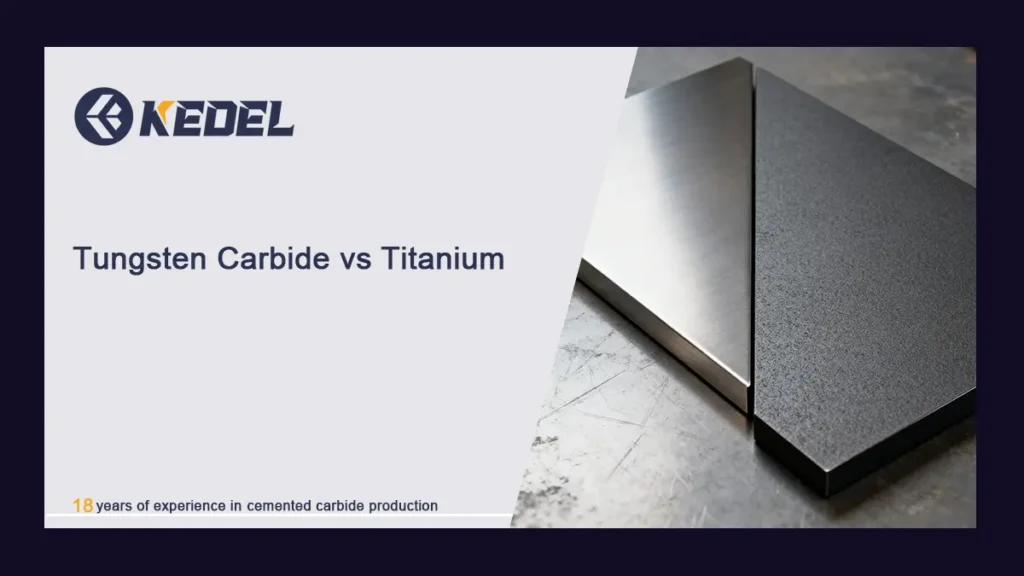
In industrial manufacturing, two materials often stand out for their unique strengths: tungsten carbide and titanium. But when should you choose one over the other? Are they interchangeable, or do their differences make them better suited for specific jobs? Tungsten carbide (a composite of tungsten carbide particles and metal binders like cobalt) and titanium (a lightweight metal, often used in alloys) excel in different areas: tungsten carbide is prized for extreme hardness and wear resistance, while titanium shines with its strength-to-weight ratio and corrosion resistance. This article breaks down their key properties, real-world applications, pros and cons, and how to decide which fits your needs. Whether you’re selecting materials for tools, machinery parts, or industrial components, this comparison will help you make informed choices.
1. First: What Are Tungsten Carbide and Titanium?
Before diving into comparisons, let’s clarify what each material is—their composition and basic structure shape their performance.
-
Tungsten carbide: A composite material, not a pure metal. It’s made by bonding tiny tungsten carbide (WC) crystals (extremely hard) with a metal binder (usually cobalt, sometimes nickel) through high-heat sintering. This combination creates a material that’s both hard (from WC) and tough (from the binder). Most industrial tungsten carbide products contain 90–95% WC and 5–10% binder.
-
Titanium: A pure metal (chemical symbol: Ti) with a low density and high strength. In industry, it’s rarely used in its pure form—instead, it’s mixed with other metals (like aluminum, vanadium) to form titanium alloys, which boost its strength and heat resistance. Common alloys include Ti-6Al-4V (6% aluminum, 4% vanadium), widely used in aerospace and medical fields.
2. Key Property Comparison: Tungsten Carbide vs Titanium
The biggest differences between these materials lie in their physical and mechanical properties. Here’s a side-by-side breakdown of the traits that matter most in industrial settings:
| Property | Tungsten Carbide | Titanium (Alloys, e.g., Ti-6Al-4V) | Practical Impact |
|---|---|---|---|
| Hardness (Mohs Scale) | 8.5–9 | 6–6.5 | Tungsten carbide is far harder—resists scratching and wear 5–10x better than titanium. |
| Density (g/cm³) | 14–15 | 4.43 | Titanium is ~3x lighter—critical for applications where weight matters (e.g., aerospace). |
| Tensile Strength (MPa) | 1,000–3,000 (varies by binder) | 900–1,200 | Both are strong, but titanium’s strength at low weight makes it ideal for load-bearing parts. |
| Wear Resistance | Excellent | Moderate | Tungsten carbide lasts longer in abrasive environments (e.g., mining, cutting). |
| Corrosion Resistance | Good (nickel-bonded > cobalt) | Excellent | Titanium resists rust, acids, and seawater better—no coating needed for wet/chemical settings. |
| Heat Resistance | Retains hardness up to 500–800°C | Retains strength up to 300–400°C | Tungsten carbide handles higher temperatures (e.g., cutting tools), while titanium softens faster under heat. |
| Toughness (Impact Resistance) | Moderate (brittle if binder is low) | High | Titanium bends or absorbs impacts without breaking; tungsten carbide may crack under heavy shock. |
3. Real-World Applications: Where Each Material Shines
Their unique properties make tungsten carbide and titanium irreplaceable in specific industries. Here’s where you’ll find each in action:
3.1 Tungsten Carbide Applications
Tungsten carbide’s hardness and wear resistance make it ideal for jobs involving friction, abrasion, or cutting:
- Cutting tools: Drill bits, lathe inserts, and saw blades for machining metal, wood, or stone. It stays sharp 10–20x longer than steel tools.
- Wear parts: Mining liners (to handle gritty ore), conveyor belt scrapers, and pump seals (resist wear from flowing liquids).
- Precision components: Nozzles for 3D printing (abrasion from metal powders) and valve seats in heavy machinery (high pressure + friction).

3.2 Titanium Applications
Titanium’s light weight, strength, and corrosion resistance make it perfect for industries where weight savings and durability in harsh environments matter:
- Aerospace: Aircraft frames, engine parts, and fasteners—reduces overall weight to save fuel.
- Medical: Implants (hip joints, bone plates) because it’s biocompatible (body doesn’t reject it) and resists corrosion from bodily fluids.
- Marine: Boat propellers, hull components, and underwater pipes—stands up to saltwater without rusting.
- Sports equipment: Bicycle frames, golf club heads, and tennis rackets—strong but light for better performance.
4. Pros and Cons: When to Choose (or Avoid) Each Material
No material is perfect. Understanding their limitations helps avoid costly mistakes:
4.1 Tungsten Carbide: Pros and Cons
-
Pros:
- Unmatched wear resistance—lasts years in abrasive environments.
- High hardness maintains shape under pressure (critical for precision tools).
- Handles high temperatures better than most metals (good for cutting tools).
-
Cons:
- Heavy (high density)—not ideal for weight-sensitive applications (e.g., aerospace).
- Brittle compared to titanium—can crack under sudden impacts (e.g., dropping a tungsten carbide tool).
- More expensive upfront than steel, though lower long-term costs due to durability.
4.2 Titanium: Pros and Cons
-
Pros:
- Lightweight (1/3 the density of steel)—reduces energy use in moving parts (e.g., aircraft, vehicles).
- Excellent corrosion resistance—no need for coatings in wet or chemical environments.
- High toughness—bends or deforms instead of breaking under shock (good for structural parts).
-
Cons:
- Poor wear resistance—scratches easily; not suitable for cutting or abrasive jobs.
- Lower hardness means it can’t hold sharp edges (won’t work as cutting tools).
- More expensive than steel (though cheaper than tungsten carbide in some forms).
5. How to Choose: 3 Key Questions to Ask
Deciding between tungsten carbide and titanium depends on your specific needs. Ask these questions to narrow it down:
-
Does the part need to resist wear or abrasion?
- If yes: Choose tungsten carbide (e.g., mining tools, cutting blades).
- If no: Titanium may work (e.g., structural brackets, medical implants).
-
Is weight a critical factor?
- If yes (e.g., aerospace, sports gear): Titanium is better (3x lighter than tungsten carbide).
- If no (e.g., stationary machinery parts): Tungsten carbide’s weight isn’t a drawback.
-
Will the part face corrosion or high heat?
- Corrosion (seawater, chemicals): Titanium wins—no rust or degradation.
- High heat (cutting, high-speed machining): Tungsten carbide retains hardness better.
6. Common Myths: Busting Misconceptions
-
Myth: “Titanium is harder than tungsten carbide.”
Fact: No—tungsten carbide (Mohs 8.5–9) is much harder than titanium (Mohs 6–6.5). Titanium is strong but not hard, which is why it scratches easily. -
Myth: “Tungsten carbide is always better for industrial parts.”
Fact: It depends on the job. For lightweight structural parts or corrosion-prone environments, titanium is superior. Tungsten carbide only shines in wear-heavy roles.
7. Final Thought: They’re Complementary, Not Competitive
Tungsten carbide and titanium aren’t rivals—they solve different problems. Tungsten carbide is the go-to for wear, hardness, and heat resistance; titanium excels in lightweight, corrosion-resistant, and impact-absorbing applications.
The best approach is to match the material to the job: use tungsten carbide for cutting tools and wear parts, and titanium for aerospace components, medical implants, or marine hardware.
If you’re still unsure which fits your specific part (e.g., a new machine component or tool design), feel free to reach out. We can help analyze your needs (wear, weight, environment) and recommend the right material.