
I. Core Definition and Function of Brazing
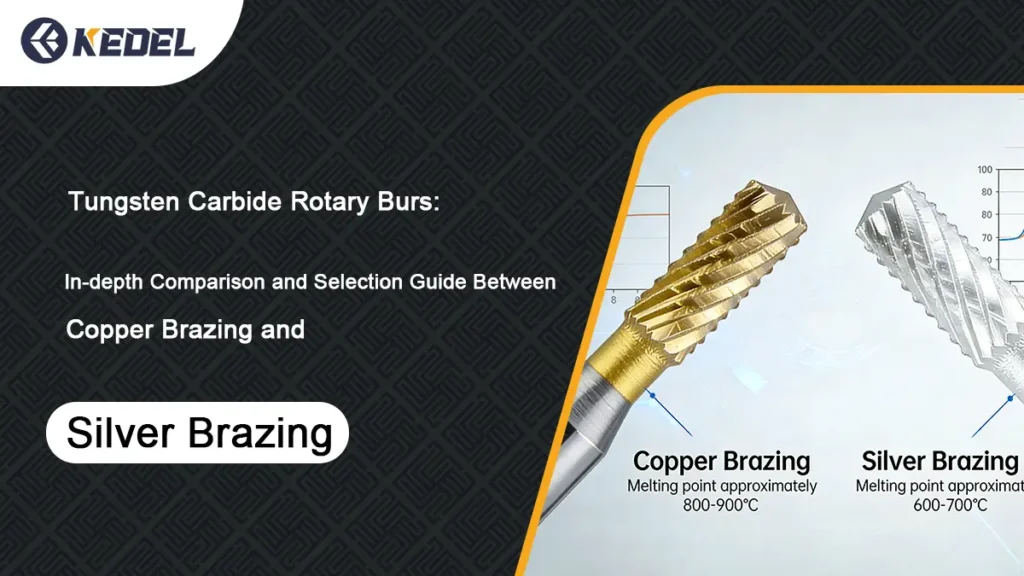
Tungsten carbide rotary burs consist of a tungsten carbide cutting head (responsible for cutting and grinding) and a steel shank (facilitating equipment installation). Brazing is the key process for connecting these two parts, with two mainstream types: copper brazing and silver brazing.
During operation, rotary burs need to run at high speed (tens of thousands of revolutions per minute) and grind hard metals. Brazing can combine the high hardness of tungsten carbide with the toughness of steel, preventing the cutting head from falling off and ensuring operational safety and efficiency.
II. Core Parameter Comparison Table of Copper Brazing and Silver Brazing
| Comparison Dimension | Copper Brazing | Silver Brazing |
|---|---|---|
| Brazing Temperature | Ultra-high (≈1083℃) | Low to medium (≈650-800℃) |
| Bond Strength | Extremely High | Good |
| Shock Resistance/Toughness | Average | Excellent |
| Heat Resistance | Excellent (no softening during continuous operation) | Average (prone to softening during continuous operation) |
| Production Process | Batch vacuum furnace brazing | Induction heating/flame brazing |
| Weld Appearance | Copper color, clean and free of impurities | Silver white, requires residue cleaning |
| Material Cost | Low (economical copper material) | High (silver is a precious metal) |
| Application Scenarios | Factory batch production, heavy-duty/prolonged grinding | Manual precision grinding, micro burs, small-batch production |
III. Core Characteristics of the Two Processes
1. Copper Brazing
- Advantages: Strong bonding, excellent heat resistance, good consistency in batch production, no need for subsequent weld cleaning;
- Limitations: Requires special vacuum furnace equipment, high temperature may affect the hardness of the steel shank (avoidable by subsequent processing from regular manufacturers).
2. Silver Brazing
- Advantages: Low brazing temperature, no easy damage to materials, good shock resistance, suitable for small-batch and multi-specification customization;
- Limitations: High cost, requires cleaning of flux residues after brazing.
IV. Quick Selection Method
- By Usage Intensity: Choose copper brazing for high-intensity, prolonged continuous operation; choose silver brazing for low-intensity, short-duration precision operation;
- By Tool Size: Choose copper brazing for large-size burs with shank diameter above 6mm (high torque resistance); choose silver brazing for micro burs with shank diameter below 3mm (preventing high-temperature deformation);
- By Market Demand: Prioritize copper brazing for exporting to high-end markets such as Europe and North America (good consistency and high recognition); silver brazing is optional for domestic small-batch/manual needs.
V. Key Procurement Points
- Prioritize Process Verification: Confirm vacuum furnace brazing for copper-brazed products and post-brazing cleaning for silver-brazed products;
- Check Weld Appearance: Copper-brazed welds are clean and copper-colored; silver-brazed welds are silver-white and free of residues;
- Customization on Demand: For special specifications or grinding scenarios (such as stainless steel, hardened steel), select manufacturers that can match the process and cutting head shape;
- Batch Procurement Suggestion: Prioritize copper brazing for factory use, featuring higher cost performance and stable quality.
VI. Summary
Copper brazing is suitable for industrial-grade batch and high-intensity grinding, with outstanding cost performance and stability; silver brazing is suitable for manual precision operation and small-batch production, offering better material protection.
Selecting the right brazing process can extend tool life and improve efficiency. For specific application scenarios, customized solutions can be further matched.