
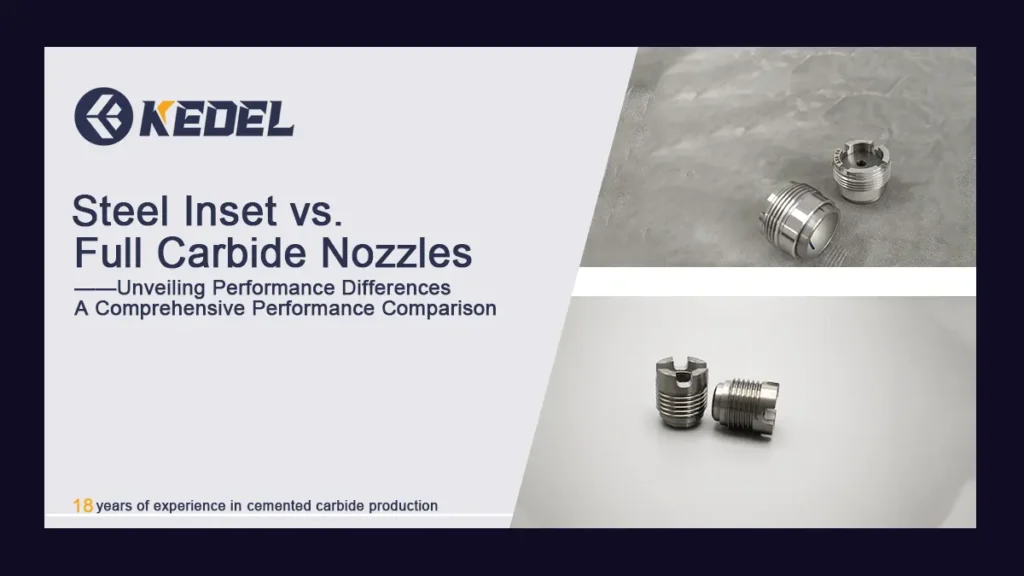
When selecting nozzles, steel-inserted nozzles (steel base + tungsten carbide functional areas) and solid tungsten carbide nozzles (entirely made of WC-Co cemented carbide) are two mainstream options. However, many professionals struggle with the choice: "Should I pick the more expensive solid tungsten carbide or the cost-effective steel-inserted?" In reality, neither is absolutely "better"—they are "scenario-specific solutions": Solid tungsten carbide nozzles, with their overall high wear resistance, excel in high-wear, low-impact precision scenarios. Steel-inserted nozzles, combining the toughness of a steel base with the wear resistance of localized tungsten carbide, are ideal for high-impact, medium-wear complex scenarios. This article comprehensively compares the two types from four dimensions—basic definitions, core performance, applicable scenarios, and common misconceptions—to help you select the right nozzle for your specific working conditions.
1. First, Clarify: Basic Definitions and Structural Differences
To compare performance, it’s essential to understand the structural nature of both nozzles. Their different designs determine their performance priorities, avoiding selection errors due to "conceptual confusion."
1.1 Solid Tungsten Carbide Nozzles
- Structural Features: Entirely made of WC-Co cemented carbide (tungsten carbide content 85%-95%, cobalt content 5%-15%), with no other material拼接. All areas from the nozzle inlet to the outlet are tungsten carbide.
- Manufacturing Process: Formed integrally via powder metallurgy (compaction → vacuum sintering → precision grinding). Details like threads and hole diameters are machined directly on the tungsten carbide substrate.
- Core Design Logic: Maximize the wear resistance of tungsten carbide, suitable for scenarios requiring "overall wear resistance."
1.2 Steel-Inserted Nozzles
- Structural Features: Adopt a "composite structure"—the main body is a steel base (e.g., 45# steel, Cr12MoV, accounting for 70%-90%), with tungsten carbide inserts (2-5mm thick) only in "high-wear areas" (e.g., nozzle outlet, inner flow channel walls).
- Manufacturing Process: First, the steel base is machined (turned to shape). Tungsten carbide inserts are then fixed to key areas via welding (silver-copper brazing) or press-fitting, followed by overall precision grinding.
- Core Design Logic: Reduce costs and enhance toughness with a steel base, while ensuring wear resistance in critical areas with localized tungsten carbide—balancing "performance and cost."
2. Core Performance Comparison: 6 Key Dimensions, Clear Differences
Performance differences between the two nozzles focus on core dimensions like "wear resistance, impact resistance, and cost." The table below compares them from a practical industrial perspective, with key reference data:
| Performance Dimension | Solid Tungsten Carbide Nozzles | Steel-Inserted Nozzles | Reason for Differences |
|---|---|---|---|
| Wear Resistance | High (overall WC-Co, wear rate ≤0.01mm/100h) | Medium (only localized WC-Co, wear rate ≤0.03mm/100h) | Solid nozzles use high-hardness WC throughout; steel-inserted nozzles only have wear resistance in key areas, while non-carbide (steel) areas wear easily |
| Impact Resistance | Low (impact toughness 20-35J/cm², prone to chipping) | High (impact toughness 50-80J/cm², less likely to fracture) | Steel bases have far higher toughness than tungsten carbide, absorbing impact energy to prevent overall nozzle fracture |
| Material Cost | High (~¥200-300/kg, entire body uses tungsten carbide) | Low (~¥80-120/kg, tungsten carbide usage only 10%-30%) | Steel-inserted nozzles drastically reduce tungsten carbide usage; steel bases cost much less than tungsten carbide |
| Weight | Heavy (density 14-15g/cm³, 30%-50% heavier than steel-inserted of the same size) | Light (density 7-8g/cm³, close to steel density) | Tungsten carbide is ~1.8x denser than steel, making solid nozzles overall denser |
| Machining Difficulty | High (requires diamond tools; complex structures cost more) | Medium (steel base machined with ordinary lathes; only carbide areas need precision grinding) | Steel is much easier to machine than tungsten carbide, simplifying the overall process for steel-inserted nozzles |
| Corrosion Resistance | Medium (cobalt-based carbide resists weak corrosion; nickel-based needed for strong corrosion) | Low (steel base rusts easily, requiring additional anti-rust treatment) | Solid carbide resists corrosion overall; steel-inserted bases need chrome plating/painting to prevent rust, otherwise prone to corrosion |
| Service Life (Reference) | Long (80-120 hours in high-wear scenarios) | Medium (40-80 hours in high-wear scenarios) | Solid carbide’s overall wear resistance extends life by 50%-100% vs. steel-inserted in high-wear scenarios; but steel-inserted outperforms in high-impact scenarios (solid carbide chips easily) |
3. Applicable Scenarios: Core Basis for Avoiding "Wrong Choices"
Performance differences ultimately point to "scenario compatibility." Below are the applicable ranges of both nozzles, with specific case references from common industrial scenarios:
3.1 Solid Tungsten Carbide Nozzles: Suitable for "High-Wear, Low-Impact, Precision" Scenarios
- Core Adaptation Conditions: Working conditions dominated by "continuous wear," with low impact, no frequent vibration, and high requirements for nozzle precision and service life.
- Typical Scenarios:
- High-pressure spraying (e.g., automotive parts painting): Nozzle outlets endure long-term coating erosion (wear-dominated) with no severe impact. Solid tungsten carbide lasts 100 hours, reducing tool changes by 3x vs. steel-inserted.
- Oil drilling (soft formations: mudstone, sandstone): Drilling fluid contains few particles and low impact. Solid carbide flow channels resist wear, avoiding spray deviation from local wear.
- Precision grinding (e.g., glass edge grinding): Nozzles continuously spray coolant (with fine abrasive particles). Solid carbide’s overall wear resistance ensures hole diameter deviation ≤0.01mm within 6 months.
3.2 Steel-Inserted Nozzles: Suitable for "High-Impact, Medium-Wear, Cost-Sensitive" Scenarios
- Core Adaptation Conditions: Working conditions involve "frequent impact or vibration," medium wear intensity, strict cost control, and no need for overall high wear resistance.
- Typical Scenarios:
- Mining crushing (e.g., granite crushing): Nozzles spray high-pressure water to assist crushing, with frequent ore impact (impact-dominated). Steel bases resist impact, avoiding chipping. Service life is 30% longer than solid carbide.
- General sandblasting (e.g., steel structure rust removal): Sandblasting particles cause medium wear, and equipment vibrates heavily. Steel-inserted nozzles cost only 50% of solid carbide and last through a single sandblasting job (≈50 hours).
- Agricultural machinery (e.g., high-pressure spray fertilization): Working conditions involve high vibration and low corrosion. Steel-inserted nozzles’ light weight (reducing equipment load) and low cost suit bulk purchases (order quantities ≥100).
4. Clarifying Common Misconceptions: 3 "Taken-for-Granted" Errors
Misconception 1: "Solid tungsten carbide nozzles have better performance and should be chosen for all scenarios."
Fact: Solid carbide’s "superiority" only applies to wear resistance; it is反而 "less durable" in high-impact scenarios. For example, a mine used solid carbide nozzles to spray and crush granite. Due to frequent ore impact, they chipped every 3 days on average. Switching to steel-inserted nozzles, though wearing slightly faster, withstood impact, extending service life to 7 days at lower overall cost.
Misconception 2: "Steel-inserted nozzles are cheap and suitable for all cost-sensitive scenarios."
Fact: In high-wear scenarios, steel-inserted nozzles’ "low cost" is offset by "frequent replacements." For example, a spray factory chose steel-inserted nozzles to cut costs. Due to rapid outlet wear, they needed 4 replacements monthly (1 hour of downtime per change). Switching to solid carbide reduced replacements to 2 monthly, cutting downtime losses by 50%. Despite higher per-nozzle costs, total costs dropped by 20%.
Misconception 3: "Tungsten carbide inserts in steel-inserted nozzles easily fall off—poor quality."
Fact:脱落多因“工艺不达标”,正规厂家的钢嵌式喷嘴通过银铜钎焊(焊接强度≥180MPa)或过盈压合固定,正常使用下脱落率≤0.5%。例如某农业设备厂用钢嵌式喷雾喷嘴,批量使用500支,仅1支出现硬质合金脱落,且是因安装时过度用力导致,非产品本身问题。
Fact: Detachment mostly stems from "substandard craftsmanship." Reputable manufacturers fix inserts via silver-copper brazing (welding strength ≥180MPa) or interference fit, resulting in a detachment rate ≤0.5% under normal use. For example, an agricultural equipment factory used 500 steel-inserted spray nozzles; only 1 had a carbide insert detach, caused by excessive force during installation—not product defects.
5. Selection Logic: 3 Quick Steps to Avoid Indecision
No complex calculations are needed. Follow these 3 steps to choose the right nozzle, ideal for production or procurement teams:
Step 1: Identify Core Working Conditions—"Wear-Dominated" or "Impact-Dominated"?
- If wear-dominated (e.g., spraying, soft formation drilling, precision grinding): Choose solid tungsten carbide nozzles to prioritize service life.
- If impact-dominated (e.g., mining crushing, high-vibration sandblasting, agricultural machinery): Choose steel-inserted nozzles to prioritize impact resistance.
Step 2: Evaluate Cost Sensitivity—"Per-Unit Cost" or "Total Cost"?
- For high-wear + long-term use (e.g., continuous production spray lines): Calculate "total cost" (nozzle cost + downtime losses)—solid tungsten carbide is more cost-effective.
- For medium-wear + short-term use (e.g., single sandblasting projects, temporary operations): Calculate "per-unit cost"—steel-inserted is more suitable.
Step 3: Confirm Additional Requirements—Do You Need "Precision/Weight/Corrosion Resistance"?
- For high precision (e.g., precision spraying, glass grinding): Choose solid tungsten carbide (integral forming ensures higher precision).
- For lightweight design (e.g., small agricultural machinery, handheld equipment): Choose steel-inserted (30%+ lighter than solid carbide).
- For corrosion resistance (e.g., acid-alkaline sprays, seawater environments): Choose solid tungsten carbide (nickel-based carbide offers better corrosion resistance).
6. Conclusion: No "Best," Only "Most Suitable"
The choice between solid tungsten carbide and steel-inserted nozzles ultimately depends on "matching working conditions with performance": solid tungsten carbide for high-wear, low-impact, high-precision scenarios; steel-inserted for high-impact, medium-wear, cost-sensitive scenarios. For tungsten carbide industry professionals, avoid pushing "high-profit" solid carbide exclusively. Instead, first understand the customer’s "core conditions (wear/impact), usage frequency, and cost budget" before recommending a suitable solution—this is how you truly solve their problems.
If your enterprise faces issues like "rapid wear," "easy chipping," or "high costs" with nozzle selection, or is unsure which nozzle fits your scenario, feel free to reach out. We can provide customized nozzle solutions (including material, structure, and size) based on your working parameters (e.g., medium, pressure, vibration frequency).