
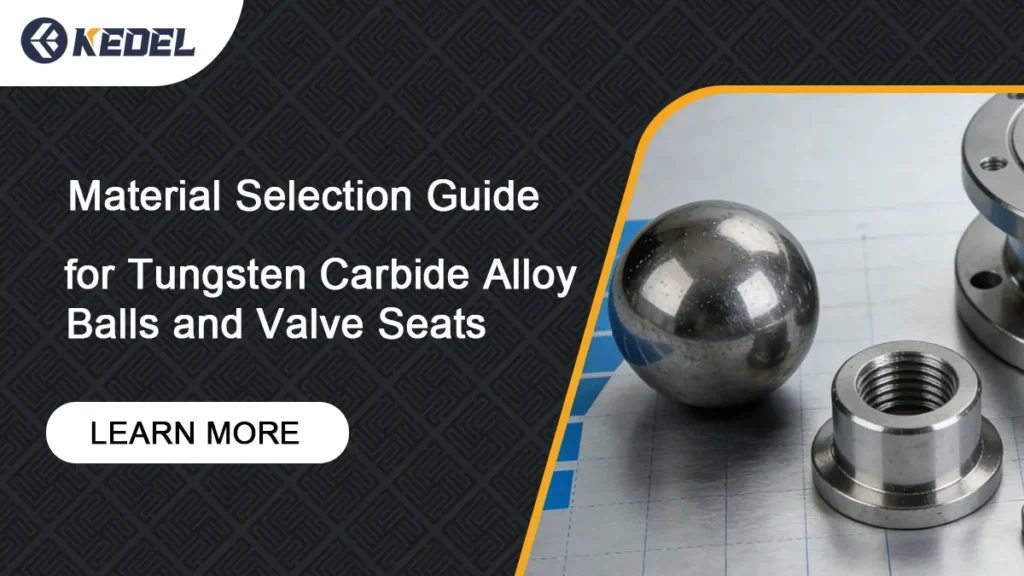
In industries like oil, natural gas, and chemical processing, tungsten carbide alloy balls and valve seats—the core sealing components of valves—act as the "heart valves" of equipment: they operate daily in harsh environments (high temperature, high pressure, heavy wear, or corrosive conditions), and choosing the right material directly determines how long the valve lasts and whether it leaks. This guide breaks down binder selection, balancing hardness and toughness, and application-specific pairing tips to help you pick the most cost-effective option that meets your performance needs.

1. First, the Core Basics: Cobalt vs. Nickel as Binder Phase?
Tungsten carbide itself is as hard as an "industrial diamond," but it can’t form a solid part on its own—it needs a metal "binder" to hold the powder particles together. So the first step in selecting balls and seats is to assess the chemical characteristics of your operating environment.
1.1 Cobalt-Based Tungsten Carbide (YG Series)
This is the most common type: cobalt bonds tightly with tungsten carbide particles, giving the alloy both high hardness and strength.
- Pros: Top-tier hardness and compressive strength; more impact-resistant than nickel-based alloys.
- Cons: Falters in acidic or highly corrosive media—cobalt tends to corrode and leach out, causing the alloy surface to become porous.
- Ideal Scenarios: Applications with pure physical wear, such as neutral oil well pumps, or standard water pipeline valves.
1.2 Nickel-Based Tungsten Carbide (YN Series)
Nickel is the more reliable choice for corrosive environments.
- Pros: Excellent resistance to acids and alkalis; stable performance in environments containing H₂S (hydrogen sulfide) or CO₂ (carbon dioxide).
- Cons: Slightly lower hardness and strength than cobalt-based alloys of the same binder ratio; marginally higher cost.
- Ideal Scenarios: Seawater pipelines, chemical acid fluid valves, or wellhead valves for high-sulfur crude oil extraction.
2. Performance Comparison of Common Materials (Industry Reference)
Note: The following data are average values for standard batches; refer to actual product test reports for specifics.
| Alloy Type | Common Grade | Binder Content (%) | Hardness (HRA) | Performance Traits |
|---|---|---|---|---|
| Cobalt-Based | YG6 | 6% | 90.5 | Ultra-high hardness; exceptional wear resistance |
| Cobalt-Based | YG8 | 8% | 89.5 | Balanced hardness and strength; handles moderate impact |
| Cobalt-Based | YG11 | 11% | 87.0 | Maximum toughness; strong impact resistance |
| Nickel-Based | YN6 | 6% | 89.5 | Good wear resistance + excellent corrosion resistance; performs well in acidic environments |
| Nickel-Based | YN9 | 9% | 88.0 | Stable all-around performance; a "jack-of-all-trades" for corrosive conditions |
3. Application-Specific Pairing Recommendations
Balls and seats work best when matched to the operating condition—here’s how to choose for common scenarios:
1. High Pressure + Sand/Grit: Prioritize Hardness
In this environment, sand acts like tiny sandpaper particles, making erosive wear the biggest threat.
- Recommendation: Choose grades with low binder content, such as YG6 or YG8.
- Why: Less binder means denser tungsten carbide particles and higher hardness—this resists scuffing from grit and prevents surface scratching.
2. Acidic Oil/Gas Wells or Chemical Fluids: Prioritize Corrosion Resistance
Corrosion is more damaging than wear in acidic media; the material must first withstand chemical attack.
- Recommendation: Opt for YN6 or YN9 directly.
- Why: Even with slightly lower hardness, nickel-based binders resist acid corrosion—unlike cobalt-based alloys, which deteriorate quickly in these conditions.
3. Frequent Valve Cycling or Severe Vibration: Boost Toughness to Prevent Chipping
Frequent opening/closing or heavy vibration causes repeated impact between the ball and seat, which can chip brittle materials.
- Recommendation: Choose grades with higher binder content, such as YG11.
- Why: More binder improves alloy toughness, reducing the risk of chipping from repeated impacts and extending service life.
4. Pro Tips to Improve Sealing Performance
Even with the right material, these small details boost sealing reliability:
- Don’t Skimp on Precision Grades: Tungsten carbide balls come in precision grades (G10, G25, G100—the smaller the number, the higher the precision). For high-pressure sealing, choose G25 or better—micron-level errors can cause leaks.
- Pair-to-Pair Lapping for a Tighter Seal: Lap the ball and seat together before installation to ensure uniform contact pressure and prevent micro-leakage.
- Avoid Mixing Materials: Use the same or similar materials for the ball and seat to prevent electrochemical corrosion (a form of "self-rusting" in corrosive environments).
Conclusion
There’s no "best" grade for tungsten carbide balls and seats—only the "right" one. For pure wear, go for the cobalt-based YG series; for corrosion challenges, stick with the nickel-based YN series; for high impact, choose higher-binder grades to boost toughness. Choosing correctly not only extends service life but also cuts down on maintenance and replacement costs.