
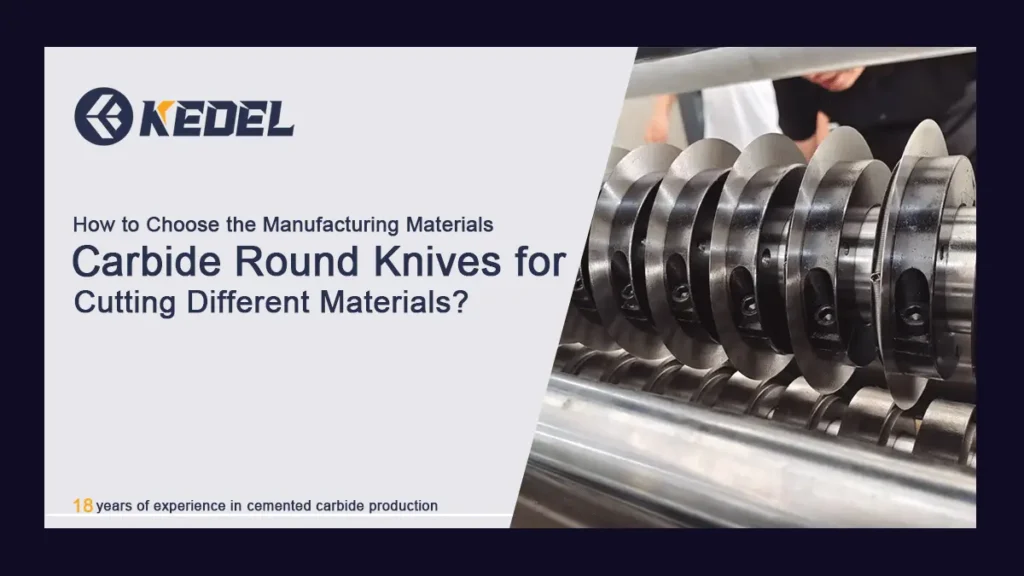
The cutting performance (such as cut flatness and efficiency) and service life of carbide circular knives depend primarily on the composition of their manufacturing materials—not just pursuing "high hardness" or "high price." Different materials to be cut (e.g., soft aluminum/copper, hard cast iron, tough plastic) vary greatly in hardness, toughness, and wear resistance. Correspondingly, the manufacturing materials of carbide circular knives (mainly the ratio of hard phase, binder phase, and additives) must be precisely matched: cutting soft materials requires prioritizing "toughness to prevent chipping," so choose coarse-grain WC with high Co content; cutting hard materials requires prioritizing "wear resistance to prevent damage," so choose fine-grain WC with low Co content; cutting corrosive materials requires replacing Co with Ni or adding anti-corrosion additives. This article starts with the core composition of carbide circular knife manufacturing materials, breaks down the logic of "selecting components based on the material to be cut," and includes specific cases and tables to help you quickly choose the right manufacturing material, avoiding the problem of "good knives failing to cut well."
1. First, Understand the Basics: Core Composition of Carbide Circular Knife Manufacturing Materials
The manufacturing material of carbide circular knives is a "composite formula," mainly composed of three parts. The selection of each part directly affects the knife’s performance, which is the basis for subsequent matching with the material to be cut:
1. Hard Phase: The Core Determinant of "Wear Resistance" (85%-95% content)
The main component is tungsten carbide (WC). In some scenarios, titanium carbide (TiC) or tantalum carbide (TaC) is added. The key parameter is "grain size":
- Coarse-grain WC (5-8μm): Slightly lower hardness (HRA 88-89) but better toughness and impact resistance, suitable for cutting soft or tough materials prone to "edge chipping" (e.g., aluminum, plastic).
- Medium-grain WC (3-5μm): Balances hardness (HRA 89-90) and toughness, suitable for cutting medium-hard materials (e.g., 45# steel, ordinary wood).
- Fine-grain WC (1-3μm): Highest hardness (HRA 90-92) and 1.5-2 times the wear resistance of coarse-grain WC, but lower toughness, suitable for cutting high-hardness, high-wear materials (e.g., cast iron, hardened steel).
- Adding TiC/TaC: TiC improves high-temperature stability (heat resistance increases from 800°C to over 900°C), suitable for materials that generate heat during cutting (e.g., stainless steel); TaC enhances impact resistance, suitable for interrupted cutting of hard materials (e.g., hardwood with knots).
2. Binder Phase: The Key Determinant of "Toughness" (5%-15% content)
Its main role is to "bond WC particles into shape." The commonly used material is cobalt (Co), and nickel (Ni) is used in some scenarios:
- Higher Co content: Better toughness (impact toughness increases from 20J/cm² to 35J/cm²), but lower wear resistance, suitable for cutting materials with impact (e.g., aluminum profiles, rubber hoses).
- Lower Co content: Better wear resistance but poorer toughness, suitable for cutting hard materials without impact (e.g., cast iron sheets, fiberglass boards).
- Ni replacing Co: Toughness is slightly lower than Co of the same content, but corrosion resistance is 3-5 times higher, suitable for cutting materials containing acids/alkalis or prone to rust (e.g., stainless steel, chemical films).
3. Additives: Supplements to Solve "Special Problems" (1%-5% content)
Added according to the special properties of the material to be cut, common types include:
- Anti-adhesion additives (e.g., Cr, Mo): Reduce "sticking" when cutting soft materials like plastic or aluminum (e.g., when cutting PVC profiles, adding Cr reduces sticking rate from 30% to 5%).
- Anti-corrosion additives (e.g., V, Nb): Enhance resistance to acids and alkalis, suitable for cutting materials containing electrolytes (e.g., waste battery casings).
- Thermal conductive additives (e.g., Cu): Improve heat dissipation, suitable for high-speed cutting of heat-generating materials (e.g., thin copper sheets, preventing edge softening due to high temperature).
2. Core Logic: Select Manufacturing Materials Based on "3 Key Properties of the Material to Be Cut"
Choosing manufacturing materials for carbide circular knives doesn’t require memorizing complex formulas. Just first judge the three core properties of the material to be cut, then match the components accordingly. The specific logic is as follows:
Step 1: Judge the "Hardness" of the Material to Be Cut—Select WC Grain Size
This is the top priority criterion, as hardness directly determines the required wear resistance of the knife:
- Soft materials (hardness HB < 100, e.g., aluminum, copper, PE plastic): Choose coarse-grain WC (5-8μm) to avoid "edge chipping" caused by excessive hardness and insufficient toughness (Example: Using coarse-grain WC for cutting aluminum profiles reduces edge chipping rate from 15% to 2%).
- Medium-hard materials (hardness HB 100-300, e.g., 45# steel, pine wood): Choose medium-grain WC (3-5μm) to balance wear resistance and toughness.
- Hard materials (hardness HB > 300 or HRC > 30, e.g., cast iron, hardened steel, hardwood): Choose fine-grain WC (1-3μm) to resist wear with high hardness (Example: Using fine-grain WC for cutting cast iron extends knife life from 50 hours to 120 hours).
Step 2: Judge the "Toughness/Impact" of the Material to Be Cut—Select Co Content
If the material to be cut is tough (easy to stretch or wrap) or cutting involves impact (e.g., interrupted cutting), the toughness of the binder phase needs to be increased:
- High-toughness/high-impact materials (e.g., rubber hoses, knotty hardwood, aluminum profiles): Choose high Co content (10%-15%). Example: Cutting knotty walnut wood with 12% Co reduces chipping rate by 80% compared to 8% Co.
- Medium-toughness/low-impact materials (e.g., steel plates, plywood): Choose medium Co content (8%-10%).
- Low-toughness/no-impact materials (e.g., fiberglass boards, cast iron sheets): Choose low Co content (5%-8%) to extend life with high wear resistance.
Step 3: Judge the "Special Properties" of the Material to Be Cut—Select Additives or Binder Substitutes
If the material to be cut has special issues like corrosion, sticking, or high temperature, solve them with additives or binder replacement:
- Corrosive materials (e.g., stainless steel 304/316, chemical films): Replace Co with Ni (binder phase) or add V/Nb anti-corrosion additives (Example: Cutting 304 stainless steel with Ni-based knives extends rust resistance life 4 times compared to Co-based knives).
- Sticky materials (e.g., PVC, PE plastic, aluminum foil): Add Cr or Mo anti-adhesion additives, or polish the edge (Ra ≤ 0.8μm).
- High-speed, heat-generating materials (e.g., thin copper sheets, titanium alloys): Add Cu thermal conductive additives or choose TiC-containing hard phases (to improve heat resistance).
3. Classified by Material to Be Cut: Recommended Manufacturing Materials for Carbide Circular Knives
For intuitive matching, the table below classifies "common types of materials to be cut" and directly provides corresponding manufacturing material formulas, core features, and applicable scenarios for reference:
| Material Type to Be Cut | Typical Examples | Recommended Manufacturing Material Formula | Core Features | Reference Service Life |
|---|---|---|---|---|
| Soft and tough materials | Aluminum profiles, copper sheets, PE plastic | Coarse-grain WC (5-8μm) + 12%-15% Co + Cr anti-adhesive | High toughness to prevent chipping; anti-sticking | Cutting aluminum profiles: 200-300 hours |
| Medium-hard common materials | 45# steel, ordinary pine, plywood | Medium-grain WC (3-5μm) + 8%-10% Co | Balances wear resistance and toughness; versatile | Cutting 45# steel: 150-200 hours |
| Hard and high-wear materials | Cast iron, hardened steel (HRC50+), hardwood | Fine-grain WC (1-3μm) + 5%-8% Co + 2% TaC | Ultra-high wear resistance; resists hard material impact | Cutting cast iron: 250-350 hours |
| Corrosive materials | Stainless steel (304/316), chemical films | Medium-grain WC (3-5μm) + 10% Ni + Nb anti-corrosive | Resists acid/alkali corrosion; prevents edge rust | Cutting stainless steel: 180-250 hours |
| High-temperature sticky materials | Thin copper sheets, PVC profiles, titanium alloys | Medium-grain WC (3-5μm) + 8% Co + 5% TiC + Cu thermal conductor | Heat-resistant to prevent softening; anti-sticking | Cutting PVC profiles: 150-200 hours |
4. Clarifying Common Misconceptions: Avoid "Taken-for-Granted" Choices in Manufacturing Materials
In many cases, incorrect material selection stems from the misunderstanding of "prioritizing a single指标." The following 3 common mistakes require attention:
Misconception 1: "Choose fine-grain WC for cutting any material—higher hardness means better wear resistance."
Fact: Fine-grain WC has poor toughness and is prone to chipping when cutting soft or tough materials. For example, a factory used fine-grain WC (2μm) + 6% Co knives to cut aluminum profiles. Due to aluminum’s toughness, the edges chipped every 2 hours. After switching to coarse-grain WC (6μm) + 12% Co, the edges lasted 30 hours without chipping. Although wear resistance slightly decreased, overall life increased 10 times.
Misconception 2: "Lower Co content is better—it saves cost and improves wear resistance."
Fact: Excessively low Co content leads to insufficient toughness, causing knives to break when cutting impact-prone materials. For example, cutting knotty hardwood with 5% Co knives caused 1 break per week. Switching to 10% Co knives, despite 20% higher Co cost, reduced breakage to 1 per month, minimizing downtime losses (over ¥5,000 per downtime).
Misconception 3: "Co-based knives are sufficient for stainless steel cutting—no need for Ni-based."
Fact: Cutting stainless steel generates high-temperature chromium-containing chips, which easily corrode Co-based materials. A factory using Co-based knives for 304 stainless steel saw edges rust and wear out in 1 month. Switching to Ni-based knives eliminated rust, extending life from 100 hours to 250 hours. Although Ni is 30% more expensive than Co, reduced tool changes lowered overall costs.
5. Conclusion: The Core of Manufacturing Material Selection Is "Material Property-Component Matching"
Choosing manufacturing materials for carbide circular knives essentially involves matching "performance requirements of the material to be cut" with "performance supply of alloy components": soft and tough materials require "toughness first" (coarse WC + high Co); hard materials require "wear resistance first" (fine WC + low Co); special materials require "function first" (Ni-based/additives).
For professionals in the tungsten carbide industry, when recommending manufacturing materials, don’t just quote "models" (e.g., YG8, YT15). Instead, first ask customers "what material to cut, its hardness, and whether there is impact/corrosion," then break down the specific formula into WC grain size, Co/Ni content, and additives. This way, customers truly feel "customized adaptation" rather than just product promotion.
If your customers frequently encounter issues like "edge chipping, rapid wear, or rust" when cutting certain materials, or need custom carbide circular knife formulas for special materials, feel free to communicate. We can provide component ratio plans and sample testing based on parameters of the material to be cut (hardness, toughness, corrosiveness).