
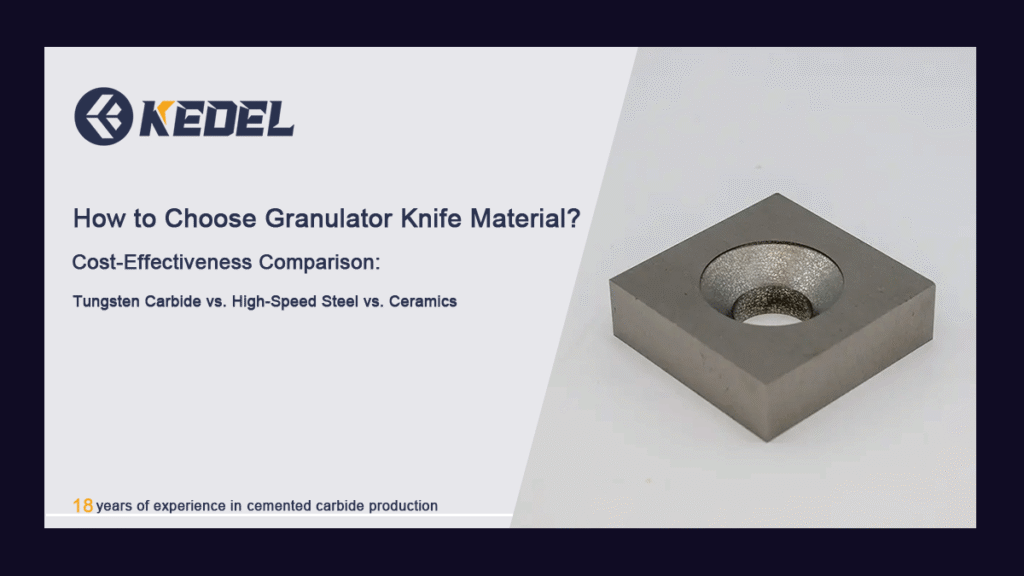
The material of granulator knives is a core factor determining granulation efficiency, tool lifespan, and overall production costs. Currently, the mainstream granulator knife materials on the market include tungsten carbide cemented carbide, high-speed steel (HSS), and ceramics. Different materials vary significantly in hardness, wear resistance, impact resistance, and cost, and are suitable for distinct materials (plastic, rubber, biomass, etc.) and working conditions. Blind selection either leads to frequent tool wear, increased costs from downtime for knife replacement, or waste from overinvesting in high-end materials. This article provides a detailed comparison of the core performance, applicable scenarios, and overall cost-effectiveness of the three materials through plain language and clear tables, helping industry practitioners accurately select materials based on their needs (material type, output, budget) and find the optimal balance between efficiency and cost.
1. First, Understand: Basic Characteristics of the Three Materials
Before comparing cost-effectiveness, let’s briefly understand the core composition and performance characteristics of the three materials to lay the foundation for subsequent selection:
1.1 Tungsten Carbide Cemented Carbide (referred to as "tungsten carbide")
- Core Composition: Composed of tungsten carbide (WC) as the hard phase and cobalt (Co) as the binder phase, sintered via powder metallurgy (common grades: YG6, YG8, YG12);
- Core Performance: Extremely high hardness (HRA≥90, equivalent to HRC68-72), the strongest wear resistance among the three materials, and medium impact resistance (optimizable by adjusting cobalt content);
- Key Features: Suitable for harsh working conditions with high abrasion and impurities, long service life, and reduced frequency of knife replacement, but relatively high cost per knife.
1.2 High-Speed Steel (referred to as "HSS")
- Core Composition: Alloy tool steel (containing elements such as tungsten, molybdenum, chromium, and vanadium), common models: W18Cr4V, W6Mo5Cr4V2;
- Core Performance: Medium hardness (HRC62-65), good toughness, strong impact resistance, and average wear resistance;
- Key Features: Simple processing technology, low cost per knife, suitable for granulation of ordinary soft materials, but fast wear and frequent knife replacement required.
1.3 Ceramics (Alumina/Silicon Nitride-Based)
- Core Composition: Sintered with alumina (Al₂O₃) or silicon nitride (Si₃N₄) as the matrix, supplemented with a small amount of additives;
- Core Performance: Extremely high hardness (HRA≥92, higher than tungsten carbide), strong wear resistance, high-temperature resistance (capable of withstanding temperatures above 800℃), but extremely poor impact resistance (high brittleness);
- Key Features: Suitable for special working conditions with no impurities, high rotation speed, and high temperature, cost per knife between HSS and tungsten carbide, but prone to chipping and requiring high maintenance.
2. Core Cost-Effectiveness Comparison Table (At a Glance)
Below is a detailed comparison of key performance, costs, and applicable scenarios of the three materials. "Relative values" are based on HSS (set to 1) for intuitive understanding:
| Comparison Dimension | Tungsten Carbide Cemented Carbide | High-Speed Steel (HSS) | Ceramics (Al₂O₃/Si₃N₄) |
|---|---|---|---|
| Material Composition | WC+Co (cobalt content 6-12%) | Alloy tool steel (W, Mo, Cr, V) | Alumina/silicon nitride-based ceramics |
| Hardness (HRA/HRC) | HRA≥90 (HRC68-72) | HRC62-65 (HRA≈85) | HRA≥92 (HRC70-75) |
| Wear Resistance (Relative Value) | 5-10 | 1 | 8-12 |
| Impact Resistance (Relative Value) | 0.8-1.2 | 2.0-2.5 | 0.3-0.5 |
| Applicable Materials | Recycled plastic, biomass (sand-containing), rubber (impurity-containing), hard plastic | New soft plastic, soft rubber, ordinary impurity-free materials | High-temperature working conditions, impurity-free hard plastic, precision granulation (no impact) |
| Service Life (Relative Value) | 8-12 | 1 | 6-8 |
| Cost per Knife (Relative Value) | 5-8 | 1 | 3-5 |
| Comprehensive Cost (Relative Value) | 0.6-0.8 (life ÷ unit cost) | 1.0 (benchmark) | 0.8-1.2 |
| Maintenance Frequency | Low (replaced every 1-3 months) | High (replaced every 1-2 weeks) | Medium-high (prone to chipping, requires careful operation) |
| Core Advantages | Wear-resistant, long service life, lowest comprehensive cost, wide applicability | Low cost, good toughness, strong impact resistance, simple processing | Extremely high hardness, high-temperature resistance, no metal contamination |
| Main Limitations | High cost per knife, sensitive to severe impact | Poor wear resistance, frequent knife replacement, high downtime loss | Poor impact resistance, prone to chipping, narrow applicable scenarios |
Supplementary Notes:
- Comprehensive cost calculation logic: Comprehensive cost = (cost per knife ÷ service life) + downtime loss from knife replacement. Although tungsten carbide has a higher unit cost, its long service life and fewer replacements result in the lowest long-term comprehensive cost;
- "Adjustability" of tungsten carbide: By adjusting cobalt content (low-cobalt YG6 for wear resistance, high-cobalt YG12 for impact resistance), it can adapt to different working conditions, further improving cost-effectiveness;
- "Special Value" of ceramics: It is the only choice for high-temperature (e.g., >500℃) or "metal-free contamination" scenarios (e.g., medical material granulation).
3. Precise Selection by Scenario: Optimal Material for Different Needs
3.1 High-Abrasion, Impurity-Containing Materials (Prioritize Tungsten Carbide)
- Applicable Scenarios: Recycled plastic (containing sand grains, metal debris), biomass (straw, rice husk, silicon-containing), waste rubber (containing steel wire, fibers), hard plastic (nylon, ABS hard materials);
- Selection Logic: These materials cause severe tool wear. HSS needs replacement every 1-2 weeks, and downtime losses far exceed the cost of a single knife; ceramics are prone to chipping from impurity impact; tungsten carbide’s high wear resistance and medium impact resistance allow stable use for 1-3 months, resulting in the lowest comprehensive cost.
- Recommended Tungsten Carbide Grades: YG10/YG12 (high cobalt, impact-resistant) for impurity-rich materials; YG6/YG8 (low cobalt, more wear-resistant) for pure hard materials.
3.2 Ordinary Soft, Impurity-Free Materials (Economical Choice: HSS)
- Applicable Scenarios: New soft plastic (PE/PP film, soft PVC), soft rubber (natural rubber new material), low-output granulation (daily output <5 tons);
- Selection Logic: These materials cause minimal wear, and HSS’s wear resistance is sufficient. With a unit cost only 1/5-1/8 that of tungsten carbide, it is suitable for small-scale production with limited budgets and low sensitivity to downtime losses.
- Notes: Prepare multiple spare knives to avoid production delays during replacement; regularly grind the cutting edge to extend single-use time.
3.3 Special Working Conditions (Targeted Selection: Ceramics)
- Applicable Scenarios: High-temperature granulation (e.g., engineering plastic granulation, material temperature >300℃), impurity-free precision granulation (e.g., medical silicone, high-purity plastic), impact-free working conditions (e.g., ring-die granulator, low rotation speed);
- Selection Logic: Ceramics’ high-temperature resistance and ultra-high hardness meet special needs, and their metal-free nature is suitable for scenarios requiring high material purity; however, materials must be impurity-free to avoid chipping from impact.
- Usage Suggestions: Use elastic tool holders to buffer impact and avoid tool collision during no-load operation.
4. Common Selection Mistakes (Avoid These to Improve Cost-Effectiveness)
- Blindly Pursuing "Highest Hardness": Assuming ceramics are the best due to their highest hardness, ignoring their poor impact resistance. When used for impurity-containing materials, they may chip in 1-2 days, increasing costs instead;
- Focusing Only on Unit Cost: Choosing HSS because it is the cheapest, but neglecting downtime losses from frequent replacements (e.g., for recycled plastic granulation with a daily output of 10 tons, each knife replacement causes 2-3 hours of downtime, equivalent to thousands of yuan in losses);
- Tungsten Carbide "The More Expensive the Better": Blindly selecting high-cobalt, fine-grain high-end tungsten carbide for ordinary soft materials, resulting in performance overcapacity and unnecessary investment;
- Ignoring Working Condition Adaptability: Selecting ceramics for impact-prone working conditions (e.g., flat-die granulators) or HSS for impurity-containing working conditions, leading to extremely short tool life.
5. Typical Case: Practical Usage Cost Comparison of Three Materials
Taking "recycled plastic granulation (daily output 10 tons, containing a small amount of impurities)" as an example, compare the annual usage costs of the three materials (based on 300 working days per year):
| Cost Item | Tungsten Carbide Cemented Carbide | High-Speed Steel (HSS) | Ceramics (Al₂O₃) |
|---|---|---|---|
| Price per Knife | 1500 Yuan/knife | 300 Yuan/knife | 800 Yuan/knife |
| Single Service Life | 60 days/knife | 7 days/knife | 15 days/knife |
| Annual Quantity Required | 5 knives | 43 knives | 20 knives |
| Total Annual Tool Purchase Cost | 7500 Yuan | 12900 Yuan | 16000 Yuan |
| Annual Downtime Loss from Knife Replacement | 5 times × 2 hours × 500 Yuan/hour = 5000 Yuan | 43 times × 2 hours × 500 Yuan/hour = 43000 Yuan | 20 times × 2 hours × 500 Yuan/hour = 20000 Yuan |
| Total Annual Comprehensive Cost | 12500 Yuan | 55900 Yuan | 36000 Yuan |
Conclusion: In this scenario, the annual comprehensive cost of tungsten carbide is only 22% of HSS and 35% of ceramics, showing significant cost-effectiveness advantages.
6. Conclusion: The Core of Selection is "Working Condition Adaptation + Comprehensive Cost Balance"
There is no "absolutely best" granulator knife material, only the "most suitable":
- High-abrasion, impurity-containing, high-output working conditions → Tungsten carbide cemented carbide (highest comprehensive cost-effectiveness);
- Ordinary soft materials, low output, limited budget → High-speed steel (economical and practical);
- High-temperature, impurity-free, precision granulation → Ceramics (exclusive for special needs).
As a tungsten carbide industry practitioner, we recommend prioritizing tungsten carbide granulator knives for mid-to-high-end, high-output scenarios. Not only can they help customers reduce knife replacement frequency and improve efficiency, but they can also be further adapted to different materials (e.g., high-cobalt for impact resistance, low-cobalt for wear resistance) by adjusting tungsten carbide’s cobalt content and cutting edge structure, maximizing cost-effectiveness.
If you need customized tungsten carbide granulator knife solutions based on specific material types (e.g., biomass, waste rubber), granulator parameters, or output requirements, please contact us for precise selection advice to help balance production efficiency and comprehensive costs!