
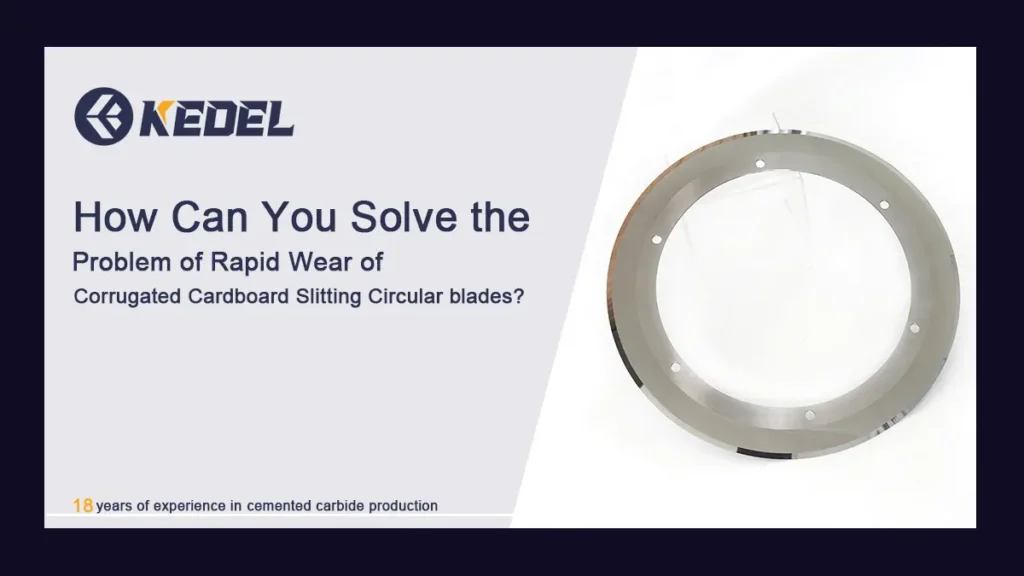
Corrugated cardboard slitting is a critical link in packaging production, and rapid wear of circular blades is a common pain point in the industry. It manifests as premature dulling of the cutting edge (frayed, fuzzy edges on slit cardboard) and increased blade change frequency (blades that should last 80 hours need replacement after only 30 hours). This not only reduces slitting efficiency but also raises tool procurement costs and downtime losses (each blade change causes 1-2 hours of downtime, affecting daily production capacity). Solving this problem does not rely solely on "buying more expensive blades"; instead, a comprehensive solution must be built around four dimensions: optimized cemented carbide tools, precise slitting parameter control, equipment accuracy assurance, and adaptation to cardboard characteristics. Among these, the selection and maintenance of cemented carbide tools are core (directly determining the blade’s basic wear resistance). This article details specific operational methods for each link, helping you extend the service life of corrugated cardboard slitting blades by over 50% while ensuring stable slitting quality.
1. First, Identify the Root Causes: 5 Main Reasons for Rapid Wear of Circular Blades for Corrugated Cardboard Slitting
Before developing solutions, it is essential to clarify the core causes of wear to avoid "blindly replacing blades" without addressing the root issue. Corrugated cardboard (composed of face paper, fluting paper, and corrugated base paper; fluting paper is wave-shaped, with moderate overall hardness but fiber impurities) causes blade wear mainly due to the following 5 factors:
| Cause of Wear | Specific Manifestation | Impact on Blades |
|---|---|---|
| Incorrect Tool Selection | Using ordinary high-speed steel blades (e.g., W18Cr4V) or low-wear-resistance cemented carbide (e.g., YG3) for slitting | High-speed steel blades dull in 10-15 hours; YG3 has insufficient toughness, leading to edge chipping and failure within 30 hours |
| Improper Cutting Edge Treatment | Cutting edge is unpassivated (too sharp) or insufficiently polished (rough surface) | Sharp edges easily get stuck in corrugated fibers, causing chipping; rough surfaces increase friction, accelerating wear by 30% |
| Unreasonable Slitting Parameters | Excessively high slitting speed (>250m/min) or excessive pressure (>0.3MPa) | High speed causes frictional heat between the edge and cardboard, accelerating wear; excessive pressure squeezes the edge against corrugations, causing local overload and dulling |
| Insufficient Equipment Accuracy | Spindle runout >0.01mm or bearing wear causing blade tilt | Uneven force on the blade leads to excessive local wear (uneven wear: one edge is worn flat, the other is barely damaged) |
| Poor Adaptation to Cardboard Characteristics | Slitting high-hardness corrugated cardboard (e.g., AB-flute, B-flute) or cardboard containing impurities (staples, sand grains) | High-hardness cardboard increases cutting load on the edge; impurities scratch the edge directly, causing "scratch wear" |
2. Core Solutions: A Systematic Approach to Extend Blade Life Across Four Dimensions
1. Optimization of Cemented Carbide Tools: Choose the Right "Basic Model" to Improve Wear Resistance from the Source
Corrugated cardboard slitting requires a balance of "wear resistance, toughness, and edge chipping resistance" in blades. Priority must be given to selecting suitable cemented carbide tools, which is the foundation for extending service life.
(1) Tool Material Selection: Prioritize "Wear Resistance + Chipping Resistance" to Match Corrugated Characteristics
Corrugated cardboard is characterized by "abundant fibers, wave-shaped fluting, and potential minor impurities." Tools must balance "wear resistance (to handle fiber friction)" and "toughness (to handle corrugation impact)." The following cemented carbide formulas are recommended:
- WC Grain Size: Choose medium-coarse grain WC (3-5μm) — Fine-grain WC is hard but brittle, easily chipped by corrugated impurities; coarse-grain WC has good toughness but poor wear resistance; medium-coarse grain balances both, suitable for fiber friction and minor impacts in corrugated slitting.
- Co Content: Choose 8%-10% Co — Co content below 6% results in insufficient toughness and easy chipping; content above 12% reduces wear resistance, making the edge prone to dulling from fiber friction; 8%-10% Co achieves the optimal balance between wear resistance and toughness, suitable for most corrugated cardboards (A-flute, B-flute, C-flute).
- Additives: Add 1%-2% tantalum carbide (TaC) — TaC improves the blade’s impact resistance and thermal stability, preventing edge softening due to frictional heat during slitting. It is especially suitable for slitting high-hardness AB-flute cardboard.
- Recommended Models: YG8 (basic model, suitable for ordinary corrugated) and YG10X (contains TaC, suitable for high-hardness or impurity-containing corrugated). Avoid low-Co models like YG3/YG6 or high-speed steel blades.
(2) Cutting Edge Treatment: Reject "Sharper = Better" and Focus on "Passivation + Polishing"
Many assume "the sharper the cutting edge, the smoother the slitting," but corrugated cardboard fibers easily get stuck in sharp edges, causing chipping and rapid wear. The correct edge treatment methods are:
- Edge Passivation: Use a dedicated passivation machine to control edge sharpness to 0.02-0.03mm (not absolutely sharp), forming a "micro-arc" edge. This can cut fibers smoothly while avoiding edge chipping due to stress concentration, reducing initial wear by 30%.
- Edge Polishing: Use a diamond grinding wheel for precision grinding to achieve an edge surface roughness of Ra ≤ 0.4μm. Rough edges increase friction with cardboard fibers; polishing reduces the friction coefficient, extending the edge wear cycle (from 30 hours to 50 hours).
2. Precise Control of Slitting Parameters: Avoid "Overload Slitting" to Reduce Unnecessary Wear
Improper parameter settings are a major cause of "abnormal wear" of blades. Parameters (speed, feed rate, pressure) must be adjusted based on the flute type (hardness) of corrugated cardboard. Specific references are as follows:
| Corrugated Flute Type (Hardness) | Slitting Speed (m/min) | Feed Rate (mm/r) | Slitting Pressure (MPa) | Notes |
|---|---|---|---|---|
| A-flute (soft, thick fluting) | 180-220 | 0.12-0.15 | 0.15-0.2 | High speed easily causes fluting fiber stretching, increasing wear |
| B-flute (hard, thin fluting) | 150-180 | 0.1-0.12 | 0.2-0.25 | High hardness requires lower speed to avoid edge overload |
| AB-flute (high hardness) | 120-150 | 0.08-0.1 | 0.25-0.3 | Match with YG10X blades; pressure must not exceed 0.3MPa |
Parameter Setting Principles:
- The harder the corrugated cardboard, the lower the speed and smaller the feed rate — Avoid excessive friction between the edge and hard cardboard.
- Pressure should be sufficient to "cut through cardboard without frayed edges"; excessive pressure squeezes the edge, accelerating wear.
- When using new parameters for the first time, test-slit 10-20 sheets of cardboard first. Only start mass production after confirming edge quality (no fraying, no indentations).
3. Equipment Accuracy Assurance: Reduce "Uneven Force" to Avoid Excessive Local Wear
Even with proper tools and parameters, insufficient equipment accuracy can still cause "uneven wear" of blades. Key equipment components must be inspected and maintained regularly:
(1) Control Spindle Runout and Bearing Wear
Spindle runout must be ≤ 0.008mm (measured with a micrometer at the spindle end). If runout exceeds 0.01mm, the blade will rotate "eccentrically" during slitting, leading to excessive local wear (e.g., one edge is worn flat, the other only slightly worn).
- Maintenance Method: Clean spindle bearings monthly and replace worn bearings (imported precision bearings are recommended, with a service life 2-3 times that of ordinary bearings). Use locating pins to position the blade during installation, ensuring coaxiality between the blade and spindle.
(2) Calibrate Workbench and Press Roller Pressure
The workbench’s positioning accuracy must be ≤ 0.02mm to avoid "skewed slitting" (uneven edge force) due to cardboard conveying deviation. Press roller pressure must be uniform (0.1-0.15MPa): excessive pressure easily deforms cardboard, increasing blade cutting load; insufficient pressure causes cardboard slippage, leading to repeated friction of the edge on the same area.
- Maintenance Method: Calibrate workbench accuracy with a laser interferometer quarterly; check press roller pressure weekly to ensure consistent pressure on both sides.
4. Cardboard Preprocessing and On-Site Adaptation: Reduce "External Damage" to Minimize Additional Blade Wear
The characteristics of corrugated cardboard (hardness, impurities) directly affect blade wear. Preprocessing and on-site adaptation are essential:
(1) Remove Impurities from Cardboard
Corrugated cardboard may contain impurities such as staples, sand grains, and glue lumps during production or storage. These impurities scratch the cutting edge directly, causing "scratch wear" (small gaps appear on the edge, accelerating dulling).
- Solution: Install a "magnetic separator + air blower" before the slitting machine — The magnetic separator adsorbs metal impurities like staples, and the air blower removes sand grains and glue lumps. Meanwhile, manually inspect cardboard edges to remove obvious impurities.
(2) Adjust Parameters Based on Cardboard Humidity
Excessive cardboard humidity (>18%) softens fibers, causing them to stick to the edge during slitting and increasing frictional wear. Insufficient humidity (<8%) hardens and embrittles cardboard, increasing edge force during slitting and causing easy chipping.
- Solution: Use a hygrometer to measure cardboard humidity. If humidity >18%, reduce slitting speed appropriately (by 10%-15%) and apply a small amount of food-grade lubricating oil to the edge (to reduce sticking). If humidity <8%, switch to YG10 tools with 10% Co (better toughness) and reduce slitting pressure (by 5%-10%).
3. Clarifying Common Misconceptions: Avoid Practices That "Accelerate Wear"
In many cases, rapid blade wear stems from "one-sided cognition" misconceptions. The following 3 common mistakes require key correction:
Misconception 1: "The Harder the Blade, the Better; Fine-Grain WC Tools Are More Wear-Resistant"
Fact: Fine-grain WC tools have poor toughness and are prone to chipping when slitting corrugated cardboard. A factory used fine-grain WC (2μm) + 6% Co tools to slit AB-flute cardboard. Due to high corrugated hardness and minor impurities, the edges chipped every 20 hours. After switching to medium-coarse grain WC (4μm) + 8% Co YG8 tools, the edges lasted 60 hours without chipping. Although hardness was slightly lower, overall service life increased by 2 times.
Misconception 2: "Faster Slitting Speed = Higher Efficiency; Wear Is Not a Concern"
Fact: Excessively high speed increases frictional heat, accelerating edge wear. A factory increased slitting speed from 180m/min to 280m/min to boost capacity. As a result, blade life shortened from 80 hours to 30 hours, and blade change frequency increased by 1.7 times. Downtime losses (¥5,000 per occurrence) far exceeded the capacity gains from higher speed. After restoring speed to 180m/min, hourly capacity decreased by 15%, but monthly blade changes dropped from 8 to 3, reducing overall costs by 25%.
Misconception 3: "Worn Blades Should Be Discarded Directly; Re-Sharpening Is Unnecessary"
Fact: Properly re-sharpened blades can be reused 2-3 times. When the flank wear of corrugated cardboard slitting blades is ≤0.2mm, they can be re-sharpened with a diamond grinding wheel (grain size 180-240 mesh). Re-sharpened blades can achieve 70% of the service life of new blades. A factory reduced monthly tool procurement costs from ¥12,000 to ¥5,000 through re-sharpening, saving ¥84,000 annually. (Note: During re-sharpening, maintain the original passivated arc of the edge to avoid grinding it into a sharp edge.)
4. Conclusion: Comprehensive Solutions Are Key, Daily Maintenance Is Indispensable
Solving the problem of rapid wear of circular blades for corrugated cardboard slitting centers on "adaptation" — tool materials must match cardboard characteristics, parameters must match equipment accuracy, and maintenance must match usage frequency. It is not about pursuing "high hardness" or "high speed" alone. For professionals in the tungsten carbide industry, when recommending tools, it is essential to first understand the customer’s "corrugated flute type, cardboard humidity, and equipment accuracy," then provide customized solutions including "material formula + edge treatment + parameter suggestions," rather than just recommending general models.
If your enterprise still struggles with rapid wear of corrugated cardboard slitting blades, or needs customized cemented carbide tools for specific flute types (e.g., AB-flute, E-flute), feel free to communicate. We can provide tool sample testing and slitting parameter adjustment guidance to help you implement the solution quickly.