
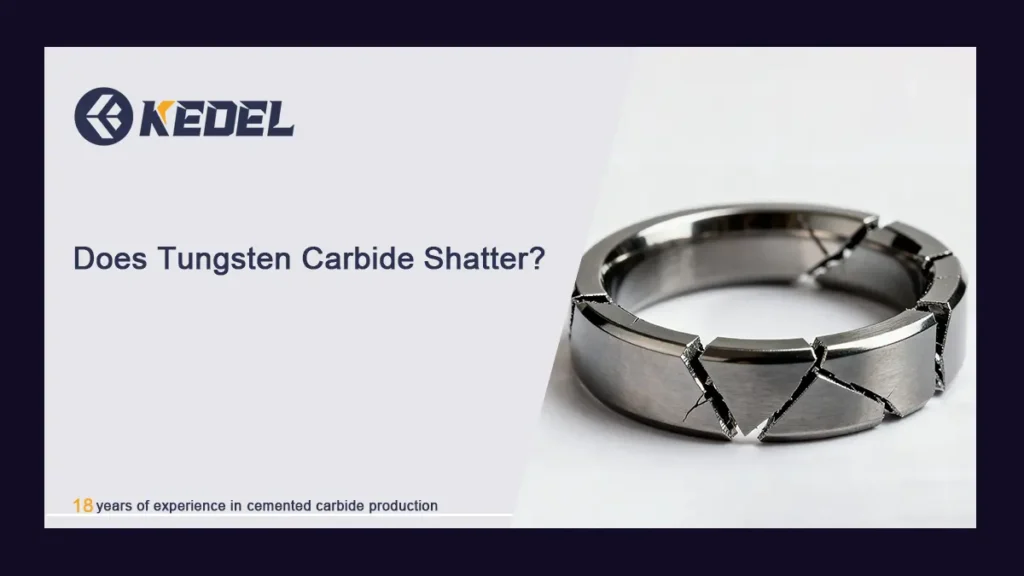
If you work with tungsten carbide products—whether they’re mining wear liners, precision cutting tools, or pump seals—you know it’s prized for its hardness. But a common concern arises: “Does tungsten carbide shatter?” The answer isn’t a simple yes or no. Tungsten carbide is not easily shattered under normal use, but it can break or shatter when exposed to extreme conditions like heavy impact, extreme cold, or poor material quality. Its durability depends on a mix of its composition (binder type and content) and how it’s handled. In this article, we’ll break down why tungsten carbide might shatter, real-world scenarios where this happens, how to tell if a shattered part is repairable, and steps to prevent it. All content is based on industrial experience, with plain language and actionable advice.
1. First: Why Tungsten Carbide Is Resistant to Shattering (But Not Indestructible)
To understand if tungsten carbide shatters, start with its structure—it’s a composite material that balances hardness and toughness:
- Tungsten carbide (WC) crystals: These are the “hard” component (Mohs 8.5–9), responsible for wear resistance. On their own, WC crystals are brittle and would shatter easily.
- Binder metal: Usually cobalt (most common) or nickel, this acts as a “tough glue” that holds WC crystals together. The binder absorbs stress and impact, preventing the crystals from breaking apart.
The key to shatter resistance lies in the binder content and type:
- Higher binder content (10–15% cobalt/nickel) = more toughness, less likely to shatter.
- Lower binder content (3–5% cobalt) = more hardness, but more brittle (prone to shattering).
Example: A tungsten carbide seal ring with 12% cobalt can withstand a light drop onto a concrete floor without damage. A ring with 4% cobalt, however, might crack or shatter from the same impact.
2. When Does Tungsten Carbide Shatter? 4 Common Industrial Scenarios
Tungsten carbide only shatters under specific extreme conditions. Below are the most frequent triggers in real-world use:
2.1 Heavy Impact or Sudden Force
Tungsten carbide’s hardness makes it resistant to slow, steady pressure (like grinding or wear), but it can’t handle sudden, intense impacts. These forces exceed the binder’s ability to absorb stress, causing the WC crystals to split.
- Common triggers:
- Dropping a carbide part onto a hard surface (e.g., a 5kg wear block falling from a workbench to concrete).
- Equipment jams (e.g., a rock getting stuck in a carbide-tipped crusher, creating a sudden “jolt”).
- Forced installation (e.g., hammering a tight carbide bushing into a housing with a metal mallet).
- What it looks like:
- Clean, sharp breaks (not just chips) in the part.
- Multiple pieces (shattering) if the impact is severe enough.
- Industrial example: A construction crew dropped a tungsten carbide drill bit (4% cobalt) onto a steel plate. The bit shattered into three pieces—its low binder content couldn’t absorb the impact.
2.2 Extreme Low Temperatures
Most tungsten carbide uses cobalt as a binder, and cobalt becomes brittle at temperatures below -40°C (-40°F). When cooled this low, the binder loses its ability to flex, so even small impacts can cause the part to shatter.
- Common triggers:
- Arctic mining operations (temperatures as low as -50°C).
- Cryogenic equipment (e.g., liquid nitrogen tanks with carbide seals).
- Winter outdoor work (road maintenance tools exposed to sub-zero temperatures).
- What it looks like:
- Small, “crisp” cracks that spread quickly.
- Shattering with minimal force (e.g., a carbide liner breaking when tapped with a wrench).
- Fix: Switch to nickel-binder tungsten carbide—nickel stays tough even at -100°C.
2.3 Poor-Quality Material or Manufacturing Defects
Low-quality tungsten carbide or flawed production can create weak points that make shattering more likely, even under mild stress.
- Common defects:
- Porosity: Tiny air holes in the material (from incomplete sintering) that act as stress concentrators.
- Uneven binder distribution: Clumps of WC crystals with no binder, creating brittle spots.
- Contaminants: Foreign particles (like dirt or unreacted carbon) that weaken the structure.
- What it looks like:
- Shattering from unexpected, minor stress (e.g., a carbide tool breaking during normal cutting).
- Irregular break patterns (not following a clean line).
- How to avoid: Buy from suppliers with ISO 9001 certification and ask for material test reports (to check for porosity and binder consistency).
2.4 Overheating or Thermal Shock
Tungsten carbide can handle moderate heat, but extreme temperatures (over 1,200°C/2,192°F) or sudden temperature changes (“thermal shock”) can cause it to shatter.
- Common triggers:
- Overheating in furnaces (e.g., a carbide nozzle in a metal-melting furnace).
- Sudden cooling (e.g., a hot carbide mold dipped in cold water to speed up production).
- Why it happens:
- High heat softens or melts the binder, so WC crystals lose support.
- Thermal shock causes uneven expansion/contraction—parts crack as different areas expand or shrink at different rates.
- What it looks like:
- Web-like crack patterns (from thermal shock).
- Shattering into small pieces if the binder melts completely.
3. Is a Shattered Tungsten Carbide Part Repairable? Quick Assessment Table
Not all shattered carbide parts are useless. Use this table to decide if repair is possible:
| Type of Shattering | Repairable? | Notes |
|---|---|---|
| Small chips (no full break) | Sometimes | Small chips on non-critical areas (e.g., tool shanks) can be ground down. |
| Clean, single break (large parts) | Rarely | Some large parts (e.g., wear liners) can be repaired with laser welding, but strength will be reduced. |
| Multiple pieces (shattering) | No | Parts broken into 3+ pieces can’t be repaired—replace them. |
| Cracks from thermal shock | No | Cracks from heat damage spread over time; repair won’t stop further failure. |
4. 5 Practical Tips to Prevent Tungsten Carbide from Shattering
Preventing shattering is far easier than repairing or replacing parts. Here are actionable steps for daily use:
4.1 Choose the Right Binder for Your Environment
Match the binder type and content to your application’s stress and temperature:
| Application Scenario | Recommended Binder | Why It Works |
|---|---|---|
| High-impact (crushers, drills) | Cobalt (10–15% content) | High binder content absorbs impact, preventing shattering. |
| Low-temperature (-40°C+) | Nickel or nickel-cobalt mix | Nickel stays tough in cold, avoiding brittle failure. |
| High-heat (up to 1,000°C) | Heat-stabilized cobalt | Added elements (like chromium) keep the binder stable at high temps. |
4.2 Handle and Install Parts Carefully
- Avoid drops: Carry carbide parts in padded containers; use lifting tools (suction cups, soft-grip pliers) for heavy items.
- No forced fitting: If a part is too tight, sand or grind it to size—never hammer it with metal tools. Use rubber or wooden mallets for alignment.
- Store safely: Keep parts in dry, temperature-controlled areas (avoid freezing garages or hot sheds).
4.3 Avoid Thermal Shock
- Gradual heating/cooling: Let hot carbide parts (e.g., molds, nozzles) cool to room temperature naturally—don’t quench them in water.
- Preheat for cold use: If using parts in sub-zero temps, preheat them to 20–30°C (room temp) before use to avoid brittle failure.
4.4 Inspect Parts for Defects Before Use
Before installing a new carbide part:
- Check for visible pores, cracks, or uneven color (signs of poor manufacturing).
- Tap the part lightly with a plastic tool—if it makes a “dull” thud (not a clear ring), it may have hidden defects.
4.5 Train Teams on Proper Use
Make sure everyone handling carbide parts knows:
- Not to drop or hit parts with metal tools.
- To report small chips or cracks immediately (these can spread and cause shattering).
- How to match parts to the right application (e.g., no low-binder parts in high-impact jobs).
5. 2 Common Myths About Tungsten Carbide Shattering (Busted)
-
Myth: “Tungsten carbide is so hard, it can’t shatter.”
Fact: Hardness doesn’t equal shatter resistance. Tungsten carbide can shatter under impact, cold, or heat—its binder is the only thing preventing this. -
Myth: “If a carbide part doesn’t shatter right away, it’s safe.”
Fact: Small cracks (from minor impacts or cold) can lie hidden and spread over time. A part that seems fine today might shatter weeks later during normal use.
6. Final Thought: Shattering Is Preventable with the Right Choices
Tungsten carbide doesn’t shatter easily, but it’s not indestructible. The key to avoiding shattering is simple: choose the right part for your environment (match binder to impact/temp), handle parts carefully, and avoid extreme conditions like sudden impacts or thermal shock.
If you’re dealing with frequent shattering—whether it’s mining liners or cutting tools—feel free to reach out. We can help analyze your application, recommend the right carbide grade, and fix the root cause.