
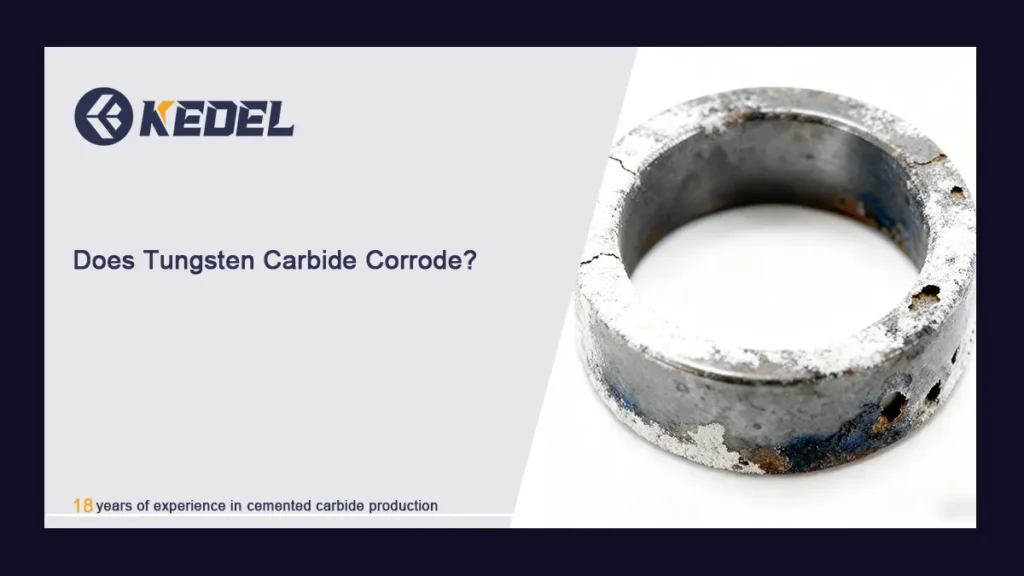
If you work with tungsten carbide products—whether it’s wear liners for mining, seal rings for pumps, or cutting tools for metalworking—you might assume this ultra-hard material is immune to corrosion. But the reality is more nuanced: the tungsten carbide crystals themselves are highly corrosion-resistant, but the overall corrosion resistance of the material depends on the metal binder that holds these crystals together (usually cobalt, sometimes nickel) and the environment it’s used in. In some conditions, tungsten carbide can show signs of corrosion; in others, it can stay intact for years. This article will break down when tungsten carbide corrodes, why it happens, how to spot early signs, and actionable steps to prevent it. All content is based on real industrial experience, with no complex jargon—just practical insights you can use on the job.
1. First: Understand Tungsten Carbide’s Corrosion Resistance Isn’t “All or Nothing”
To answer whether tungsten carbide corrodes, you need to start with its structure. Tungsten carbide is a composite material, and only one part of it is at risk of corrosion:
- Tungsten carbide (WC) crystals: These are the hard, durable “backbone” of the material. They have excellent chemical stability and resist most acids, alkalis, and environmental factors. Even in neutral water or mild chemicals, the crystals themselves won’t corrode.
- Binder metal: This is the “glue” that holds the WC crystals together. The most common binder is cobalt, though nickel or nickel alloys are used for specialized needs. The binder is the “weak link” for corrosion—when tungsten carbide “corrodes,” it’s almost always the binder reacting with substances in the environment, not the WC crystals.
Key takeaway: Corrosion in tungsten carbide is almost always a binder issue, not a problem with the hard WC crystals.
2. When Does Tungsten Carbide Corrode? 3 Common Scenarios
Tungsten carbide rarely corrodes in neutral, mild environments. But specific conditions can attack the binder, leading to visible damage or performance loss. Below are the three most common triggers in industrial settings:
2.1 Exposure to Strong Acids or Alkalis
Cobalt (the most widely used binder) is sensitive to strong chemicals. When it comes into contact with concentrated acids or alkalis, it reacts to form soluble salts. These salts either wash away or leave a powdery residue, weakening the bond between WC crystals over time.
- High-risk chemicals:
- Strong acids: Hydrochloric acid (HCl), sulfuric acid (H₂SO₄), nitric acid (HNO₃) (common in chemical processing, metal plating, and battery manufacturing).
- Strong alkalis: Sodium hydroxide (NaOH), potassium hydroxide (KOH) (used in paper production, detergent manufacturing, and metal cleaning).
- Signs of corrosion:
- Green or brown stains on the surface (from cobalt salts).
- Powdery flaking (eroded binder falling off).
- Reduced hardness (the material feels “softer” when scraped lightly).
- Industrial example: A chemical plant used cobalt-based tungsten carbide seal rings in a sulfuric acid transfer pump. After just 2 months, the rings developed green spots and started leaking. Lab tests showed the cobalt binder had dissolved in the acid, creating gaps between the WC crystals.
2.2 Contact with Seawater or High-Chloride Environments
Seawater or any solution with high chloride levels (like saltwater used in cooling systems or chlorinated wastewater) is another major corrosion trigger—especially for cobalt-based binders. Chloride ions react with cobalt to form cobalt chloride, a compound that breaks down over time and weakens the material’s structure.
- High-risk environments:
- Marine equipment: Seawater pumps, propeller shafts, offshore drilling components.
- Chlorinated water systems: Pool filters, wastewater treatment plants (where chlorine is used for disinfection).
- De-icing environments: Road maintenance equipment (exposed to salt used for melting snow).
- Signs of corrosion:
- White, powdery deposits on the surface (cobalt chloride).
- Dull, gray discoloration (loss of the binder’s metallic sheen).
- Small cracks (from WC crystals loosening as the binder erodes).
- Industrial example: A coastal power plant used cobalt-based tungsten carbide liners in its seawater cooling system. After 6 months, the liners began to crack and chip. Inspections revealed the seawater had corroded the cobalt binder, causing the WC crystals to fall off.
2.3 High Temperatures + Oxygen (Oxidation Corrosion)
When temperatures exceed 500°C (932°F), even stable binders like cobalt or nickel react with oxygen in the air—a process called “oxidation corrosion.” This reaction forms a thick oxide layer on the surface. As the oxide layer flakes off, it exposes fresh binder to oxygen, creating a cycle of further corrosion.
- High-risk applications:
- High-temperature molds: Plastic injection molds, metal casting dies.
- Furnace components: Tungsten carbide nozzles or liners in industrial furnaces.
- Engine parts: Components exposed to high heat in combustion systems (e.g., diesel engine valves).
- Signs of corrosion:
- Blue, brown, or black discoloration (from metal oxides).
- Surface peeling (oxide layer flaking off).
- Faster wear (the material loses its wear resistance as the binder erodes).
- Industrial example: A foundry used cobalt-based tungsten carbide nozzles in its metal melting furnace. After 3 weeks, the nozzles turned black and started leaking molten metal. The high heat had caused the cobalt binder to oxidize, breaking down the nozzle’s structure.
3. When Doesn’t Tungsten Carbide Corrode? 2 Low-Risk Scenarios
In most industrial settings, tungsten carbide stays corrosion-free. Here are two common low-risk situations:
- Neutral, dry environments: In room-temperature, dry conditions (e.g., woodworking tools, metal stamping dies) or when exposed to pure, neutral water (e.g., freshwater pumps with no chemicals), cobalt-based binders don’t react with air or water. These parts can last for years without corrosion.
- Nickel or nickel-alloy binders: If tungsten carbide uses nickel (instead of cobalt) as the binder, its corrosion resistance improves dramatically. Nickel forms a stable oxide layer on its surface that blocks further reactions—making it ideal for seawater, acidic, or high-temperature environments.
Example: A wastewater treatment plant switched from cobalt-based to nickel-based tungsten carbide seal rings. The seal ring lifespan increased from 3 months to 18 months, with no signs of corrosion.
4. How to Spot Early Corrosion in Tungsten Carbide: 4 Easy-to-See Signs
Catching corrosion early can prevent equipment failure and costly downtime. Here are four simple signs to look for:
- Unusual discoloration: Green, white, blue, or black spots that won’t wipe off with a solvent (like acetone). This distinguishes corrosion from dirt or oil.
- Powdery residue: A fine, dry powder on the surface—this is eroded binder or its reaction products.
- Reduced performance: Faster wear (e.g., a tool that dulls quickly), seal leaks, or parts that bend slightly under stress (loss of hardness).
- Chipping or flaking: Small pieces of the material falling off—this happens when the binder is so eroded that it can’t hold the WC crystals together.
5. 3 Practical Tips to Prevent Tungsten Carbide Corrosion
Corrosion isn’t inevitable. With the right steps, you can protect your tungsten carbide parts:
5.1 Choose the Right Binder for Your Environment
The most important step is matching the binder to the environment. Use this table to guide your choice:
| Environment Type | Recommended Binder | Why It Works |
|---|---|---|
| Neutral, dry, freshwater | Cobalt-based | Cost-effective, good toughness, no corrosion risk in mild conditions. |
| Chemicals (acids/alkalis) | Nickel-based or nickel-molybdenum alloy | Resists chemical reactions, forms stable oxide layer. |
| Seawater/high chloride | Nickel-based | Blocks chloride ion reactions, prevents cobalt chloride formation. |
| High temperatures (>500°C) | Nickel-based or heat-stabilized cobalt | Nickel resists oxidation; heat-stabilized cobalt has added elements to slow oxidation. |
Pro tip: If you’re unsure about your environment, ask your supplier to run a “corrosion test” on a sample part—this will confirm if the binder is a good fit.
5.2 Add a Protective Coating (for Extreme Environments)
For harsh conditions (e.g., concentrated acids, high heat + chemicals), add a thin protective coating to the tungsten carbide surface. Common options include:
- Titanium nitride (TiN): Resists oxidation and mild chemicals; also reduces friction.
- Chrome plating: Blocks chloride ions, making it ideal for seawater or de-icing environments.
- Diamond-like carbon (DLC): Enhances chemical resistance and wear resistance; works well for precision parts like seals.
5.3 Clean and Inspect Parts Regularly
- Clean after use: Wipe parts with a neutral solvent (acetone or isopropyl alcohol) to remove chemical residues, salt, or oil—these can speed up corrosion.
- Monthly inspections: Check parts for early corrosion signs (discoloration, powder) during routine maintenance.
- Quarterly professional checks: For high-risk parts (e.g., marine seals, furnace nozzles), have a technician test the binder integrity (e.g., hardness tests) to catch hidden corrosion.
6. 2 Common Myths About Tungsten Carbide Corrosion (Busted)
-
Myth: “Tungsten carbide never corrodes.”
Fact: While WC crystals are corrosion-resistant, the binder (especially cobalt) can corrode in harsh environments. Using the wrong binder for your application will lead to corrosion. -
Myth: “If tungsten carbide corrodes, it needs to be replaced immediately.”
Fact: Early corrosion (e.g., mild discoloration with no flaking) can be fixed. Clean the part and apply a protective coating to stop further damage. Only replace parts if the binder is severely eroded or crystals are falling off.
7. Final Thought: Corrosion Depends on “Binder + Environment” Matching
Tungsten carbide doesn’t corrode like soft metals (e.g., steel that rusts uniformly), but its binder can fail in harsh conditions. The key to preventing corrosion is simple: choose the right binder for your environment (cobalt for mild conditions, nickel for harsh ones) and maintain parts regularly.
If you’re dealing with corrosion issues—whether it’s a leaking seal ring in a chemical pump or a chipped liner in a seawater system—feel free to reach out. We can help assess your environment, recommend the right tungsten carbide grade, and even test samples to ensure long-term performance.