
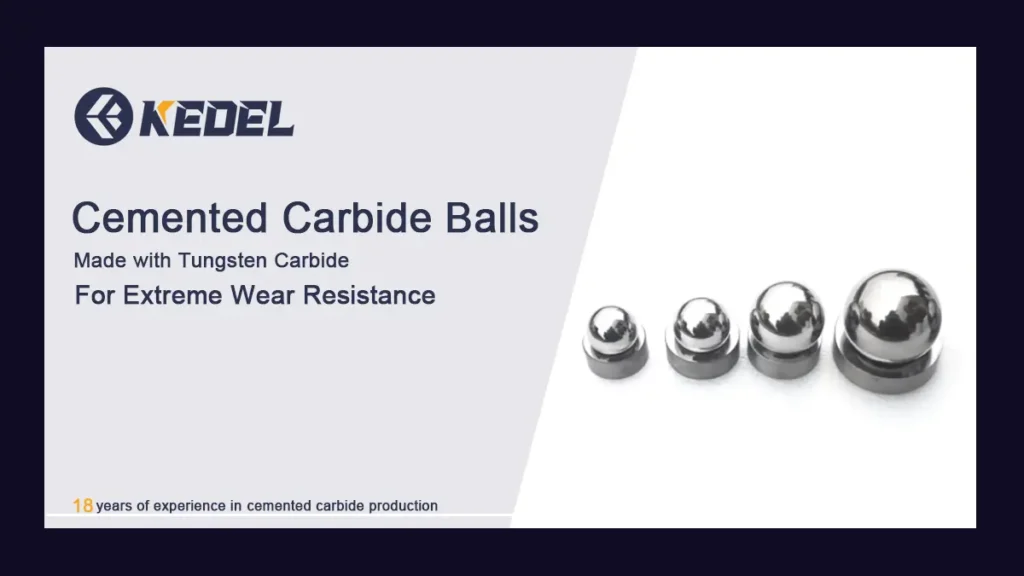
Among wear-resistant tungsten carbide parts, tungsten carbide balls are one of the most versatile and widely used categories. They are not ordinary "metal balls" but high-hardness, wear-resistant spherical components made from tungsten carbide (WC) as the core hard phase and cobalt (Co) as the binder, via powder metallurgy. Compared to traditional steel balls and ceramic balls, tungsten carbide balls can withstand high-load friction while resisting impact and corrosion. This makes them indispensable in scenarios requiring "wear resistance + long service life," such as bearings, grinding, mining, and hydraulics. This article breaks down the key value of these critical wear-resistant parts through their basic properties, core application scenarios, selection tips, and common misconceptions—using plain language and clear tables for easy understanding.
1. First, Understand: What Are Tungsten Carbide Balls? What Are Their Core Properties?
To grasp the advantages of tungsten carbide balls, it is essential to clarify their "identity": they are not simply "balls made of tungsten carbide" but composite parts with precise material ratios and controlled manufacturing processes, outperforming traditional spherical components in performance.
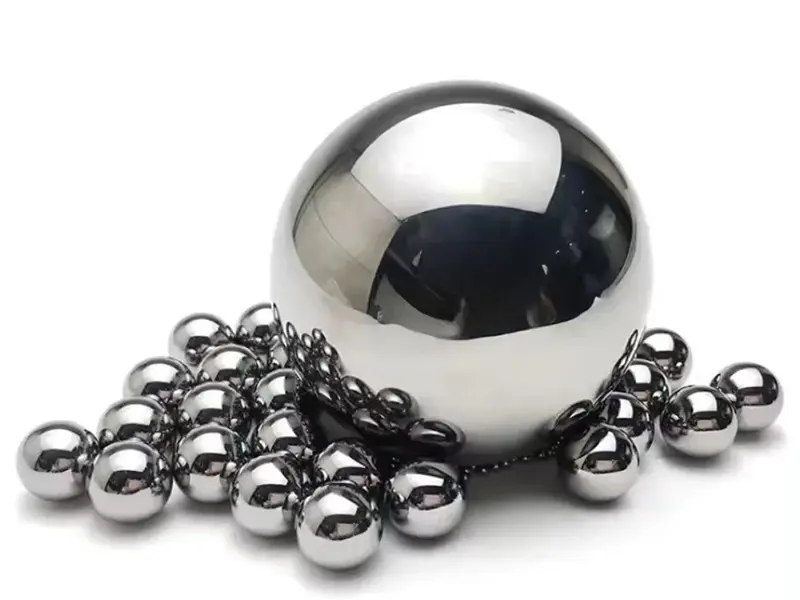
1.1 Basic Composition & Manufacturing Process
The core composition of tungsten carbide balls is "tungsten carbide (WC) + cobalt (Co)." For specific scenarios, small amounts of titanium carbide (TiC) or tantalum carbide (TaC) may be added to optimize performance. The production process is similar to other tungsten carbide parts but demands higher "spherical precision":
- Powder Blending: WC accounts for 90%–95% (determines hardness and wear resistance), while Co accounts for 5%–10% (determines toughness and impact resistance).
- Compaction Molding: Mixed powder is pressed into spherical green compacts, with uniform density controlled to avoid deformation during subsequent sintering.
- Vacuum Sintering: Sintering at 1400–1450°C in a vacuum allows full fusion of WC particles and Co, forming a dense structure.
- Precision Grinding: Diamond grinding wheels are used to polish the spherical surface, ensuring compliance with roundness and surface roughness requirements (e.g., for high-precision bearing balls, roundness error ≤0.001mm).
1.2 Tungsten Carbide Balls vs. Traditional Spherical Components: Performance Comparison
Many people hesitate between "tungsten carbide balls, steel balls, or ceramic balls," but the choice ultimately depends on scenario needs. The table below compares their core properties, highlighting the advantages of tungsten carbide balls:
| Comparison Dimension | Tungsten Carbide Balls (WC-Co Type) | Bearing Steel Balls (GCr15) | Zirconia Ceramic Balls (ZrO₂) |
|---|---|---|---|
| Hardness (Mohs) | 8.5–9 (Highest, second only to diamond) | 6.5–7 (Medium, limited hardness increase after quenching) | 8–8.5 (High, but highly brittle) |
| Wear Resistance (Service Life) | 5–10x that of steel balls; service life up to 1–3 years in continuous friction scenarios | Short service life; replacement needed every 3–6 months under high-frequency friction | Wear resistance close to tungsten carbide, but poor impact resistance (prone to chipping) |
| Impact Resistance | Moderate (higher Co content = better toughness; less prone to chipping) | Good (high toughness, but prone to deformation under impact) | Poor (high brittleness; prone to cracking under impact; unsuitable for high-impact scenarios) |
| Corrosion Resistance | Good (superior in low Co content; resistant to weak acids/bases) | Poor (prone to rust; requires anti-rust plating; fails easily in humid environments) | Excellent (resistant to strong acids/bases, but high cost) |
| Applicable Scenarios | High-wear + medium-impact scenarios (bearings, grinding, mining) | Low-load + low-impact scenarios (ordinary mechanical bearings, toys) | High-corrosion + low-impact scenarios (chemical pumps, medical equipment) |
Key Conclusion: The core advantage of tungsten carbide balls lies in their "balanced hardness and toughness"—they are more wear-resistant than steel balls and more impact-resistant than ceramic balls. They are the "optimal solution" for most industrial wear scenarios, especially those requiring both high-frequency friction resistance and moderate impact tolerance.
2. Core Application Scenarios of Tungsten Carbide Balls: Industries That Cannot Do Without Them
Tungsten carbide balls are suitable for any scenario requiring "wear-resistant, impact-resistant spherical components." Below are the 4 most common industrial application areas, each with specific use cases and core value explanations:
2.1 Bearing Industry: Core Components for High-Precision, High-Load Bearings
In bearings for large equipment such as wind turbines, machine tools, and construction machinery, tungsten carbide balls are critical components. These bearings must withstand enormous radial/axial loads (e.g., tens of tons for wind turbine bearings) while operating at high speeds (up to thousands of revolutions per minute), demanding exceptional wear resistance and precision.
- Specific Applications: Wind turbine main shaft bearings, machine tool spindle bearings, hydraulic pump bearings.
- Core Value: High hardness ensures minimal wear during long-term rotation, extending bearing service life to 5–10 years (3–5x that of steel ball bearings). Roundness error ≤0.001mm guarantees stable operation and reduced equipment vibration noise.
2.2 Grinding Industry: High-Efficiency, Wear-Resistant Grinding Media
In grinding processes for ceramics, building materials, and metallurgy, tungsten carbide balls replace steel balls and agate balls as high-efficiency grinding media. Their high hardness enables rapid material pulverization, while minimal wear prevents material contamination, ensuring grinding purity.
- Specific Applications: Ceramic glaze grinding, metal powder refinement, ore sample grinding.
- Core Value: Wear resistance is 8–10x that of steel balls; self-wear rate during grinding ≤0.1% (vs. ≥1% for steel balls), avoiding material contamination. High density (14–15g/cm³, 1.8x that of steel balls) delivers strong impact, increasing grinding efficiency by 30%–50% compared to steel balls.
2.3 Mining & Construction Machinery: Impact-Resistant, Wear-Resistant Structural Components
In mining and construction crushing scenarios, tungsten carbide balls are used in core parts of equipment such as crushers and ball mills. They withstand ore extrusion and impact, requiring both wear resistance and impact resistance.
- Specific Applications: Grinding balls for mining ball mills, buffer balls for crushers, wear-resistant balls for concrete mixing plants.
- Core Value: Tungsten carbide balls with 8%–10% Co content balance impact resistance (to avoid chipping) and wear resistance. A single batch of ball mill balls can last 1–2 years (vs. 3–6 months for steel balls), reducing equipment downtime for ball replacement and boosting mining productivity.
2.4 Hydraulic & Valve Industry: Precision Sealing Spools/Valve Balls
In high-pressure hydraulic systems and valve equipment, tungsten carbide balls act as spools or valve balls to control fluid on/off. They require high sealing precision and long-term wear resistance (to prevent leakage from wear).
- Specific Applications: Valve balls for high-pressure hydraulic valves, sealing balls for natural gas valves, distribution balls for hydraulic pumps.
- Core Value: Surface roughness Ra ≤0.02μm (mirror finish) ensures high sealing precision, with fluid leakage ≤0.01mL/min. Resistant to high pressure (30–50MPa) and wear, valve service life extends to 8–10 years (vs. 2–3 years for steel valve balls).
3. Tungsten Carbide Ball Selection: 3 Key Parameters to Avoid Mistakes
Many people only consider "size" when selecting, ignoring other critical parameters—leading to short service life or incompatibility with equipment. The following 3 parameters are core to selection and must align with your specific scenario:
3.1 Cobalt (Co) Content: Key to Balancing Wear Resistance and Toughness
Co content directly determines the "wear resistance-toughness balance" of tungsten carbide balls; different scenarios require different Co contents:
- High-wear, low-impact scenarios (e.g., grinding, precision bearings): Choose balls with 5%–6% Co content. Higher WC proportion delivers higher hardness (8.8–9 Mohs) and optimal wear resistance.
- Medium-wear, medium-impact scenarios (e.g., mining ball mills, hydraulic valves): Choose balls with 8%–10% Co content. Enhanced toughness improves impact resistance (reducing chipping) while retaining sufficient wear resistance.
- Low-wear, high-impact scenarios (e.g., crusher buffer balls): Choose balls with 12%–15% Co content. Prioritize toughness to avoid impact fracture, with wear resistance meeting basic needs.
3.2 Size & Precision: Aligned with Equipment Installation Requirements
- Size Range: Tungsten carbide balls typically range from 5mm to 200mm in diameter—from 5mm micro-balls for precision bearings to 150mm large balls for mining. Sizes must strictly match equipment installation dimensions (e.g., bearing inner race groove diameter).
- Precision Grades: Classified by roundness error and dimensional tolerance, common grades include G10, G5, and G2.5 (increasing precision):
- Ordinary scenarios (e.g., grinding): Choose G10 grade (roundness error ≤0.005mm).
- Precision scenarios (e.g., spindle bearings, hydraulic valves): Choose G5 or G2.5 grade (roundness error ≤0.002mm).
3.3 Surface Roughness: Affects Sealing and Operational Stability
Surface roughness directly impacts the performance of tungsten carbide balls:
- Sealing scenarios (e.g., valve balls): Require Ra ≤0.02μm (mirror finish) to prevent fluid leakage from surface irregularities.
- Rotational scenarios (e.g., bearings): Require Ra ≤0.05μm to reduce friction with other components and ensure stable operation.
- Grinding scenarios (e.g., grinding media): Require Ra ≤0.1μm to avoid scratching materials and minimize self-wear.
4. Common Misconceptions: 3 Wrong Views About Tungsten Carbide Balls
Misconception 1: "Higher Co Content Is Better—Greater Toughness Means Longer Service Life"
Fact: Excessively high Co content reduces wear resistance. For example, tungsten carbide balls with 15% Co content have a hardness of only 8.2–8.5 Mohs, 40% lower wear resistance than those with 5% Co content. Their service life in grinding scenarios is halved. High Co content is only necessary for high-impact scenarios; choosing high Co for ordinary wear scenarios wastes resources.
Misconception 2: "Size Doesn’t Matter Much—Small Deviations Won’t Affect Performance"
Fact: Dimensional deviations cause equipment failures. For example, if a tungsten carbide ball for bearings is 0.01mm larger than the design size, it will jam the bearing inner race. If 0.01mm smaller, excessive clearance causes increased vibration and noise during operation, shortening bearing life by 30%. Sizes must strictly follow equipment drawing specifications.
Misconception 3: "All Tungsten Carbide Balls Are Corrosion-Resistant and Suitable for Acid/Alkali Environments"
Fact: Corrosion resistance of tungsten carbide balls depends on Co content and environment. Co corrodes in strong acids (e.g., hydrochloric acid, nitric acid), causing surface spalling. Tungsten carbide balls are only corrosion-resistant in weak acids/bases (e.g., water with pH 6–8). For strong-corrosion scenarios, choose nickel (Ni)-based tungsten carbide balls (Co replaced by Ni) or ceramic balls directly.
5. Conclusion: Tungsten Carbide Balls – A "Versatile Solution" for Wear Scenarios
As a common wear-resistant tungsten carbide part, the core value of tungsten carbide balls lies in using WC’s high hardness for wear resistance and Co’s bonding effect for toughness. They address the "poor wear resistance" of steel balls and "brittleness" of ceramic balls, becoming essential components in industries like bearings, grinding, mining, and hydraulics.
For professionals in the tungsten carbide industry, when recommending tungsten carbide balls, avoid solely promoting high-profit high-Co products. Instead, first clarify the customer’s "scenario (impact/wear needs), equipment precision, and operating environment (corrosion or not)"—then match the appropriate Co content, precision grade, and size. This ensures customers receive "effective and cost-efficient" products.
If your enterprise needs custom tungsten carbide balls (e.g., special sizes, high Co content) or is unsure which parameters suit your scenario, feel free to reach out. We can provide customized material ratios and size solutions based on your equipment drawings and scenario descriptions.