

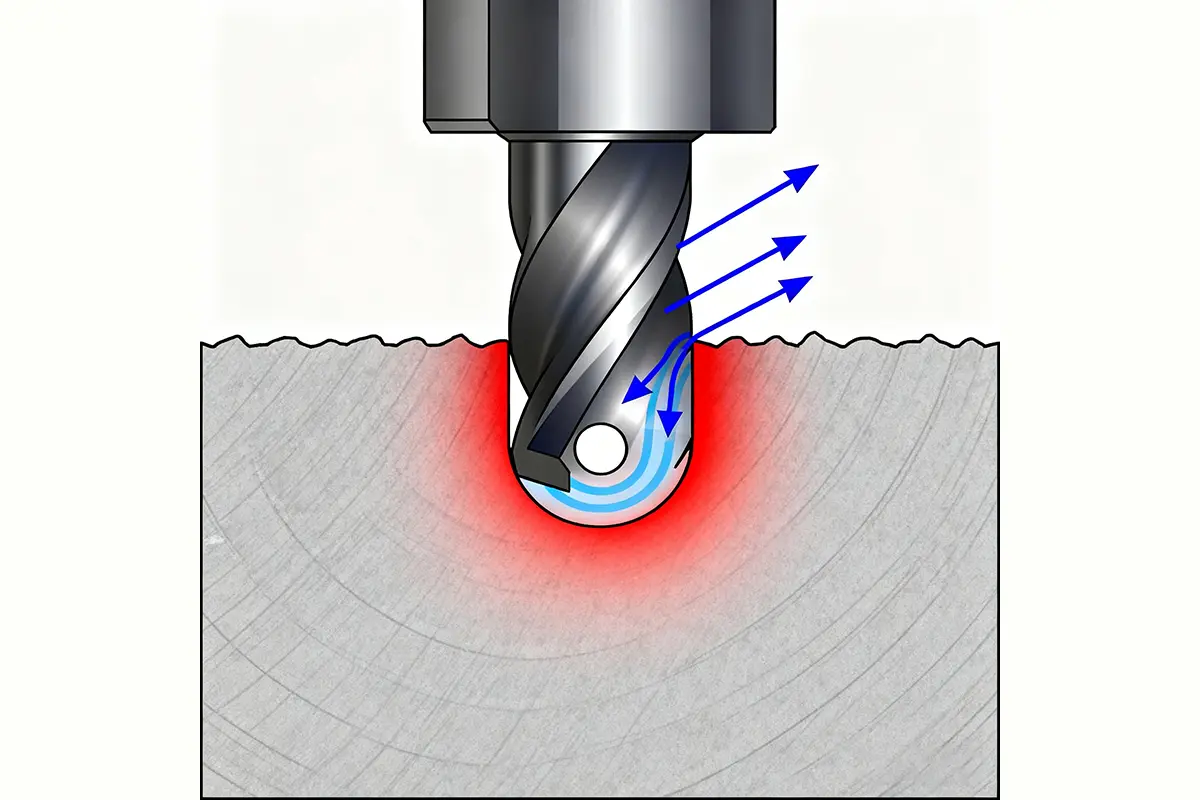
In industrial scenarios like mold manufacturing, deep-hole drilling, and high-speed milling, cemented carbide rods serve as the base material for core cutting and forming tools. However, traditional solid carbide rods have a critical shortcoming: the heat generated during machining cannot be dissipated quickly, leading to softening and accelerated wear of the tool edge, and even compromising workpiece precision. Cemented carbide rods with coolant holes address this issue by pre-designing through or semi-through coolant channels inside the rod, allowing coolant to reach the cutting edge or machining area directly, controlling heat at the source. This design not only extends the service life of cemented carbide rods by 30%–60% but also increases machining efficiency by over 20%. It also reduces workpiece deformation caused by high temperatures, making it particularly suitable for machining hard materials (such as stainless steel and titanium alloys) and complex processing scenarios. This article breaks down the core value, structural types, application scenarios, and usage key points of cemented carbide rods with coolant holes. All content is based on industrial practical experience to help you quickly master this tool upgrade solution.
1. Why Do We Need Cemented Carbide Rods with Coolant Holes? First, the Pain Points of Traditional Rods
Although traditional solid carbide rods have high hardness, high temperatures restrict their performance in medium-to-high-speed machining or difficult-to-machine material scenarios. The specific pain points can be summarized into three categories:
1.1 High Temperatures Cause Rapid Tool Wear
Friction between the carbide rod and workpiece during cutting or forming generates local temperatures of 300–800°C. Even though cemented carbide itself is heat-resistant, prolonged high temperatures soften the binder phase (e.g., cobalt) at the tool edge, reducing wear resistance. For example: when machining 304 stainless steel with traditional carbide rods, the edge wears 2–3 times faster than when machining ordinary carbon steel, requiring tool replacement after processing only 50 workpieces on average.
1.2 Coolant Cannot Reach the Core Area
In traditional machining, coolant is only applied via external spraying. However, due to machining paths (e.g., deep holes, blind holes) or tool structures, coolant struggles to penetrate the cutting edge. For instance, during deep-hole drilling, external coolant heats up before reaching the hole bottom, drastically reducing its cooling effect and causing the hole wall precision deviation to exceed 0.02mm.
1.3 High Temperatures Lead to Workpiece Precision Issues
Undissipated heat transfers to the workpiece, causing local thermal deformation. For example: when machining thin-walled mold parts, the heat generated by traditional carbide rods warps the workpiece edges, requiring multiple subsequent corrections and increasing processing costs and cycles.
Cemented carbide rods with coolant holes solve the above problems at the root by using built-in channels to deliver coolant "directly to the problem area," achieving threefold improvements in "cooling, wear resistance, and precision."
2. Cemented Carbide Rods with Coolant Holes: Analysis of Core Advantages
Compared to traditional solid rods, the coolant hole design is not just a simple "drilling" process—it optimizes channel structures based on machining needs, ultimately achieving four core advantages:
2.1 Real-Time Temperature Control Extends Tool Life by 30%–60%
Coolant reaches the tool edge directly through built-in channels, quickly dissipating over 70% of frictional heat and controlling the edge temperature within 200–400°C (the stable range for the carbide binder phase). Practical cases show:
- When machining titanium alloys, carbide rods with coolant holes last for 80–120 workpieces, while traditional rods only last 40–60—an increase of 50% in service life.
- In deep-hole drilling scenarios, traditional rods require edge regrinding every 2 hours due to high temperatures, while rods with coolant holes extend this interval to 4–5 hours, reducing downtime for tool changes.
2.2 Improved Machining Efficiency for High-Speed Applications
Controlled temperatures allow carbide rods to withstand higher cutting speeds (15%–25% faster than traditional rods). For example:
- When milling 45# steel, the safe cutting speed for traditional rods is 80–100m/min, while rods with coolant holes can reach 100–125m/min, shortening the processing time for a single batch by 20%.
- In mass production of automotive parts, efficiency improvements directly translate to increased productivity. Based on an 8-hour workday, rods with coolant holes can process 30–50 more workpieces.
2.3 Reduced Workpiece Thermal Deformation for Precision Machining
Real-time coolant cooling prevents heat transfer to the workpiece, making it ideal for machining thin-walled and precision parts. For example:
- When machining 2mm-thick stainless steel thin-walled parts, the warpage of workpieces processed with traditional rods reaches 0.1mm, while rods with coolant holes control this to within 0.03mm, eliminating the need for subsequent correction.
- In mold cavity machining, rods with coolant holes can control dimensional accuracy errors within ±0.005mm, meeting the requirements for precision molds.
2.4 Adaptability to Complex Scenarios, Breaking Traditional Limitations
For scenarios where traditional rods struggle—such as deep holes (depth > 10× diameter), blind holes, and hard materials (HRC > 40)—the coolant hole design overcomes limitations:
- Deep-hole machining (e.g., oil passage holes in engine blocks): Coolant reaches the hole bottom through channels, preventing chip accumulation and hole wall scratches.
- Machining of hard alloys (e.g., nickel-based alloys): Controlled temperatures prevent the carbide rod edge from chipping due to "thermal brittleness," significantly improving machining stability.
3. Cemented Carbide Rods with Coolant Holes: Common Structural Types & Selection
Different machining needs correspond to different channel designs, with core differences in the number, distribution, and penetration of holes. Below are the three most commonly used types in industry, with a table comparing key selection points:
| Structural Type | Coolant Hole Design Features | Suitable Machining Scenarios | Advantages | Recommended Rod Diameter Range |
|---|---|---|---|---|
| Central Single-Hole | 1 circular hole running through the rod axis, 2–5mm in diameter | Base material for deep-hole drills, end mills, drill bits | Coolant concentrates at the cutting edge, ideal for single-edge or central cutting tools | φ6–20mm |
| Multi-Side-Hole | 2–4 circular holes distributed radially (non-through) along the rod, 1–3mm in diameter | Base material for face mills, forming tools, multi-edge tools | Coolant sprays from the sides, covering multi-edge cutting areas | φ10–30mm |
| Spiral-Hole | 1–2 spiral channels (extending spirally along the axis), 1.5–4mm in diameter | High-speed milling, thread machining tools | Coolant evenly covers the edge via spiral channels, preventing chip adhesion | φ8–25mm |
Key Selection Criteria: 3 Core Dimensions
- Machining Type: Choose "Central Single-Hole" for deep-hole/central cutting, "Multi-Side-Hole" for multi-edge/face machining, and "Spiral-Hole" for high-speed rotation/thread machining.
- Rod Diameter: Smaller rod diameters require correspondingly smaller holes (to avoid reducing rod strength). For example, φ6mm rods match φ2mm holes, while φ20mm rods match φ4–5mm holes.
- Coolant Pressure: High pressure (>5bar) is suitable for small-diameter holes (to prevent clogging), and low pressure (2–3bar) is suitable for large-diameter holes (to ensure flow).
4. Usage Notes: Avoid Common Issues & Maximize Performance
While cemented carbide rods with coolant holes offer excellent performance, details during use directly affect their service life and effectiveness. Focus on the following four points:
4.1 Coolant Selection: Match Materials & Scenarios
- Prioritize "water-based anti-rust coolants" (e.g., emulsions, synthetic coolants); avoid pure oil-based coolants (high viscosity easily clogs holes).
- When machining corrosion-prone materials (e.g., stainless steel, titanium alloys), the coolant must contain anti-rust agents (concentration >5%) to prevent rust and clogging in the hole walls.
4.2 Hole Maintenance: Regular Cleaning to Prevent Clogging
- Before each use: Blow through the holes with compressed air (0.3–0.5MPa) to check for residual chips or impurities.
- After long-term storage: Rinse the holes with clean water, dry them, and apply anti-rust oil (to prevent oxidation of the hole walls).
- If clogging occurs: Gently clear the hole with a thin steel wire (slightly smaller than the hole diameter); do not poke forcefully (to avoid damaging the channels).
4.3 Tool Grinding: Protect Hole Integrity
- Avoid grinding near the hole areas (especially for multi-side-hole and spiral-hole designs) to prevent砂轮 damage to the hole edges.
- After grinding: Check if the holes are unobstructed. If there are burrs at the hole openings, gently polish them with fine sandpaper (1000# or higher).
4.4 Installation Compatibility: Ensure Smooth Coolant Supply
- Matching tool holders must have coolant ports, and the ports must align with the rod holes (deviation ≤0.5mm) to prevent coolant leakage.
- Before first use: Test the coolant flow (ensure no leakage or clogging) before starting machining.
5. Clarifying Common Myths: Avoid These Misconceptions
Myth 1: "Holes Reduce the Strength of Cemented Carbide Rods"
Fact: A well-designed hole structure (hole diameter ≤ 1/3 of the rod diameter, holes away from stress-concentrated areas) does not significantly reduce strength. For example, a φ15mm rod with a φ4mm hole still has a bending strength of over 2500MPa, meeting the needs of most machining scenarios. In fact, controlled temperatures reduce "thermal stress damage" to the rod, improving overall durability.
Myth 2: "Only High-Speed Machining Needs Rods with Coolant Holes"
Fact: Even low-speed machining (e.g., deep-hole drilling, difficult-to-machine materials) requires this design. For instance, when machining nickel-based alloys at low speeds, the high material hardness still causes concentrated frictional heat. Traditional rods wear quickly due to poor heat dissipation, while rods with coolant holes maintain stability via continuous cooling.
Myth 3: "All Rods with Coolant Holes Are Universal"
Fact: Hole designs are highly scenario-specific—universal use leads to reduced effectiveness. For example, using a "Central Single-Hole" rod for face milling prevents coolant from covering multi-edge areas, resulting in only 30% of the cooling effect of a "Multi-Side-Hole" rod. Conversely, using a "Multi-Side-Hole" rod for deep-hole drilling prevents coolant from reaching the hole bottom, causing chip accumulation.
6. Conclusion: Cemented Carbide Rods with Coolant Holes – A Cost-Effective Tool Upgrade
Compared to upgrading to higher-grade carbide grades (which increases costs by over 50%), the coolant hole design only adds 10%–20% to the cost while delivering 30%–60% longer service life and over 20% higher efficiency. It is a cost-effective upgrade solution. Especially in precision machining, difficult-to-machine material processing, and mass production, these rods directly solve the high-temperature pain points of traditional tools and reduce overall processing costs.
If your machining scenarios face issues like rapid tool wear, poor workpiece precision, or difficult deep-hole machining, and you are unsure how to select cemented carbide rods with coolant holes, feel free to reach out. We can provide customized hole designs and rod solutions based on your machining type (drilling/milling/forming), workpiece material, and precision requirements.