
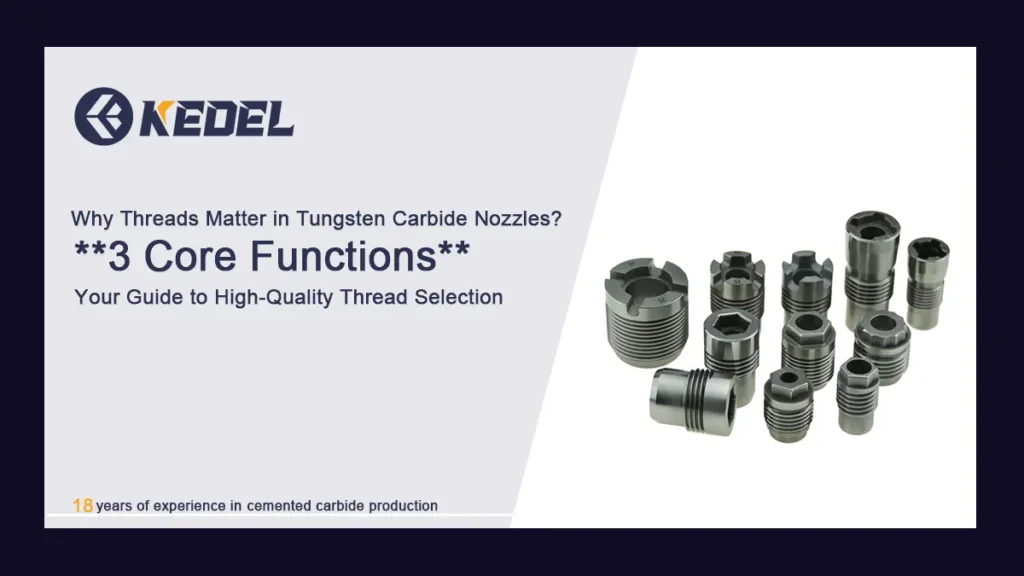
When selecting and using tungsten carbide nozzles, many professionals focus on material hardness (e.g., whether to use high-purity WC-Co alloys) and hole diameter precision, but easily overlook a critical connection detail: the thread. In reality, the thread of a tungsten carbide nozzle is far from a "simple screwing component"—it directly affects the nozzle’s stability in high-pressure, vibrating, and corrosive environments. Poor-quality threads can lead to seal failure (fluid or gas leakage), detachment under high pressure, or even shortened nozzle life due to uneven force distribution. For tungsten carbide nozzles, high-quality threads are a core component that ensures "seal protection, safety support, and stable force transmission". This article breaks down the 3 core functions of high-quality threads and provides specific thread selection criteria, helping you avoid the mistake of "prioritizing the main body while neglecting the thread" to ensure efficient and safe equipment operation.
1. First, Clarify: Why Is the Thread of Tungsten Carbide Nozzles Easily Overlooked?
Before discussing the importance of threads, let’s address a common cognitive bias—why are threads often regarded as a "secondary detail"? There are 3 main reasons:
- Cognitive Focus Bias: Most people focus on the "core value" of tungsten carbide nozzles, which is wear resistance (to withstand particle erosion). They default to the thread being just a "connecting tool" that only needs to screw into the equipment interface, ignoring its role in sealing and anti-detachment.
- Misunderstanding of Processing Difficulty: Tungsten carbide has extremely high hardness (Mohs 8.5-9), and thread processing requires specialized diamond tools and precision equipment. Some professionals believe "any machined thread is qualified" and pay no attention to precision details (e.g., thread profile integrity, gap size).
- Cost Trade-off Misconception: High-precision threads increase processing costs (15%-30% higher than ordinary threads). To control costs, some enterprises choose low-precision threads, but fail to recognize subsequent downtime losses caused by leakage or detachment (e.g., in oil drilling, the cost of a single shutdown to repair nozzle leakage exceeds 10,000 yuan).
2. 3 Core Functions of High-Quality Threads: Determining the "Usability" of Tungsten Carbide Nozzles
Tungsten carbide nozzles are used in scenarios (e.g., oil drilling, high-pressure spraying, mining machinery) often accompanied by "high pressure, vibration, and corrosive fluids". The thread’s role goes far beyond "connection", and can be broken down into 3 core functions:
2.1 Seal and Prevent Leakage: Avoid High-Pressure Fluid Leakage and Ensure Pressure Stability
Tungsten carbide nozzles mostly operate in high-pressure environments (e.g., oil drilling nozzles withstand 30-100MPa, high-pressure spraying nozzles withstand 2-10MPa). The thread is a key sealing component to prevent fluid leakage:
- If the thread precision is low (e.g., incomplete thread profile, large fitting gap), high-pressure fluids (such as drilling fluid or coating) will seep through the thread gap, causing system pressure drop. For example, in the spraying industry, nozzle leakage leads to uneven coating thickness and a 15%-20% increase in scrap rates.
- High-quality threads achieve sealing through "precision fitting": For instance, tapered pipe threads (NPT type) have a built-in taper, so the thread surfaces fit tightly when screwed together. With a small amount of sealant, "zero leakage" can be achieved. Even for parallel pipe threads (G type), the thread precision must meet ISO 4759-1 Class 2, and rubber gaskets are required to block leakage channels.
2.2 Load Bearing and Anti-Detachment: Resist Vibration and Impact to Prevent Nozzle Falling Off
Scenarios using tungsten carbide nozzles are often accompanied by vibration (e.g., mining crushing equipment has a vibration frequency of 5-10Hz, and drilling platforms have continuous vibration). The thread must bear axial force and vibration loads to prevent the nozzle from falling off:
- Poor-quality threads have insufficient thread profile strength (e.g., flattened thread crests during processing) and will gradually loosen under long-term vibration. In severe cases, a falling nozzle may damage equipment. An oilfield once experienced a stuck drill pipe due to a loose and detached drilling nozzle, resulting in a 2-day shutdown for repairs and losses exceeding 100,000 yuan.
- High-quality threads have a complete profile (e.g., the 60° thread angle of ordinary threads has an error ≤0.5°) and uniform force distribution, which can disperse vibration loads. In some scenarios, anti-loosening structures are also designed (e.g., with undercuts, using Spiralock anti-loose threads) to further improve anti-detachment capabilities.
2.3 Stable Force Transmission: Ensure Installation Precision and Avoid Operational Deviations
The performance of tungsten carbide nozzles (e.g., spraying angle, drilling fluid injection direction) depends on precise positioning, and the fitting precision of the thread directly affects installation coaxiality:
- If the thread precision is low (e.g., large pitch deviation), the nozzle will be "eccentric" during installation. For example, a 1° deviation in the angle of a spraying nozzle causes "edge blurring" on the coating, requiring secondary touch-ups.
- High-quality threads ensure "coaxiality ≤0.02mm", aligning the nozzle with the equipment interface precisely. For example, tungsten carbide nozzles for precision spraying have thread precision meeting GB/T 197 (equivalent to ISO 965-1) Class 6g/6H. After installation, the injection angle deviation is ≤0.2°, improving coating uniformity by 30%.
3. Selection Criteria for Tungsten Carbide Nozzle Threads: 5 Dimensions to Precisely Match Scenarios
Choosing the right thread is more important than simply pursuing "high precision". Judgment should be based on application scenarios (pressure, medium, vibration) from 5 dimensions. Specific criteria are shown in the table below:
| Selection Dimension | Specific Requirements | Core Role | Application Examples |
|---|---|---|---|
| Thread Type | Prioritize tapered pipe threads (NPT, PT type); for low-pressure scenarios, choose ordinary threads (M type) or parallel pipe threads (G type) | Tapered threads have built-in sealing, no additional seals needed; ordinary threads require gaskets | High-pressure sealing (NPT for oil drilling, high-pressure cleaning); low-pressure positioning (M type for spraying, ordinary sandblasting) |
| Precision Class | Pipe threads: ISO 4759-1 Class 2 or higher; Ordinary threads: GB/T 197 Class 6g/6H or higher | Low precision causes fitting gaps, leading to leakage/loosening | High-pressure (≥5MPa) or vibrating scenarios require Class 2/6g; low-pressure (≤2MPa) non-vibrating scenarios can use Class 3/8g |
| Surface Quality | Thread surface roughness Ra ≤1.6μm, no burrs or oxide layers; nitriding treatment (surface hardness increased to HV800+) is optional | High roughness wears the sealing surface; nitriding enhances wear and corrosion resistance | Corrosive media (e.g., acid-base coatings in chemical spraying) require nitriding; all scenarios require no burrs |
| Material Matching | Hardness difference between the thread and the connecting component ≤30HRC to avoid "seizure" | Tungsten carbide is hard (HRC65+); if the connecting component is soft (e.g., aluminum alloy HRC15), excessive hardness difference causes thread seizure | For aluminum alloy/copper components, the thread surface can be phosphatized; for steel components (HRC30+), direct use is allowed |
| Anti-Loosening Design | Vibrating scenarios require additional anti-loosening measures: anti-loose threads (Spiralock), undercuts, or matching anaerobic anti-loose adhesives | Prevent thread loosening and detachment under long-term vibration | Mining machinery, drilling equipment, high-frequency vibrating conveying pipelines |
4. Clarifying Common Misconceptions: 3 "Taken-for-Granted" Wrong Views
Misconception 1: "If It Can Be Screwed On, the Thread Is Qualified"
Fact: "Being screwable" does not mean "qualified fitting". For example, if the taper deviation of an NPT tapered pipe thread is 0.5° during processing, it can still be screwed into the interface, but local gaps will occur, leading to inevitable leakage under high pressure. A spraying factory once used "screwable but low-precision threads", resulting in over 500 scrapped workpieces per month due to leakage, with losses approaching 10,000 yuan.
Misconception 2: "Tungsten Carbide Is Rust-Proof, So Threads Don’t Need Surface Treatment"
Fact: Tungsten carbide itself is corrosion-resistant, but oxide layers or burrs may form during thread processing, which can scratch the sealing surface of the connecting component (e.g., the zinc coating on steel interfaces) and accelerate corrosion instead. It is recommended to apply thread surface treatment (e.g., nitriding, phosphatizing) in all scenarios, especially in humid or corrosive environments.
Misconception 3: "Thread Specifications Can Be Mixed, e.g., NPT and G Types Are Interchangeable"
Fact: Different thread types have completely different sealing principles—NPT is a tapered pipe thread (sealing by taper), while G is a parallel pipe thread (sealing by gaskets). Mixing them will cause the sealing surfaces to not fit, resulting in 100% leakage. An oil drilling team once mixed thread types, causing the nozzle to leak within 1 hour under high pressure and forcing an emergency shutdown for replacement.
5. Conclusion: Threads Are the "Invisible Lifeline" of Tungsten Carbide Nozzles
For tungsten carbide nozzles, high-quality threads are not an "add-on" but a "must-have"—they determine whether the nozzle can seal safely in high-pressure and vibrating environments, and avoid equipment losses caused by loosening and detachment. During selection, you should not only focus on material hardness and hole diameter but also choose the correct thread type, precision, and anti-loosening design based on the scenario. Only then can the "wear resistance advantage" of tungsten carbide nozzles be truly realized.
If your enterprise has encountered issues such as thread leakage or loosening when using tungsten carbide nozzles, or is unsure which thread specification to choose for a specific scenario, feel free to communicate with us. We can provide customized thread design solutions based on your working environment (pressure, medium, vibration frequency).